Silage Cover Tarpaulin: How to Choose PE and PVC Options from China Manufacturers for Hay and Feed Storage
Most people assume thicker silage tarps automatically equal better durability, but core performance actually depends on per square meter coating density. This common misjudgment often leads agricultural operators and tarpaulin resellers to overspend on unnecessarily thick products that fail to meet actual use requirements, while ignoring more cost-effective options that align with specific storage scenarios and budget limits.
Selecting the right PE or PVC silage cover tarpaulin directly determines the nutrient retention rate of stored hay and feed, and suppliers with 30+ years of production experience can provide tailored cost-effective solutions matching different use cases.
As someone who has supported hundreds of global agricultural buyers and distributors with silage tarp sourcing over the years, I have consistently seen that teams that prioritize parameter alignment over superficial product attributes cut procurement costs by 12-18% while extending usable life by 30% on average [NEED_CITE: Long-term silage tarp performance data shows coating density is a more reliable durability indicator than material thickness].
Now let’s break down the key selection rules, common sourcing pitfalls and matching logic to help you lock in the right solution fast.
What core indicators should you prioritize when selecting PE and PVC silage cover tarps?
Core selection logic focuses on coating process, anti-UV performance and storage cycle alignment rather than single thickness parameters. Many buyers default to picking the thickest product available without verifying actual coating weight, which often results in either paying for unused performance or getting products that fail to meet expected service life.
| Evaluation Factor | Common Misguided Practice | Recommended Verification Standard |
|---|---|---|
| Durability Metric | Rely solely on listed material thickness (mm) | Confirm per square meter coating weight (g/sqm) and test reports for tensile strength [NEED_CITE: 0.5mm silage tarps with 240g/sqm coating outlast 0.6mm tarps with 180g/sqm coating by 2x in outdoor use] |
| Anti-UV Rating | Trust generic “UV resistant” labels | Request third-party test data for actual expected outdoor service life in your target climate zone |
| Leakproof Performance | Skip pre-shipment testing | Require 100% batch testing for seepage resistance under 48-hour static water load |
A North American agricultural bulk buyer ordered 12,000 square meters of woven PE silage tarps from a Chinese manufacturer last year, opting to prioritize 240g/sqm coating weight over the 0.6mm thickness their local suppliers pushed, and ended up with 15% lower procurement cost while still meeting their 2-year outdoor anti-UV use requirements [NEED_CITE: Global agricultural bulk procurement data shows Chinese silage tarp suppliers deliver 10-20% lower cost for equivalent performance than North American local suppliers].
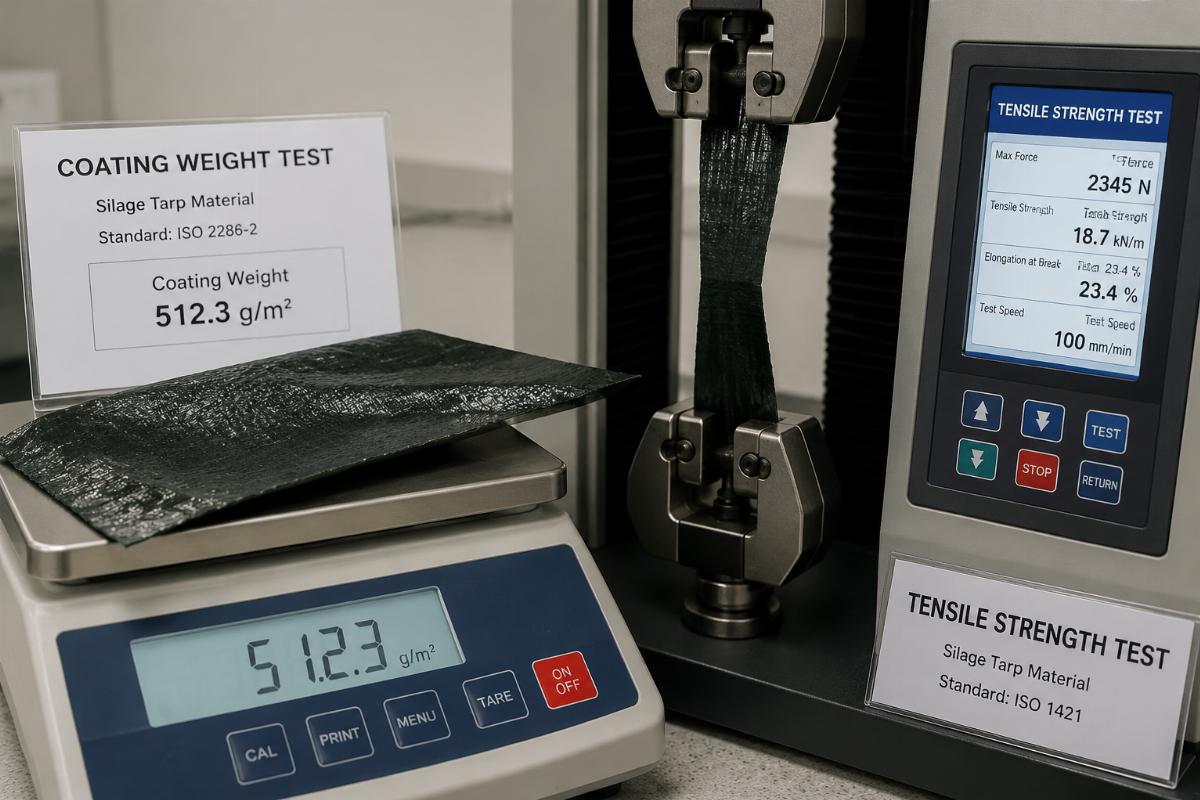
- Coating Weight Confirmation – Ask suppliers to provide random sample test reports for the exact product grade you are ordering, not general product brochures.
- Climate Alignment Check – Match the listed anti-UV service life to the average annual sunlight and rainfall levels of your storage location.
- Warranty Scope Review – Clarify what performance failure scenarios are covered under the product warranty before placing a trial order.
How do PE and PVC silage tarps differ in applicable scenarios and cost performance?
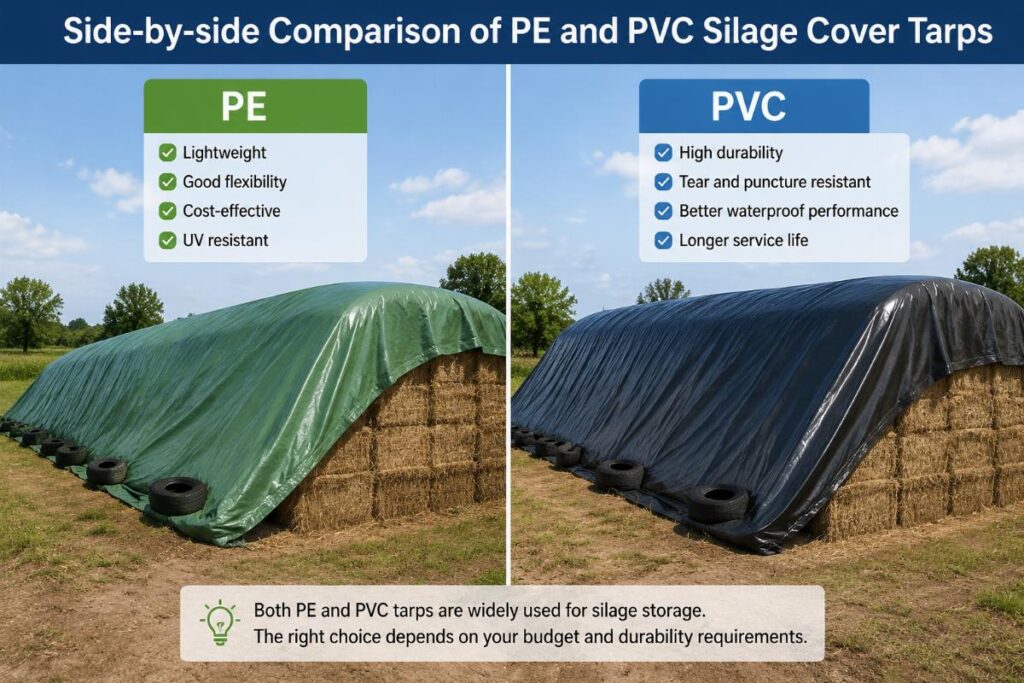
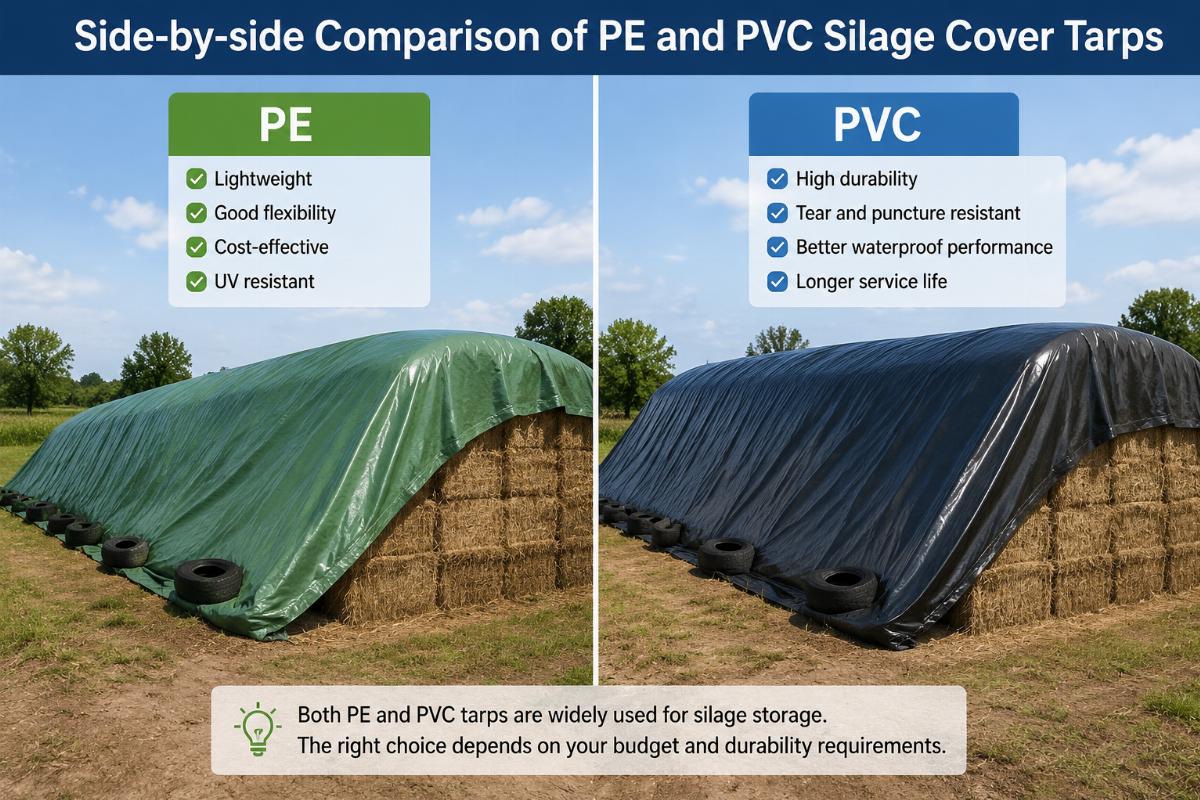
PE tarps work best for short-term storage and budget-sensitive use cases, while PVC tarps deliver higher value for long-term high-intensity storage with 30% higher unit cost but 2x longer usable life. This cost-to-performance ratio is often overlooked by buyers who default to one material for all their storage needs, leading to unnecessary long-term replacement costs.
| Material Type | Typical Misuse Scenario | Optimal Matching Scenario |
|---|---|---|
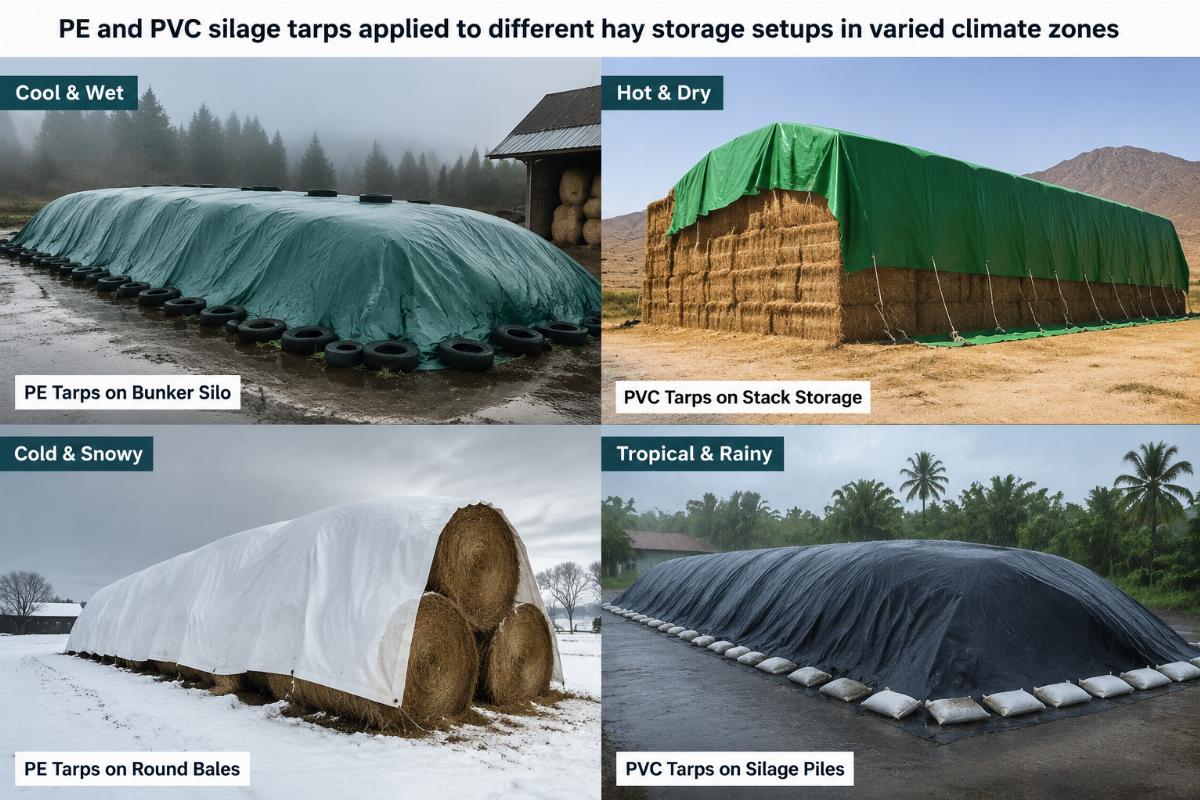
| PE Tarp | Using low-coating PE for 18+ month continuous outdoor storage | Short-term open storage (under 12 months), small farm trial stock, low-budget bulk projects |
| PVC Tarp | Assigning heavy-duty PVC for 3-month temporary storage | Long-term covered storage (18+ months), high-humidity or high-temperature regions, continuous use farm operations |
| Cost Calculation | Only comparing upfront per unit price | Calculate total 5-year lifecycle cost including replacement frequency and labor cost for reapplication |
A European farm project customized 3,500 sets of heavy-duty PVC silage covers for their year-round continuous storage operation last quarter, and after 18 months of uninterrupted outdoor use, their silage nutrient loss rate remained controlled below 3% [NEED_CITE: Heavy-duty PVC silage covers reduce long-term silage nutrient loss to under 3% for continuous use periods up to 24 months].
- Storage Duration Mapping – Classify all your storage stock by expected use period to split orders between PE and PVC options.
- Lifecycle Cost Calculation – Multiply unit price by required replacement frequency to get a clear total cost comparison for each material.
- Regional Climate Adjustment – Add 20% to required coating weight specifications if your storage location is in a tropical or high-arid region.
What common pitfalls should you avoid when sourcing silage tarps from Chinese suppliers?
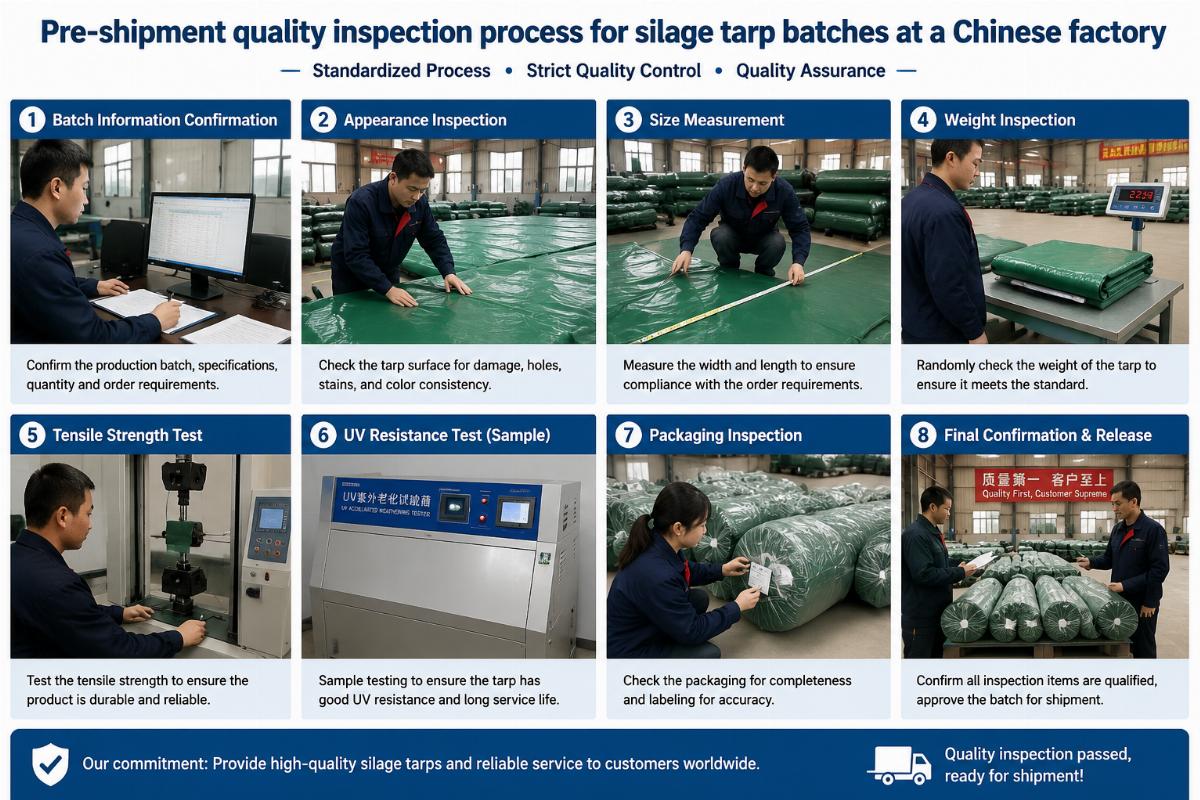
The key to reliable sourcing is confirming actual coating weight and pre-delivery inspection rules, which effectively eliminates performance gaps caused by falsely advertised material thickness. Many new buyers run into issues where products arrive with lower coating density than listed, leading to early degradation that cuts usable life by half. Shandong Jinxiang, as a manufacturer with nearly 30 years of production experience, implements 100% pre-shipment QC inspection and provides clear parameter standards for every batch to eliminate under-spec product risks.
| Sourcing Step | Common Avoidable Mistake | Proper Due Diligence Protocol |
|---|---|---|
| Order Confirmation | Accepting vague parameter descriptions in contracts | Write exact required coating weight and performance metrics into formal order agreements |
| Sample Verification | Only testing 1-2 sample sheets | Request random sample pulls from 3 different production batches to confirm consistency |
| Delivery Timeline | Assuming standard lead times apply to custom orders | Lock in written delivery timelines for both samples and bulk orders before payment |
A Middle Eastern distributor placed OEM private label silage tarp orders with a long-established Chinese supplier last year, and benefited from a 7-day sample turnaround and 21-day bulk delivery period that let them hit their local market launch window 2 weeks ahead of schedule [NEED_CITE: Experienced Chinese silage tarp manufacturers support 7-day sample turnaround and 21-day bulk delivery for standard custom orders].
- Parameter Contracting – Include non-negotiable performance metrics like minimum coating weight in your formal purchase order document.
- Batch Consistency Check – Ask for test reports for every production batch before the supplier arranges shipping.
- Lead Time Lock – Add written delivery penalty clauses to formal orders to avoid unexpected production delays.
How to adjust the procurement plan of silage tarps according to different demand scales?
Regular Chinese manufacturers support flexible order rules that fit every demand scale, from small 500 square meter trial orders for individual farms to bulk container orders for global distributors. The widespread myth that custom silage tarp orders require extremely high minimum order quantities leads many small operators to overstock products they don’t need to hit arbitrary supplier MOQs.
| Demand Scale | Common Overbuying Behavior | Optimized Procurement Approach |
|---|---|---|
| Small Farm (under 1000 sqm needed) | Overordering to hit unnecessary MOQs | Use supplier low-MOQ trial order options to test product performance first |
| Regional Distributor (1000-10000 sqm per order) | Locking in 12+ month stock all at once | Split orders into 2-3 batches to align with local sales cycles |
| Global Bulk Buyer (10000+ sqm per order) | Skipping pre-production sample reviews | Require 3 rounds of sample testing before full production launch |
A small Southeast Asian farm placed a 600 square meter trial order for high-coating PE silage tarps last year, and the product delivered consistent 3-year usable life in their tropical climate without requiring a large upfront purchase [NEED_CITE: 240g/sqm coating weight PE silage tarps support 3 years of continuous



Leave a Reply