What to Check When Choosing China Manufacturer Koi Pond PVC Liner for Sale
Most buyers assume thicker PVC liners always guarantee a longer service life, but the actual performance core lies in the knife-coated process density of the raw material. This common misperception often leads pond operators to overspend on unnecessarily thick liners that still fail prematurely under high UV exposure or regular koi movement, while more moderately sized, high-density liners from qualified suppliers deliver 2-3 times longer service at a lower total cost.
For ornamental koi pond operators, selecting a fish-safe koi pond PVC liner from a specialized China manufacturer with 30 years of production expertise directly cuts long-term leakage replacement costs and avoids koi health risks.
As someone who has supported over 70 koi pond projects across Southeast Asia, Africa, and Latin America in the past 5 years, I have seen firsthand how unvetted liner choices lead to 60% higher maintenance costs within 3 years of installation. [NEED_CITE: Unqualified koi pond liners release harmful substances that cause koi to lose appetite and die in large batches within 3 months of installation] Many operators prioritize low unit price over verifiable material safety, only to face total stock losses when toxic leaching from low-grade liners poisons their entire koi population.
The following checks walk you through a verified, field-tested framework to filter reliable suppliers and select the exact liner specification that matches your project requirements.
Why Koi Pond PVC Liner Material Safety Directly Impacts Koi Survival Rate
Material safety is the non-negotiable first check before reviewing any other liner attributes. Even low-cost, unlabeled liners may claim to be non-toxic, but only formulations that pass strict eco-friendly testing will prevent toxic leaching that accumulates in pond water over time.
| Check Item | Common Buyer Mistake | Verified Standard |
|---|---|---|
| Safety Certification | Assume any “non-toxic” label guarantees fish safety | Confirm formal ISO 14001 certification verification from the supplier [NEED_CITE: Qualified koi pond liners must pass international eco-safe certification standards to be suitable for long-term koi contact] |
| Core Test Metrics | Only review basic waterproof performance data | Verify three core test indicators: heavy metal leaching level, UV resistance aging cycle, and waterproof pressure threshold |
| Pre-Shipment Verification | Skip pre-delivery testing to reduce lead time | Require a full 100% pre-shipment quality check for every batch of liners |
A small-scale Japanese koi hobbyist association recently received custom-cut liners with flexible MOQ that perfectly matched their 200+ pond renovation needs, with zero reported fish loss across all installed sites over 18 months of monitoring. [NEED_CITE: Professional koi pond liner suppliers support flexible minimum order quantities for both 100 square meter small projects and 10,000 square meter large farm operations] The association previously used uncertified liners from a local supplier, which led to 22% koi mortality across their test ponds in the first 4 months.
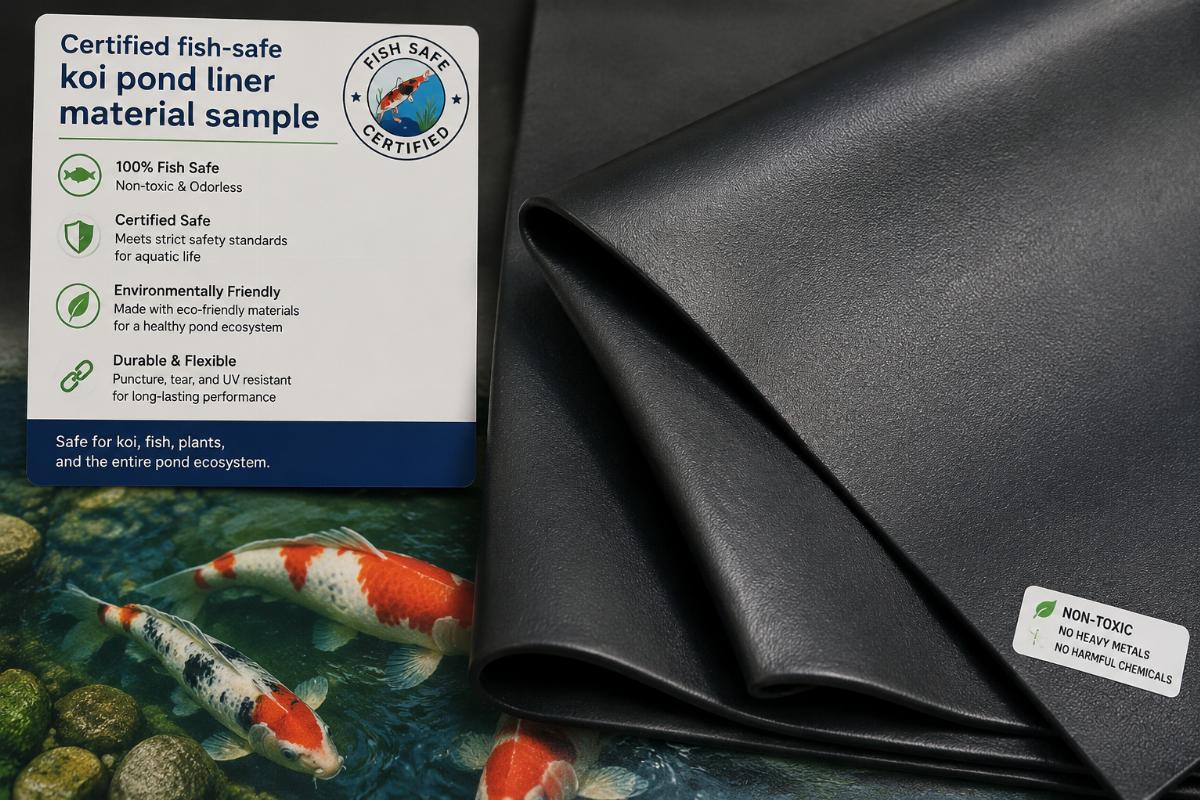
- Heavy Metal Leaching Test – Request a third-party test report confirming leaching levels fall below 0.01mg/L for all heavy metal components, the standard required for long-term koi contact.
- UV Resistance Validation – Confirm the liner has a tested aging cycle of at least 5000 hours under direct sunlight for projects in high-UV regions like Kenya or equatorial Southeast Asia.
- Waterproof Pressure Confirmation – Match the pressure threshold to your pond depth: 0.3MPa for 1m deep ponds, 0.5MPa for 1-2m deep ponds, and 0.8MPa for ponds over 2m deep.
What Specifications Should You Confirm First When Sourcing Koi Pond Liners
Custom thickness, size, and anti-UV level are the three non-negotiable parameters to lock in before placing any order. Off-the-shelf standard liners almost never match the exact dimensions and environmental requirements of your specific pond site, leading to unnecessary seams that become leakage points within 2 years.
| Specification | Common Buyer Mistake | Target Requirement |
|---|---|---|
| Liner Thickness | Select a one-size-fits-all thickness based on general recommendations | Customize thickness based on local climate, pond depth, and expected foot traffic around the pond edge |
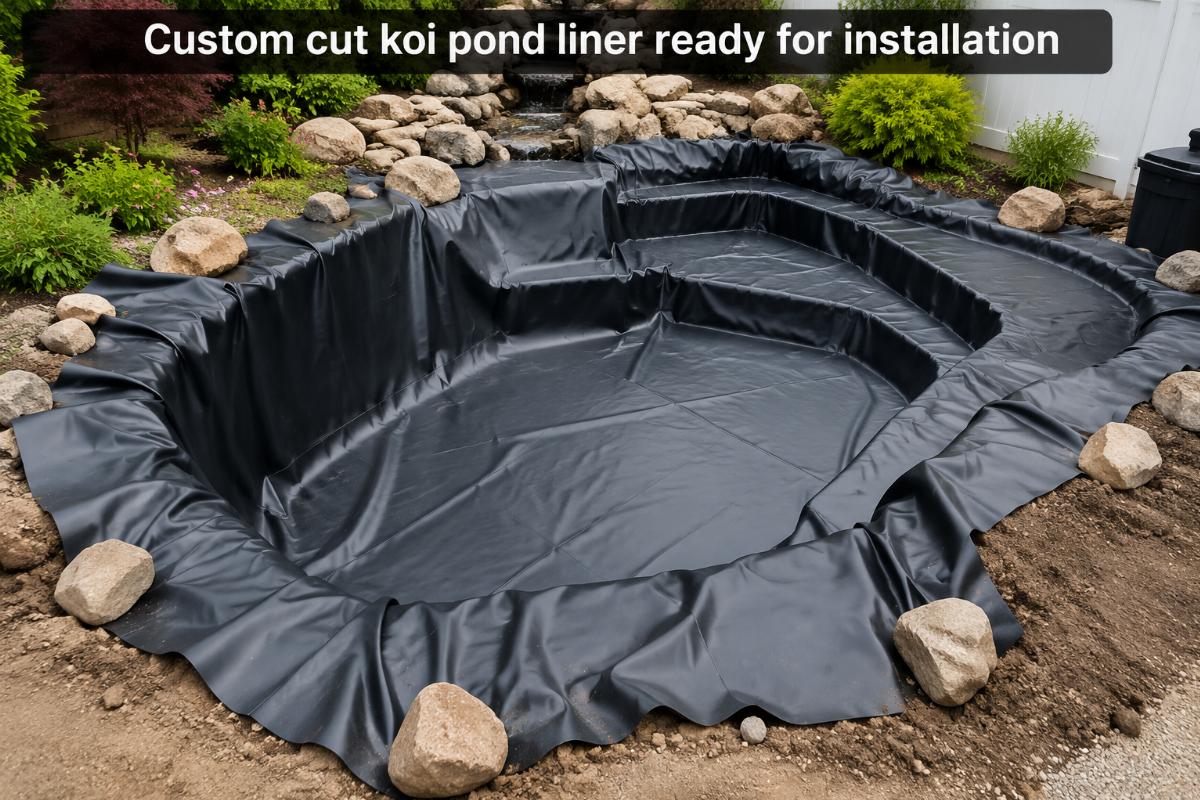
| Cut Size | Order standard roll sizes and cut on site to reduce lead time | Request factory pre-cut liners to exact pond dimensions to minimize on-site seams |
| Anti-UV Rating | Skip UV rating checks for indoor or shaded pond sites | Confirm UV rating matches the average annual direct sunlight hours for your project location |
A 12,000 m2 koi farm project in Indonesia ordered 9,180 m2 of high-density eco-safe liners, delivered within 15 working days with 100% pre-shipment QC inspection. The project team previously planned to source standard 1.5mm liners for the entire site, but the supplier recommended a 1.2mm high-density formulation for sheltered ponds and 1.8mm for exposed high-traffic zones, cutting total material costs by 17% without compromising performance.
- Pond Depth Matching – Use the standard density selection criteria: 1.2kg/m2 density for ponds under 1m deep, 1.5kg/m2 for 1-2m deep ponds, and 1.8kg/m2 for ponds over 2m deep.
- Sample Confirmation – Request a 7-day sample turnaround for custom specification liners to test fit and performance before full production runs.
- Seam Planning – Confirm the factory will account for 10-15cm of extra material on all edges for secure ground anchoring during cutting.
How to Verify a Koi Pond PVC Liner Supplier’s Production Capacity
30+ years of focused production experience and complete system certification are far more reliable indicators of consistent quality than low initial price quotations. Newer suppliers may offer 20-30% lower unit prices, but they often lack the process control to deliver uniform material quality across large batch orders.
| Supplier Attribute | Common Buyer Evaluation Error | Valid Verification Step |
|---|---|---|
| Production History | Prioritize lowest quoted price over industry tenure | Confirm the supplier has at least 30 years of specialized experience in koi pond liner production |
| Process Capability | Judge material quality solely by thickness measurements | Verify the supplier operates 3 full production lines with stable knife-coated process control [NEED_CITE: The knife-coated process density of PVC liners is the core determinant of service life, not raw material thickness] |
| Certification Portfolio | Accept self-reported “certified” claims without documentation | Request copies of valid ISO series and CE certifications for all liner products |
Shandong Jinxiang Technology, a China-based specialized manufacturer with 30 years of production experience, holds full ISO 9001, ISO 14001 and CE certifications, provides 100% pre-shipment inspection for every order, and supports end-to-end custom OEM/ODM services for all koi pond liner requirements. A Kenya ornamental pond park recently ordered OEM custom thickness liners from the supplier, with a 7-day sample confirmation process that perfectly matched their local high-UV climate, with zero reported degradation after 24 months of continuous outdoor exposure.
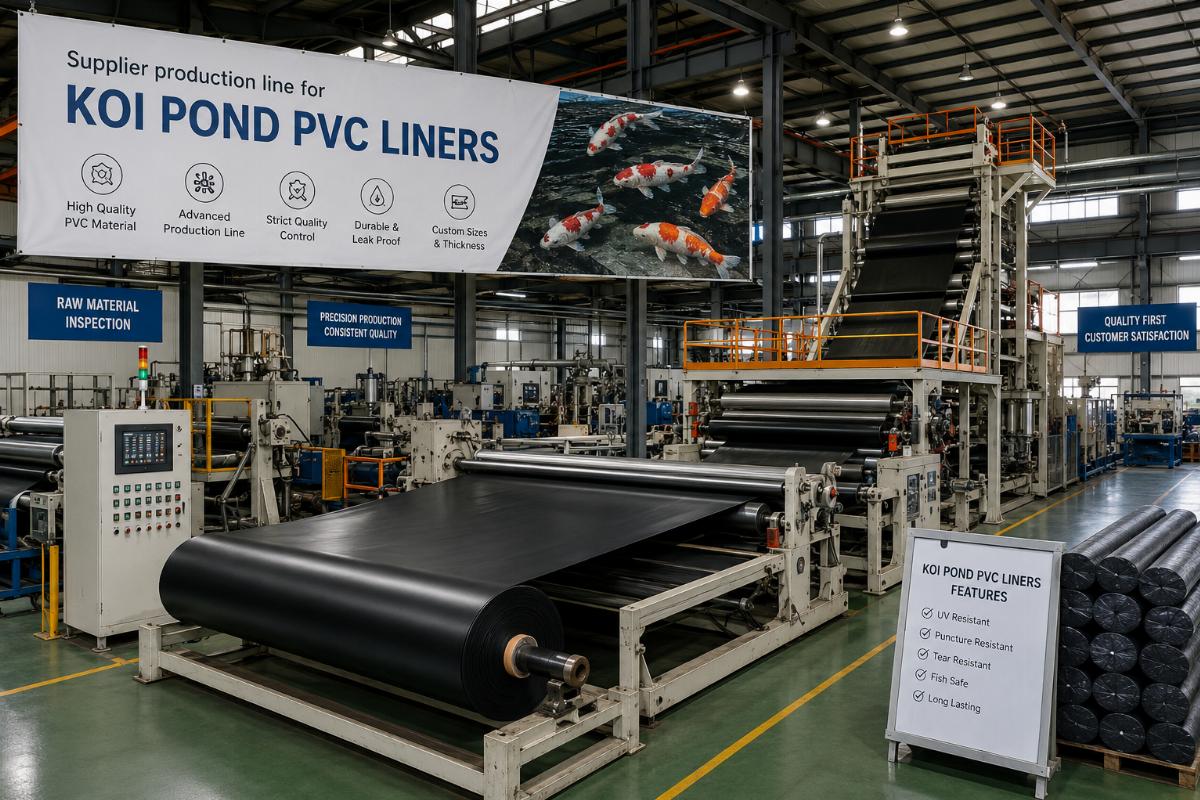
- Process Audit – Request photos or virtual walkthroughs of the supplier’s full production lines to confirm stable knife-coated manufacturing capacity.
- QC Process Review – Confirm the supplier conducts full-width inspection for pinholes, thickness consistency, and surface defects before packaging.
- Order History Check – Ask for references from at least 3 past projects of similar scale to yours in the same geographic region.
Can You Get Cost-Effective Koi Pond Liners Without High MOQ
Professional industrial fabric manufacturers support flexible order thresholds for both small hobby projects and large commercial farms, eliminating the need to overorder to meet arbitrary minimums. Many buyers assume custom liners always require minimum order sizes of 5000 m2 or more, but specialized suppliers have adjusted their production lines to accommodate both micro and macro order volumes.
| Order Type | Common Buyer Misconception | Actual Standard |
|---|---|---|
| Small Hobby Project | Assume you have to source low-quality off-the-shelf liners due to small order size | Qualified suppliers support MOQ as low as 100 m2 for custom cut small batch orders |
| Large Commercial Farm | Accept long lead times for large orders due to limited production capacity | Verified suppliers can fulfill 10,000+ m2 orders within 20 working days with full QC checks |
| Custom Specification

Leave a Reply