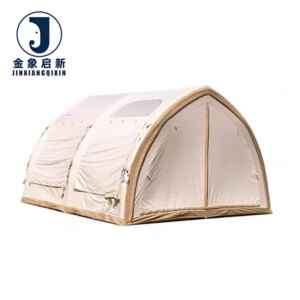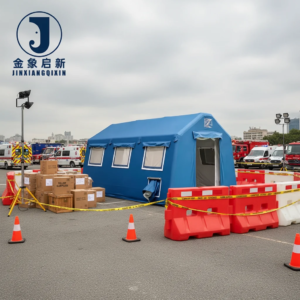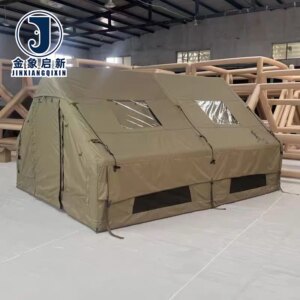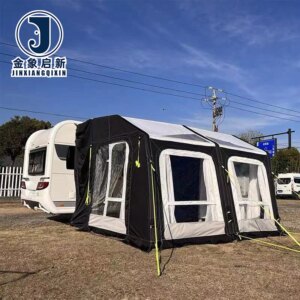

Description
Production Line Capacity — three dedicated coating lines support bulk roll output with batch-to-batch consistency for inflatable tent fabric orders.
Technical Specifications
| Parameter | Value |
|---|---|
| Product Type | PVC Inflatable Tent Fabric |
| Coating Material | PVC |
| Core Material | PVC tarpaulin (knife-coated fabric) |
| Flame Retardant Grade | DIN 4102 B1 |
| Waterproof Rating | 1000mm water column |
| Wind Load Resistance | 12m/s |
| Pressure Retention | 72-hour hold |
| Seam Strength | 250N minimum |
| Air Leakage Rate | <0.5% per hour |
| Material Thickness Tolerance | ±0.1mm |
| Hardware Durability | 500-cycle operation |
| Accelerated Aging Test | 2000-hour |
| Color Matching | Pantone system |
| Customization Service | OEM & ODM (sample customization, pattern printing) |
| Standards | ISO9001, ISO14001, ISO45001, CE, DIN 4102 B1 |
Application Suitability
| Application | Exposure & Requirement |
|---|---|
| Commercial camping ground operations | Extended outdoor deployment, UV exposure, seasonal weather cycles, guest safety compliance |
| Outdoor event facilities | Rapid inflation and deflation cycles, crowd safety, wind load during temporary installation |
| Industrial temporary shelters | Abrasion from equipment movement, dust and moisture ingress, fire safety on active sites |
| Construction site accommodations | Wind-driven rain, UV degradation over multi-month use, flame retardant compliance for site approval |
| Mobile exhibition spaces | Frequent transport and reinstallation, colour consistency across multiple structures, surface printability |
Why Batch Consistency Matters More Than Stated Weight for PVC Inflatable Tent Fabric Bulk Roll Orders
A roll that matches the spec sheet but differs in colour or coating adhesion from the next roll in the same shipment creates visible seams and uneven weld behaviour on the production floor.
When inflatable tent manufacturers source PVC inflatable tent fabric bulk roll stock, the quoted GSM often passes incoming inspection while other variables go unchecked. Coating weight distribution across the web, plasticiser migration, and pigment dispersion can shift between production runs even when the base fabric remains the same. I have seen fabrication shops discover colour banding only after welding two panels from different rolls side by side on a large dome structure — at which point the entire batch is already cut and the delivery deadline is fixed. [NEED_CITE: colour consistency standards for coated fabrics in batch production]
How Roll-to-Roll Uniformity Supports Inflatable Structure Production
Inflatable tent fabrication depends on predictable heat-welding behaviour across every linear metre of PVC inflatable tent fabric bulk roll material. Coating thickness variation of even a fraction of a millimetre shifts the optimal weld temperature, meaning a setting that produces a strong seam on one roll may leave an under-bonded joint on the next. Maintaining tight thickness tolerance of ±0.1mm across the entire production run gives fabricators a stable process window and reduces scrap from weld rework.
Colour Control Across Multi-Roll Shipments
Pantone system colour matching allows specification of exact shades for branded or multi-panel inflatable structures. The real challenge is holding that colour within a narrow delta across every roll in a container load. Batch pigment dosing, controlled coating temperature, and consistent curing time all contribute to reducing visible variation. For buyers ordering multiple rolls of PVC inflatable tent fabric bulk roll stock for a single project, confirming the acceptable colour tolerance range before production begins avoids costly disputes after delivery. [NEED_CITE: Pantone colour matching tolerances for PVC coated textiles]
Reading the Specification Sheet Beyond the Weight Number
The base fabric denier and weave density determine the tensile and tear platform that the PVC coating builds upon. A heavier coating does not automatically produce a stronger fabric — if the base cloth is loosely woven, the coating fills gaps without adding structural contribution. Knife-coating, as used for this PVC tarpaulin, forces paste into the weave under blade pressure, producing better adhesion and higher peel strength than simple dip or spread methods. This matters directly for inflatable structures, where the welded seam must transfer load into the fabric body without the coating delaminating under air pressure. The flame retardant grade of DIN 4102 B1 indicates classification for building materials, which is relevant when inflatable structures are deployed in venues governed by European fire safety codes — confirm the grade required for your specific market jurisdiction.
The Hidden Cost of Undetected Specification Drift
When a PVC inflatable tent fabric bulk roll arrives with lower coating adhesion than the sample approved months earlier, the failure does not appear immediately. The welded seams hold during initial inflation testing but begin to peel under sustained pressure cycling — typically at the stress concentration points where the air beam meets the ground flange. By then, the fabricator has already committed to cutting, welding, and shipping the finished structures. [NEED_CITE: seam peel failure modes in inflatable coated fabric structures]
Why Fabricators Source This Material Here
Three full production lines running dedicated coating schedules allow large-volume roll orders to be completed within a single production window, reducing the risk of inter-batch variation that arises when an order is split across multiple runs. A 10-person R&D team handles material selection, Pantone colour development, and sample fabrication, enabling confirmation of weld parameters and surface finish before the main order enters production. In-process QA checkpoints monitor coating weight, colour consistency, and thickness tolerance at intervals across each roll, with 100% pre-shipment inspection providing a final verification layer. Every roll ships with a material specification sheet documenting GSM, base fabric construction, and coating type, giving the buyer traceable data for incoming quality checks.
Documentation & Verification
- Material specification sheet stating GSM, base fabric denier and weave, and PVC coating weight per roll
- DIN 4102 B1 test report supporting the flame retardant grade for site compliance submissions
- Pre-shipment inspection record covering thickness tolerance, colour consistency, and surface defect count
- Roll packing list with net weight, gross weight, and roll dimensions for container loading plans
- Certificate of origin and customs documentation for cross-border shipment clearance
Fabrication, Handling & Storage
- Set heat-weld temperature based on the PVC knife-coated surface; confirm peel strength on a test coupon from each roll before production welding
- Maintain ±0.1mm thickness tolerance awareness when adjusting roller pressure on automated welders to avoid crushing the coating layer
- Store rolls vertically on end-caps in a shaded, ventilated area to prevent flat-spot deformation of the PVC tarpaulin surface
- Use Pantone-matched rolls under consistent lighting conditions during panel layout to detect any residual colour drift before cutting
- Clean the coated surface with mild detergent only; solvents can soften the PVC coating and reduce seam adhesion in repaired areas
- When repairing field damage, apply compatible PVC adhesive patches and heat-activate to restore the original air retention performance
What to Include in Your Inquiry
Provide the intended application environment, including expected wind exposure, duration of continuous inflation, and any fire safety codes that apply at the installation site. Specify the required roll width, total linear metres, and whether Pantone colour matching or pattern printing is needed. Indicate if you require finished cut panels or full rolls, and whether a pre-production sample is needed to confirm weld parameters on your equipment.
Frequently Asked Questions
Q: How should roll width and length be selected for container loading efficiency?
A: Standard container dimensions dictate the maximum roll length and diameter that can be loaded without wasted space. Providing your target roll width and total quantity allows the packing plan to be calculated for optimal container utilisation, reducing freight cost per linear metre of PVC inflatable tent fabric bulk roll material received at your facility.
Q: How is batch colour consistency controlled across multiple rolls in one order?
A: Pigment batches are mixed for the full order volume before coating begins, eliminating mid-run colour shifts. Each roll is checked against the approved Pantone reference under standardised lighting during the pre-shipment inspection. Any roll falling outside the agreed tolerance is flagged and replaced before the shipment is released.
Q: What is the procedure for verifying GSM on arrival?
A: The material specification sheet included with each roll states the exact GSM, base fabric construction, and coating weight. Buyers can conduct incoming inspection by cutting a measured sample from the roll end and weighing it on a calibrated scale. Any discrepancy beyond the agreed tolerance should be reported with photographic evidence before fabrication begins.
Q: Does the DIN 4102 B1 grade satisfy fire safety requirements in all export markets?
A: DIN 4102 B1 is recognised across European jurisdictions and accepted in many international markets. However, some regions require alternative classifications such as NFPA 701 or local building code equivalents. Confirm the fire safety standard mandated at your installation site before placing the order so the correct flame retardant formulation can be applied during coating.
Q: What protective measures are used for rolls during ocean freight?
A: Each roll is wrapped in protective film and packed vertically or horizontally depending on the container loading plan. End-caps protect the roll edges from impact damage, and desiccant packs are included to control moisture during transit. The packing list documents roll count, dimensions, and weight for customs and receiving inspection.