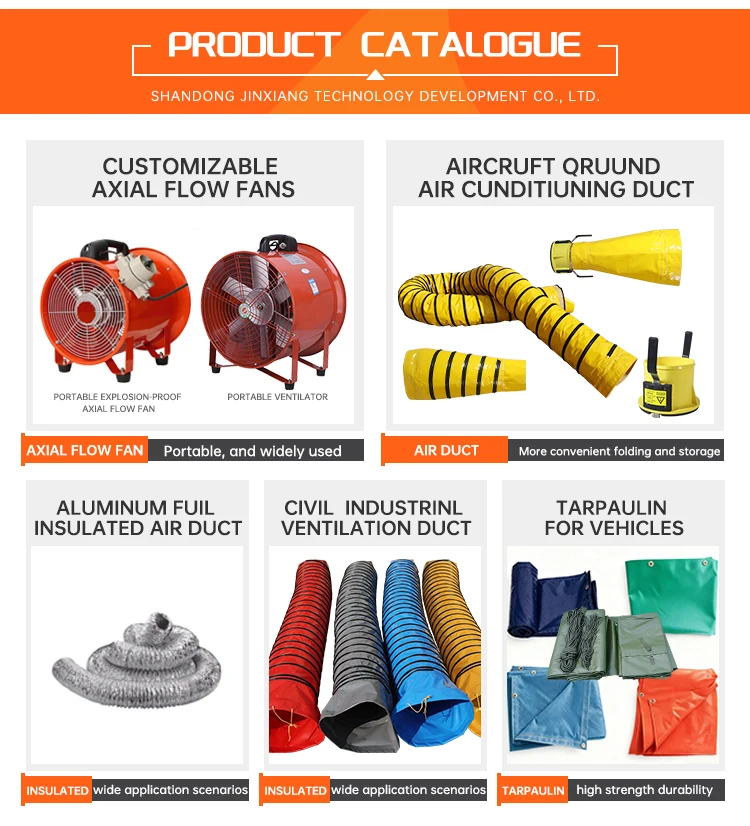

Description
Multi-Diameter Range — eleven fan sizes from 200mm to 900mm stocked for immediate dispatch, supporting mixed-size container loads with consistent airflow performance verified across production batches.
Technical Specifications
| Parameter | Value |
|---|---|
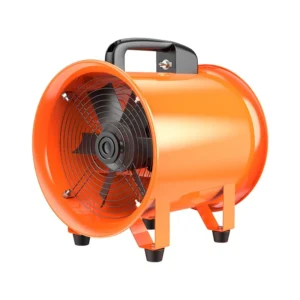
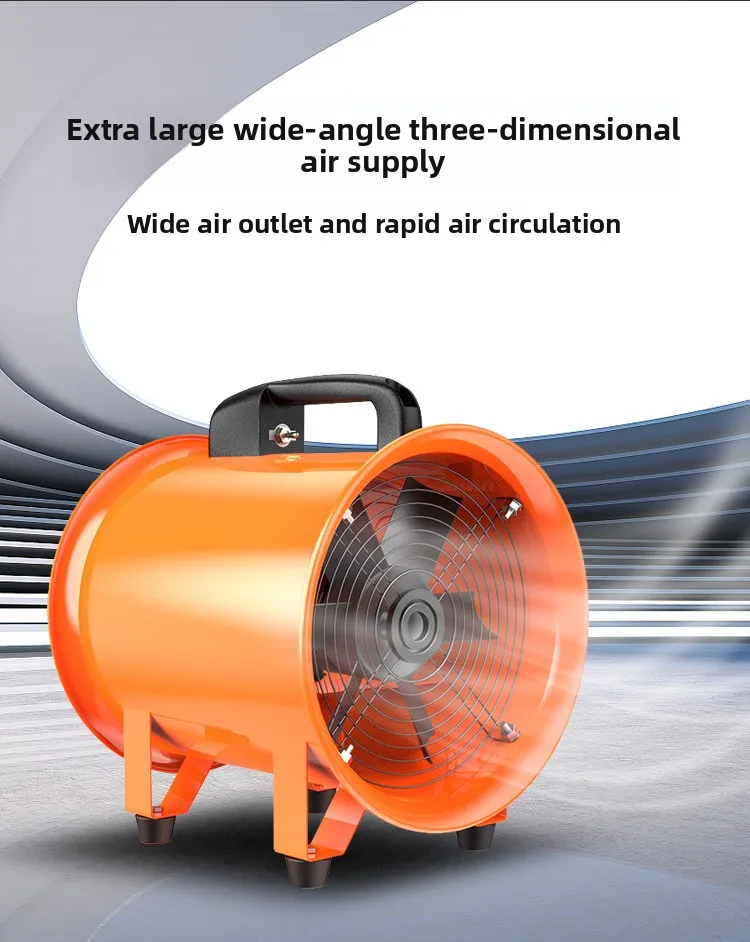
| Product Type | Portable Axial Flow Fan with Flexible Duct Hose |
| Size Options | 200mm / 250mm / 300mm / 350mm / 400mm / 450mm / 550mm / 650mm / 750mm / 850mm / 900mm |
| Power Range | 250W to 5500W |
| Air Volume Range | 1,300 to 28,000 m³/h |
| Total Pressure Range | 140 to 320 Pa |
| Voltage Options | 220V / 380V |
| Noise Level | 57 to 88 dB(A) depending on size |
| Accessory | Flexible duct hose (diameter matched to fan outlet) |
| Certifications | ISO and CE |
Application Suitability
| Application | Exposure & Requirement |
|---|---|
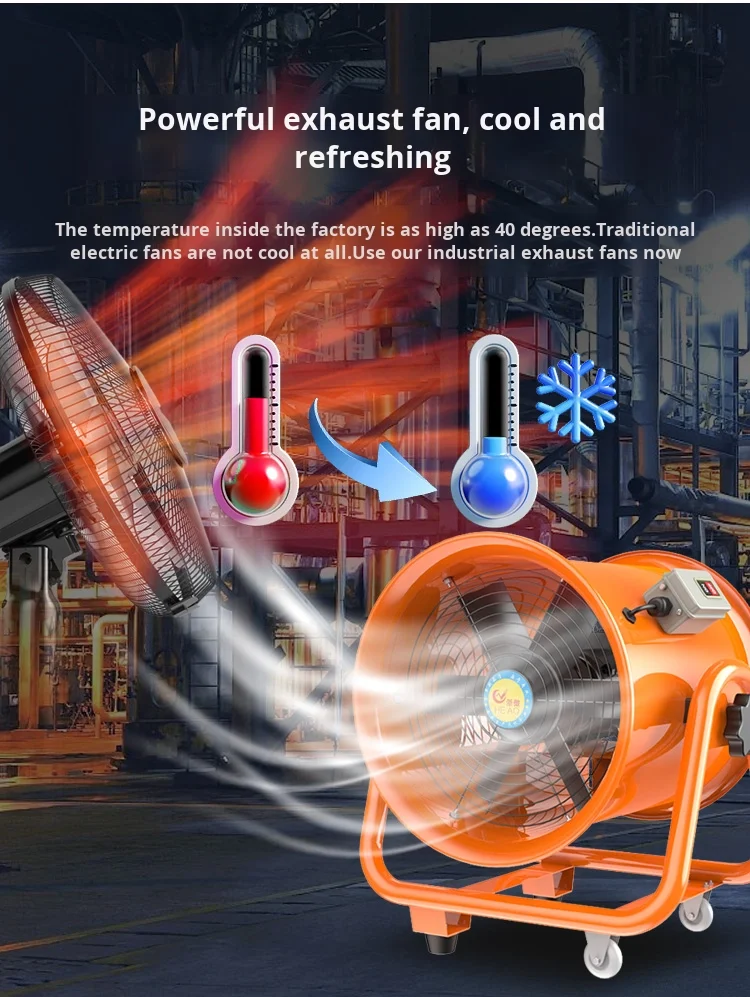
| Factory floor exhaust | Continuous duty, fume extraction, particulate-laden airstream requiring adequate static pressure |
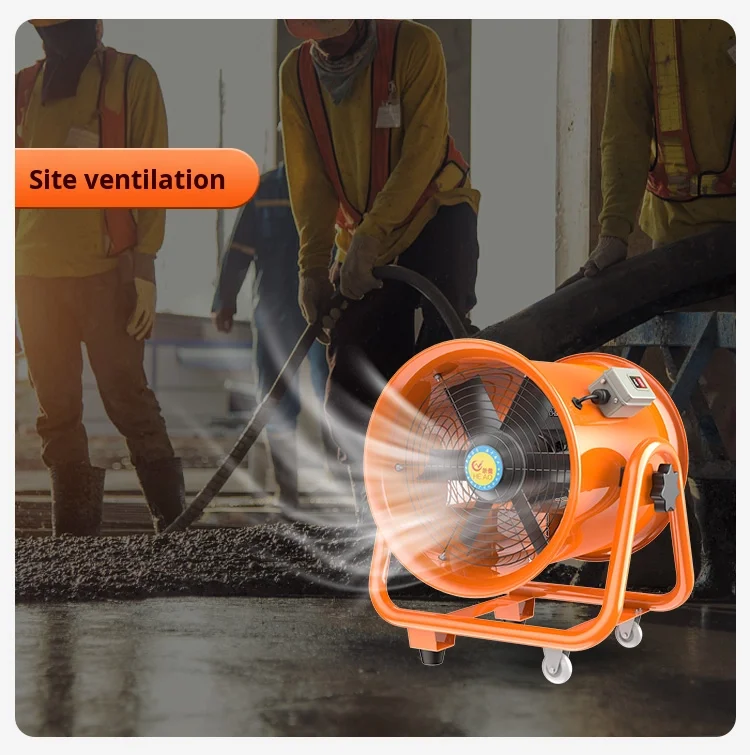
| Construction site confined space | Temporary ventilation, dust displacement, flexible duct routing through narrow openings |
| Welding bay ventilation | Localised fume capture, heat-laden air, intermittent high-demand cycles |
| Tunnel and mining ventilation | Extended duct runs, pressure drop over distance, sustained airflow to face |
| Warehouse and depot air exchange | Large-volume air movement, low-resistance open duct layout |
Why Portable Axial Flow Fan Selection Demands More Than a Diameter Number
Matching the fan to the duct run and site conditions prevents under-ventilation on the day it matters most.
Purchasing a portable axial flow fan based on diameter alone leads to two common failures on site: the unit moves less air than the safety plan requires, or the motor overheats when pushing through a longer duct run than the quoted pressure rating allows. We have seen projects delayed by weeks because the ventilation crew arrived with fans that could not sustain airflow through the actual hose length deployed underground [NEED_CITE: confined space ventilation pressure drop calculations per site safety standards]. The air volume and total pressure figures in the table above must be read together — high volume at zero resistance means little when thirty metres of flexible duct stands between the fan and the workspace.
Diameter Selection Across the Full Working Range
Eleven diameter options allow buyers to specify the exact portable axial flow fan needed for each section of a ventilation plan rather than forcing a single compromise size across an entire project. Smaller units in the 200mm to 350mm range serve local exhaust at welding stations or small confined spaces, while the 750mm to 900mm models move the volume required for tunnel face ventilation or large depot air exchanges. Stocking multiple sizes from one supplier means one shipping schedule, one documentation set, and consistent coupling standards across the order.
Voltage Compatibility and Site Power Planning
The 220V and 380V options cover both single-phase site supplies common on smaller construction projects and three-phase industrial power available in established factories and processing plants. Confirming voltage before dispatch eliminates the need for transformers on arrival and prevents motor damage from phase mismatch. Each fan in a bulk order should be tagged with its rated voltage so that site electricians can verify connections without cross-referencing paperwork on the ground [NEED_CITE: industrial fan voltage verification procedures for multi-unit deployments].
Reading Air Volume and Total Pressure Together
The air volume figures from 1,300 to 28,000 m³/h describe free-air delivery — the maximum the fan moves with no resistance. Once flexible duct hose is attached, every metre of hose, every bend, and every restriction reduces actual delivered airflow. Total pressure ratings from 140 to 320 Pa indicate how hard each model can push against that resistance. A longer duct run or a run with multiple bends demands a fan with higher total pressure capability, even if a lower-pressure model offers the same nominal air volume. Ventilation system designers must calculate the system resistance curve and select the fan whose performance curve intersects at the required operating point.
The Cost of Undersizing the Ventilation System
Selecting fans without accounting for duct friction losses leads to underperforming systems that fail safety inspections on regulated sites. Occupational health regulations in most jurisdictions specify minimum air exchange rates for confined spaces, and a fan that delivers adequate volume at the outlet but cannot sustain it through the actual duct layout leaves workers exposed. Rectifying this mid-project means emergency procurement of larger units, idle crews, and failed compliance audits [NEED_CITE: occupational ventilation compliance requirements for confined space entry]. The penalty is never just the price difference between two fan sizes — it is the delay and rework that cascade through every trade downstream.
Sourcing Ventilation Equipment at Wholesale Scale
Buyers ordering for multiple projects or maintaining rolling stock across a fleet of sites benefit from consistent specifications and batch-to-batch reliability across units. Our production lines hold tight tolerances on motor winding, impeller balance, and casing dimensions so that flexible duct hose couplings from one batch fit fans from another without modification. Volume orders are loaded by unit count and container utilisation, with packing documentation that lets receiving teams verify quantities against the shipping manifest without opening every carton. A 10-person R&D team handles custom voltage requests, non-standard coupling configurations, and project-specific labelling requirements. Pre-shipment inspection covers electrical safety testing, airflow verification, and cosmetic checks on every unit before container loading.
Documentation & Verification
- Airflow test record per unit showing measured volume against stated specification
- Electrical safety test certificate confirming insulation resistance and earth continuity
- Flexible duct hose diameter and coupling compatibility confirmation per fan size
- ISO and CE certificates covering manufacturing facility and product compliance
- Voltage and phase marking verified on each unit nameplate before dispatch
- Packing list with unit count, size breakdown, and container load plan
Fabrication, Handling & Storage
- Store fans upright on pallets to prevent casing deformation and impeller misalignment during warehouse holding
- Inspect flexible duct hose for compression creases before deployment, as collapsed sections restrict airflow significantly
- Verify coupling diameter match between fan outlet and hose before securing clamps on site
- Keep motor terminals sealed and dry during outdoor staging to prevent moisture ingress before commissioning
- Handle larger units from 650mm upward with mechanical lifting aids due to motor and casing mass
- Route flexible duct hose in gradual bends to minimise pressure drop and maintain rated air volume delivery
Requesting a Quotation for Your Ventilation Requirements
Specify the diameter size or range you need, the voltage and phase available on site, and the maximum duct run length including the number of bends in each run. Let us know your annual unit volume so we can quote against the appropriate pricing tier and confirm production scheduling. If your project requires site-specific labelling, non-standard plug configurations, or performance curves validated by third-party testing, include those requirements in your initial inquiry so we can address them in the first sample batch.
Frequently Asked Questions
Q: How do I choose the right fan size for my confined space ventilation requirement?
A: Calculate the air volume your safety plan requires based on space dimensions and exchange rate, then add the pressure losses from your actual duct length and bends. Select the fan whose performance curve delivers the required volume at that system resistance. We can provide performance data for each size to support this calculation.
Q: Is the flexible duct hose supplied with each fan or ordered separately?
A: The flexible duct hose is available as a matched accessory for each fan size. Specify the hose diameter and total length required per fan so we can confirm coupling compatibility and include both items on a single packing list for your order.
Q: Can these fans operate on single-phase 220V site power?
A: Yes, 220V single-phase is available across the range alongside 380V three-phase. Specify voltage at the inquiry stage so the correct motor winding is fitted during production. Dual-voltage units are not standard but may be discussed for projects with changing site power conditions.
Q: What noise levels should I expect, and how do I manage them on noise-sensitive sites?
A: Noise ranges from 57 dB(A) on the smallest models to 88 dB(A) on the largest 900mm units. For noise-restricted environments, specify acoustic enclosures or position fans outside the restricted zone with extended duct runs to deliver air without exceeding site noise limits.
Q: What certifications support deployment on regulated construction and mining sites?
A: Our facility holds ISO and CE certification covering production processes and product compliance. For sites requiring additional market-specific electrical or safety approvals, provide the applicable standard at inquiry so we can verify compatibility or arrange supplementary testing before dispatch.