
Description
Bulk availability, volume consistency — Every fan order is cross-checked for air volume and pressure output against the stated specification before dispatch, ensuring batch-to-batch reliability across container loads.
Technical Specifications
| Parameter | Value |
|---|---|
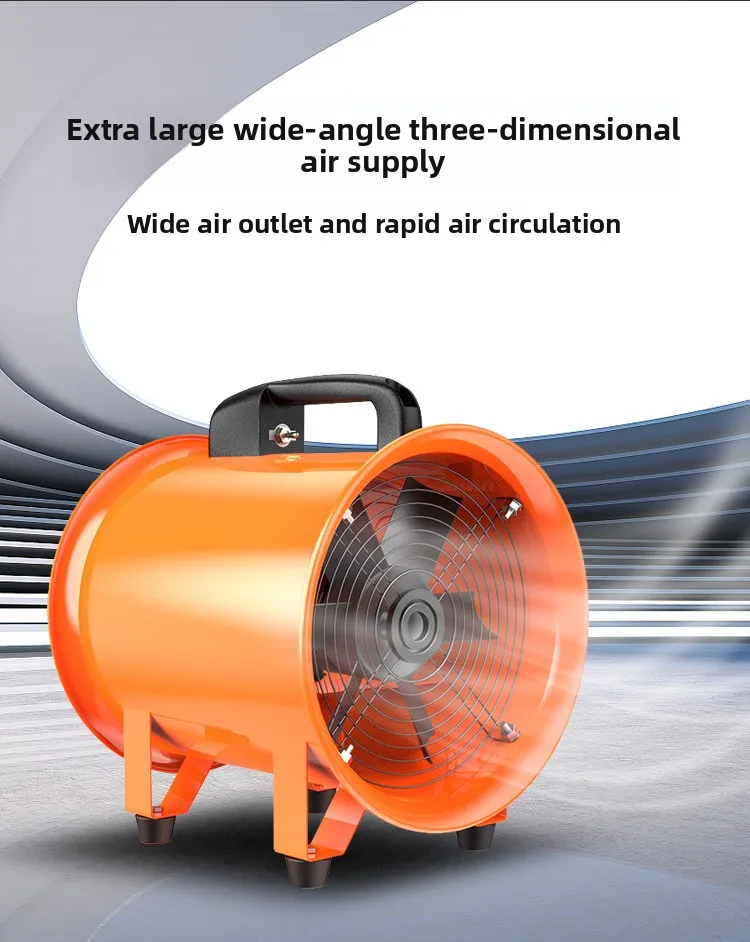
| Product Type | Portable Axial Flow Ventilation Fan |
| Size Options | 200mm / 250mm / 300mm / 350mm / 400mm / 450mm / 550mm / 650mm / 750mm / 850mm / 900mm |
| Power Range | 250W – 5500W (varies by size) |
| Air Volume Range | 1300 m³/h – 28000 m³/h (varies by size) |
| Total Pressure Range | 140 Pa – 320 Pa (varies by size) |
| Voltage | 220V / 380V |
| Noise Level | 57 dB(A) – 88 dB(A) (varies by size) |
| Speed | 3000 RPM |
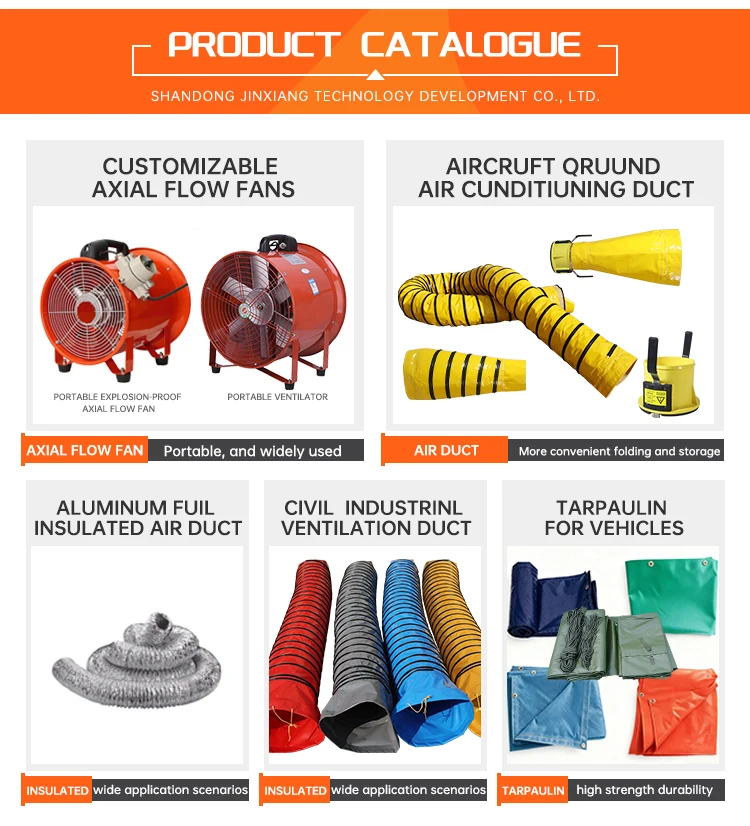
| Accessory | Flexible Duct Hose |
| Certification | ISO, CE |
Application Suitability
| Application | Exposure & Requirement |
|---|---|
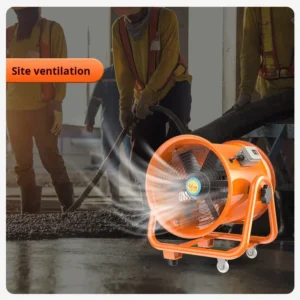
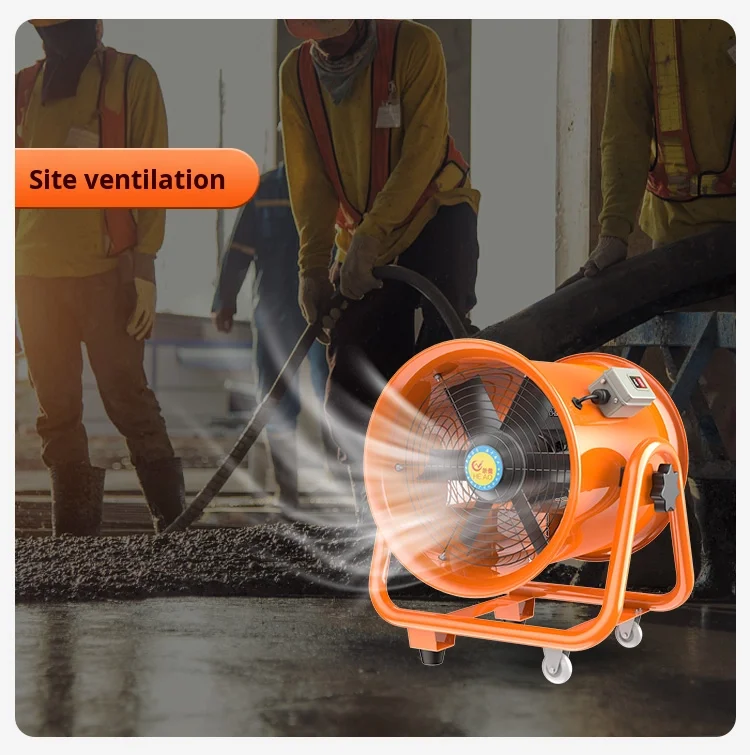
| Construction site trench ventilation | Confined space air movement, dust and diesel particulate extraction, continuous operation in damp conditions |
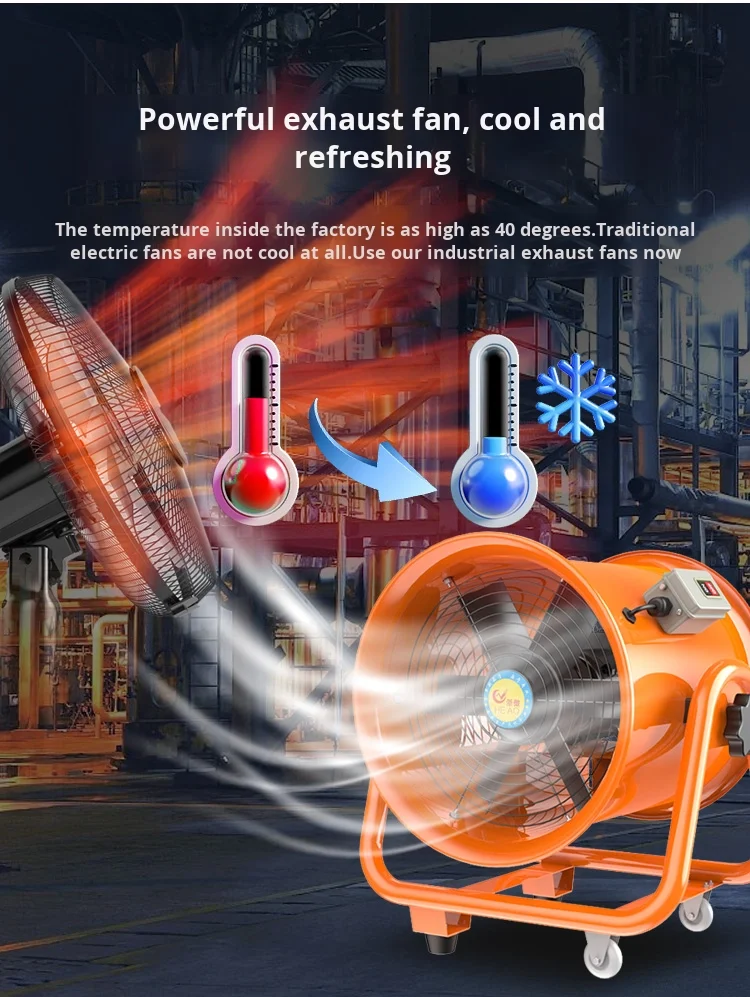
| Factory workshop exhaust | Fume and heat removal, steady-state airflow across production lines, noise compliance near workers |
| Mining and tunnelling ventilation | Extended duct runs requiring sustained pressure, abrasive dust in airstream, compliance with underground safety standards |
| Temporary demolition site ventilation | Rapid deployment, flexible duct routing through irregular openings, exposure to debris impact |
| Warehouse air circulation | High-volume air exchange, low-noise requirement for occupied spaces, variable seasonal demand |
Why Air Volume Figures Alone Do Not Guarantee Site Ventilation Compliance
The fan must deliver the stated volume at the duct length and bend count your site actually uses.
Many portable axial flow ventilation fans are rated at free-air conditions with no duct attached. Once flexible duct hose is connected — especially over runs exceeding a few metres with elbows or reductions — the effective air volume at the delivery end can drop significantly below the nameplate figure. Procurement teams who specify fans on maximum air volume alone often find the system under-performs at the face of the tunnel or the bottom of the trench [NEED_CITE: fan performance derating under duct back-pressure conditions per AMCA 210]. Matching the fan curve to the installed duct system resistance avoids undersized equipment arriving on site.
Sizing the Fan to the Duct Run and Worksite Geometry
Selecting the correct portable axial flow ventilation fan starts with the installed system, not the fan in isolation. The 200mm to 900mm size range covers applications from single-room extraction to multi-branch tunnelling layouts. For short, straight duct runs in confined-space work, smaller diameters deliver adequate volume with lower power draw. For extended runs with multiple bends — common in trench ventilation or demolition staging — larger fan sizes maintain pressure across the full duct length, ensuring air reaches the workface at a usable velocity.
Voltage Selection and Site Electrical Compatibility
The dual 220V and 380V options address a recurring procurement friction point on international projects. Sites with single-phase supply can deploy the 220V configuration for smaller fan sizes, while three-phase 380V supports the higher-power units needed for heavy-volume extraction. Confirming voltage compatibility before dispatch prevents the delay and cost of on-site transformers or motor rewinds. Container-load orders can be configured to a single voltage for standardised site electrical distribution [NEED_CITE: IEC voltage classification for portable industrial motors].
Understanding the Pressure-to-Volume Relationship Across Sizes
Air volume increases with fan diameter, but total pressure — the force that pushes air through duct resistance — does not scale linearly. The 140 Pa to 320 Pa total pressure range across this product line reflects different impeller and housing configurations tuned to each size. A 900mm fan moving 28,000 m³/h at the lower end of the pressure range suits open-area exhaust where duct runs are minimal. For forcing air through long flexible duct against friction losses, the smaller high-pressure models may deliver more usable airflow at the endpoint despite a lower free-air rating. Specifying based on installed system resistance rather than catalogue air volume prevents undersized installations.
The Hidden Cost of Mismatched Fan and Duct Specifications
Ordering fans and flexible duct from separate sources frequently results in mismatched flange diameters or incompatible hose clamping arrangements. On site, this means improvised adapters that leak air, reduce effective volume, and create vibration points that shorten hose life. Sourcing the portable axial flow ventilation fan and its paired duct from a single supply chain eliminates these fit-up failures and reduces commissioning time. Buyers who have dealt with flange incompatibility on multi-site projects recognise the cumulative cost of field modifications across dozens of units [NEED_CITE: field failure rates from mismatched ventilation components in construction projects].
Consistent Supply for Multi-Site Project Rollouts
Jinxiang operates three full production lines and 36 sets of professional equipment, supporting bulk fan orders with reliable lead times for phased project deployments. The 10-person R&D team handles voltage configuration and duct pairing specifications at the order stage, reducing on-site engineering adjustments. A dedicated QA/QC process inspects every unit before shipment — air volume and pressure are verified against the stated performance curve, not assumed from the motor rating. ISO and CE certification documentation ships with every consignment, supporting customs clearance and site safety audits. Container loading plans are prepared on request to maximise unit count per shipment and protect equipment during ocean transit.
Documentation & Verification
- Air volume and pressure test record per unit against stated specification before dispatch
- ISO and CE certificates included in the shipping documentation package
- Voltage and wiring configuration confirmed on the packing list for site electrical teams
- Certificate of origin and customs documentation prepared for international bulk shipments
- Flexible duct pairing schedule listing matched hose diameter for each fan size in the order
Fabrication, Handling & Storage
- Inspect flexible duct hose connections before first use to confirm airtight clamping on the fan flange
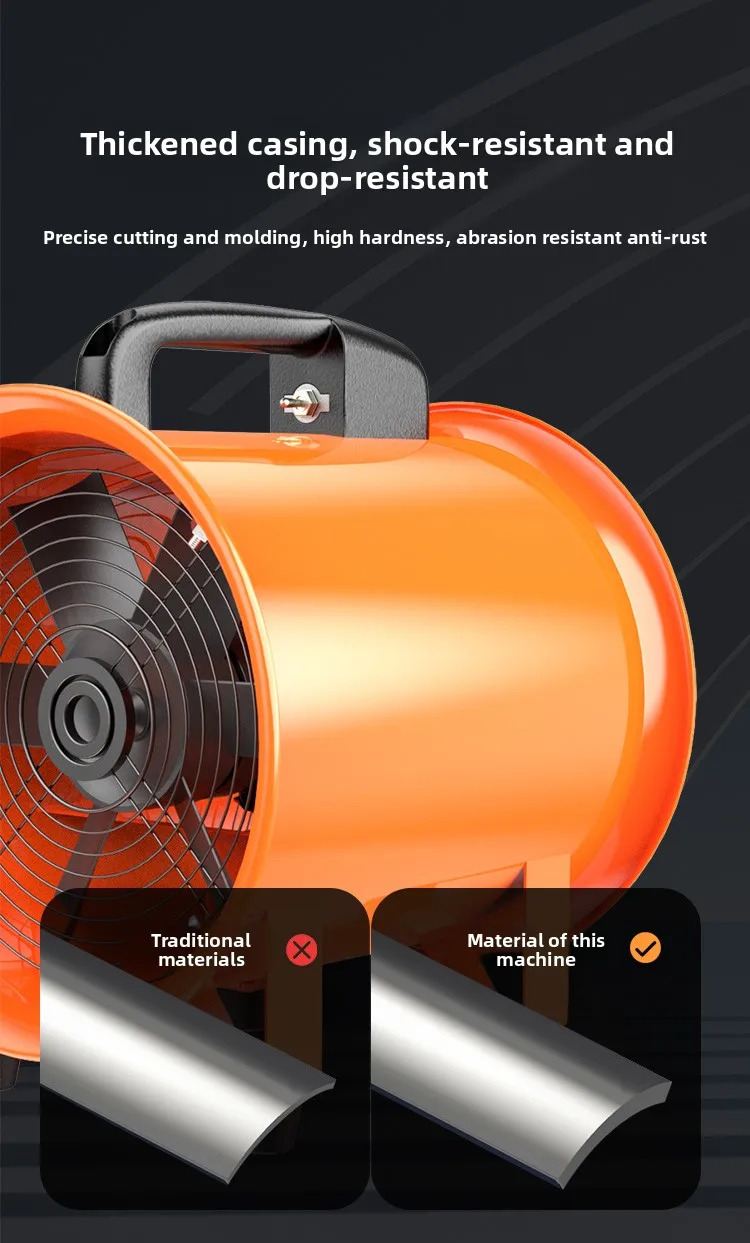
- Store fans upright on pallets to prevent housing deformation during container transit and warehouse stacking
- Verify voltage selector position matches site supply before energising — incorrect voltage can damage the 3000 RPM motor
- Route flexible duct with minimum bend radius to avoid airflow restriction and premature hose fatigue
- Clean fan housing and impeller with dry compressed air — solvent cleaners may degrade protective coatings on the casing
Specifying Your Ventilation Fan Order
Provide the duct run length, number of bends, and required air delivery at the workface so the correct fan size and pressure rating can be selected. Confirm site voltage availability (220V single-phase or 380V three-phase) and whether flexible duct hose is required as part of the supply scope. For multi-site projects, share the deployment schedule so container loading and phased dispatch can be planned. Sample units are available for site trials before full-volume order commitment.
Frequently Asked Questions
Q: What flexible duct hose diameter matches each fan size?
A: Each fan size from 200mm to 900mm pairs with a corresponding flexible duct hose diameter to ensure airtight connection without adapters. The duct pairing schedule is provided at quotation stage, listing matched hose diameter and clamping specifications for every fan model in your order. This eliminates on-site fit-up issues that occur when fans and duct are sourced separately.
Q: Can I order fans in bulk for a multi-site construction project?
A: Bulk orders for multi-site deployment are supported with phased dispatch aligned to your project schedule. Container loading plans are prepared to maximise unit count and protect equipment during transit. Every unit undergoes pre-shipment inspection for air volume and pressure output. Voltage configuration and duct pairing are standardised per site requirement to simplify on-site commissioning.
Q: What documentation is provided for customs clearance on export orders?
A: Each shipment includes ISO and CE certificates, a certificate of origin, and a detailed packing list identifying fan model, voltage, and paired duct specifications per carton. These documents support customs clearance in destination markets and satisfy site safety audit requirements. Additional documentation can be prepared upon request to meet specific import regulations.
Q: Is 220V or 380V more suitable for my site power supply?
A: The 220V configuration suits single-phase supply common on smaller sites and for fan sizes up to mid-range. The 380V three-phase option supports higher-power units needed for heavy-volume applications and large-diameter fans. Confirm your site electrical infrastructure before ordering. Mixed-voltage orders can be fulfilled in a single shipment for projects with varied power availability across locations.
Q: How is the fan packaged to prevent transit damage in container loads?
A: Each unit is packed in a protective carton with the fan secured upright to prevent housing deformation and impeller misalignment. Flexible duct hose, when ordered together, is packed separately to avoid compression damage. Container loading plans are available on request, detailing pallet arrangement and unit count to optimise space and minimise movement during ocean freight.