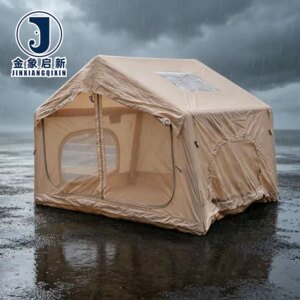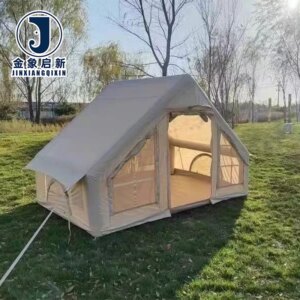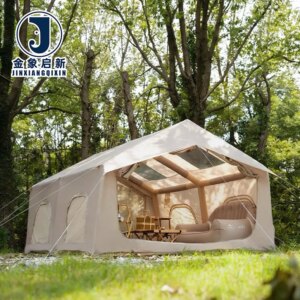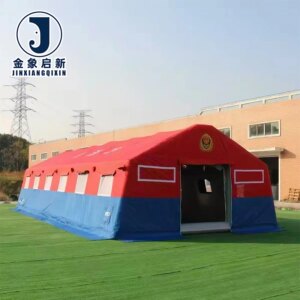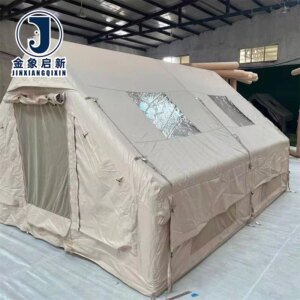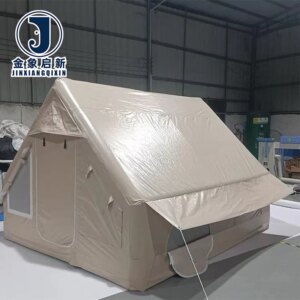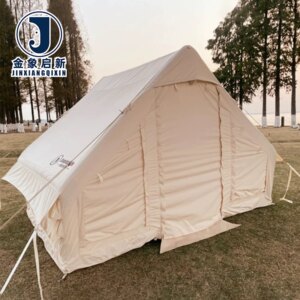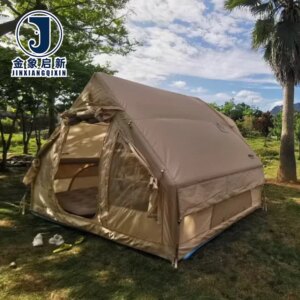
Description
Consistent Roll Output — dedicated QA/QC at every production stage and 100% pre-shipment inspection ensures each roll of inflatable tent fabric matches the approved sample across the entire order.
Technical Specifications
| Parameter | Value |
|---|---|
| Product Type | Inflatable Tent |
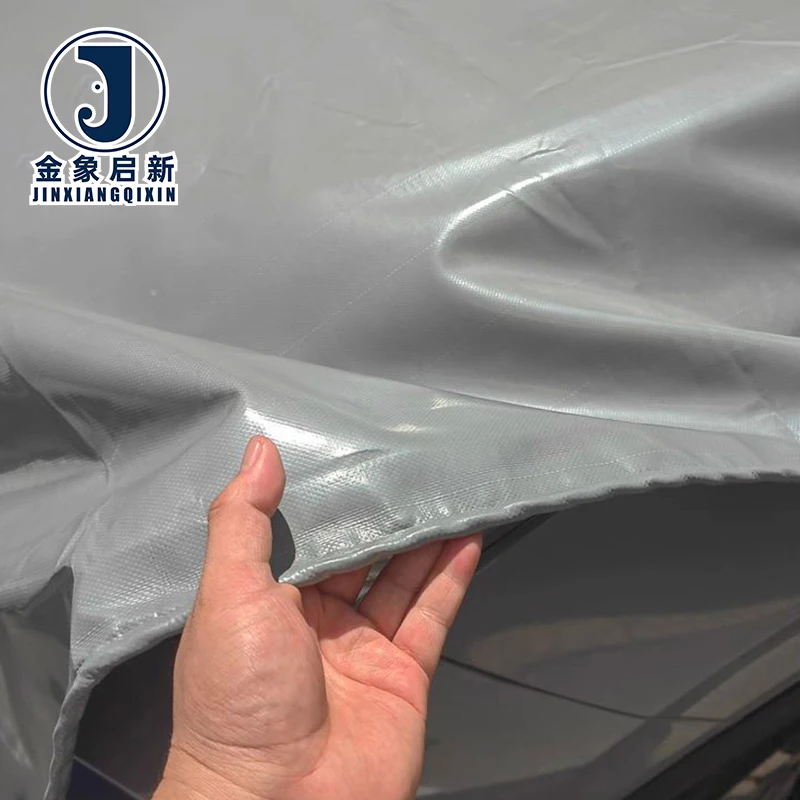
| Core Material | PVC waterproof fabric |
| Waterproof Performance | Fully waterproof coated construction |
| UV Treatment | UV-resistant (test basis not stated in source — confirm grade required for your market) |
| Tear Resistance | Tear-resistant (test basis not stated in source — confirm grade required for your market) |
| Flame Retardant | Available in flame retardant grades — confirm the grade required for your market |
| Anti-Static | Available upon request — confirm certification required for your site |
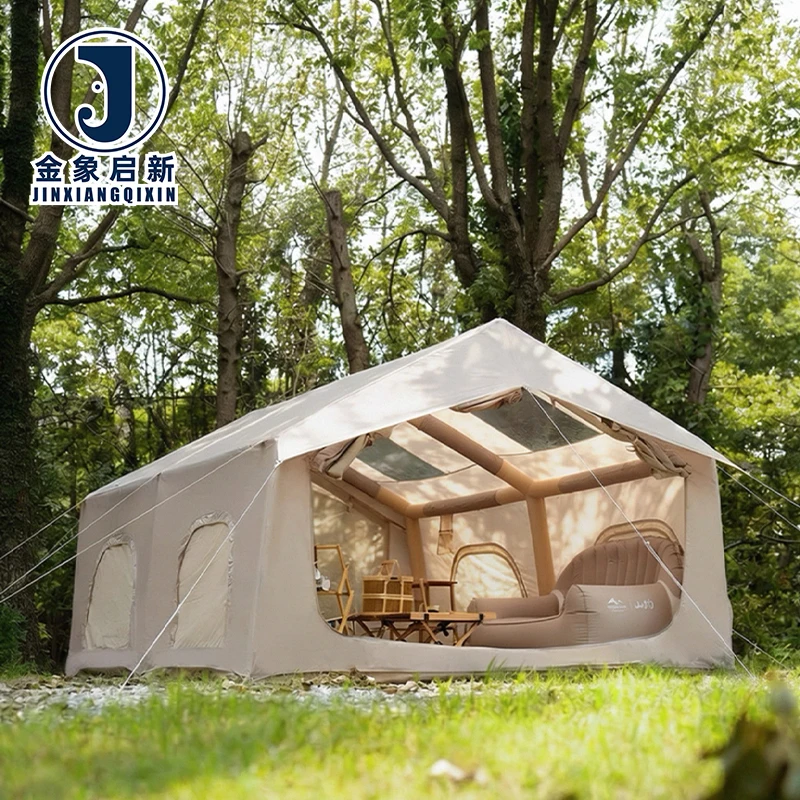
| Key Features | Waterproof, UV-resistant, tear-resistant, quick automatic opening design |
| Customization | OEM & ODM, sample customization, pattern printing |
| Certifications | CE, ISO 9001, ISO 14001, ISO 45001 |
Application Suitability
| Application | Exposure & Requirement |
|---|---|
| Inflatable tent manufacturing | Bulk roll stock with batch-to-roll colour and weight consistency for cutting and welding on production lines |
| Tarpaulin distribution and import | Regional resale requiring uniform appearance and performance across multiple rolls in the same shipment |
| Disaster relief procurement agencies | Large-batch supply with traceable inspection records and reliable material behaviour under rapid deployment conditions |
| Temporary engineering site shelters | Year-round outdoor exposure demanding waterproof integrity and structural stability under inflation |
| Mobile storage for outdoor industrial events | Frequent setup and teardown cycles requiring tear resistance at stress points and seam durability |
Why Batch Colour Drift Ruins an Entire Inflatable Tent Run
Colour consistency across rolls is a coating-process control issue, not a dye-lot problem.
When you are cutting panels from multiple rolls to assemble a single inflatable tent, even a slight shade shift between rolls becomes visible once the structure is inflated and viewed in daylight. Buyers have reported rejecting entire shipments because two adjacent panels, cut from consecutive rolls, showed a perceptible difference under natural light. [NEED_CITE: colour measurement standards for coated fabrics under varying light sources] This is not a finishing defect — it originates from inconsistent pigment dispersion during the coating stage or from temperature variation across the coating head. Controlling it requires in-process checks at the coating line, not just a final visual inspection before packing.
How Roll-to-Roll Consistency Supports Tent Production Lines
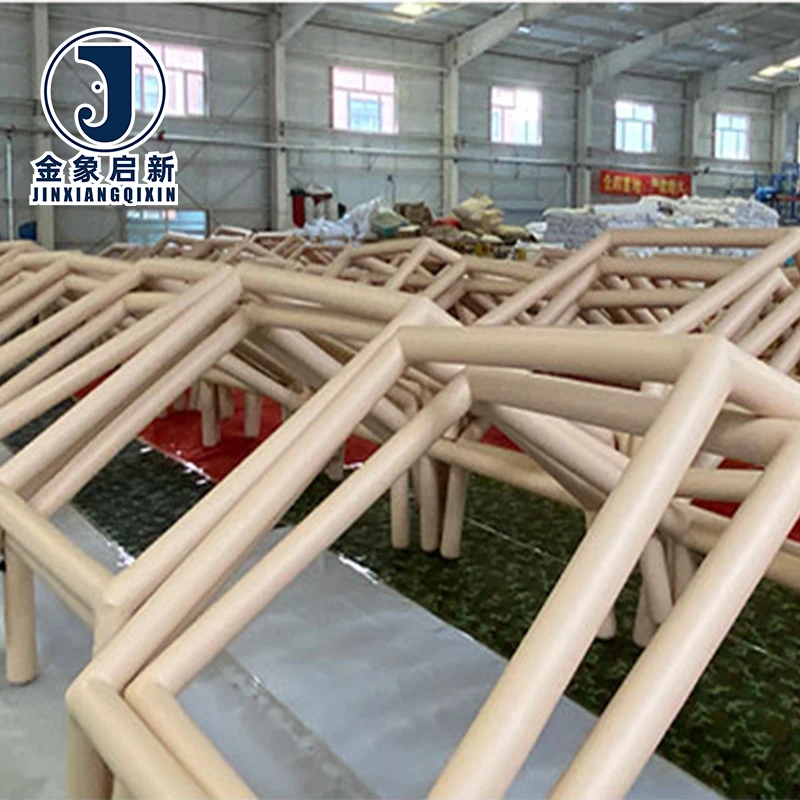
Tent manufacturers running continuous cutting and welding operations need every roll to behave identically under the same machine settings. A variation in coating thickness or surface finish between rolls forces operators to adjust heat-seal temperature and pressure mid-run, increasing scrap rates and slowing throughput. Our PVC waterproof inflatable tent fabric is produced with in-process QA checkpoints that monitor coating weight and surface uniformity, so your welding parameters remain stable from the first roll to the last in an Inflatable Tent bulk order.
Pattern Printing and Branding Across Volume Orders
When inflatable tents carry printed branding or custom patterns, the substrate surface must accept ink uniformly across every roll in the order. A glossy section on one roll and a slightly matte section on another will cause the same ink to appear different after curing. [NEED_CITE: ink adhesion and colour reproduction on PVC coated fabrics] We provide pattern printing as part of the OEM and ODM customization service, with sample approval required before mass production begins. This ensures the printed result on the production run matches the approved sample, roll after roll.
Reading the Specifications Beyond the Data Sheet
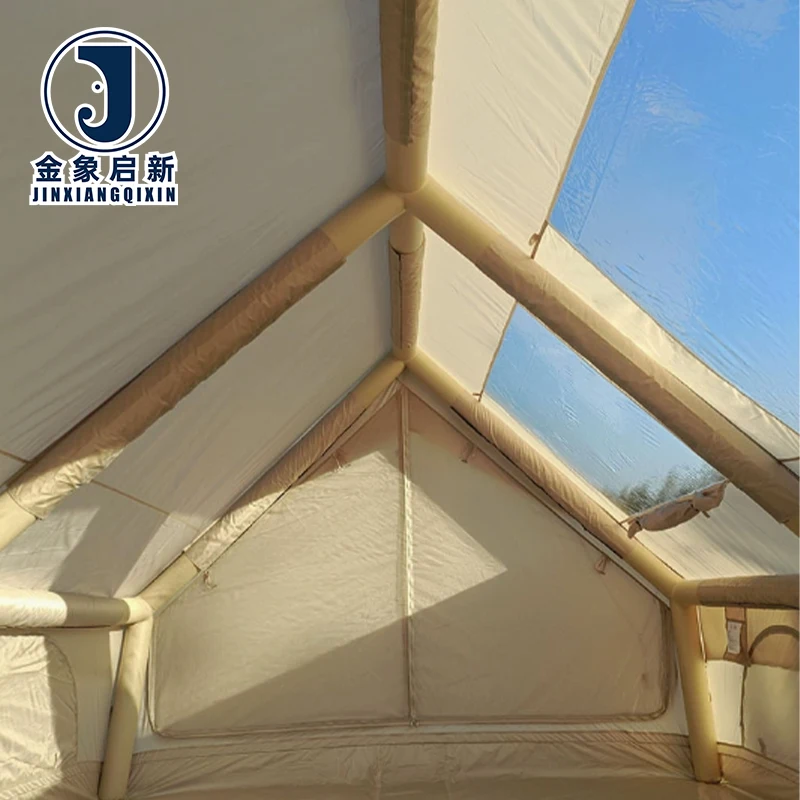
The PVC waterproof fabric core provides the barrier performance that inflatable tent structures depend on — once inflated, the air beams and canopy panels are under constant tension, and any pinhole or coating discontinuity compromises structural rigidity. Tear resistance matters most at the junctions where air beams meet the base, because these zones concentrate stress during inflation and deflation cycles. UV-resistant treatment is essential for tents deployed outdoors for extended periods, but the specific grade must match the climate and expected exposure duration of the end market — always request the test report to verify the treatment level before committing to a production run. The quick automatic opening design places additional demands on the fabric, because rapid inflation generates sudden tensile loads across the entire structure simultaneously. [NEED_CITE: tensile and tear test methods for coated fabrics per ISO 1421] Width and roll length directly affect cutting layout efficiency: wider rolls reduce the number of welded seams in large tent panels, while longer rolls minimise roll-change downtime on automated cutting tables.
What Inconsistent Coating Weight Costs on the Production Floor
A roll that tests lighter than the stated specification at one end and heavier at the other creates two problems simultaneously. The lighter section may fail a tensile or tear test during incoming inspection, while the heavier section causes welding defects because the heat-seal parameters were calibrated for the nominal weight. Manufacturers have reported that weld failures on inflatable tent air beams frequently originate from coating weight variation within a single roll, not from the welding equipment itself. [NEED_CITE: relationship between coating weight uniformity and heat-seal strength in PVC fabrics] This is why our 100% pre-shipment inspection includes weight verification at multiple points along each roll, not just a single sample from the roll end.
Why Volume Buyers Source Inflatable Tent Fabric Here
Three full production lines and 36 sets of professional processing equipment provide the capacity to fulfil large roll-stock orders without splitting production across incompatible lines. A 10-person R&D team handles material selection, custom width specifications, and pattern printing development, producing samples within days for buyer approval before mass production begins. Dedicated QA/QC personnel are stationed at each production stage rather than only at final inspection, catching coating weight deviations and surface defects before they propagate through the run. Every roll undergoes individual inspection against the material specification sheet before dispatch, with a pre-shipment inspection record tied to the order number for full traceability. Roll packing lists detail roll count, individual weight, and container loading plans so that logistics planning can be completed before the shipment leaves the facility.
Documentation & Verification
- Material specification sheet stating base fabric type, coating details, and colour reference per roll
- Pre-shipment inspection record with weight verification at multiple points per roll, traceable by order number
- Test report for UV-resistant grade available upon request to verify treatment claims against market requirements
- Roll packing list with individual roll weight, total roll count, and container loading plan for freight planning
- ISO and CE certificates covering the production facility and quality management system
- Certificate of origin and customs documentation for cross-border shipments
Fabrication, Handling & Storage
- Heat-seal PVC waterproof fabric at manufacturer-recommended temperature; adjust if coating weight varies across the roll
- Store rolls upright on pallets to prevent flat-spot deformation that causes creasing on the PVC coating surface
- Allow cold-transported rolls to reach workshop temperature before unrolling to avoid coating cracking at low temperature
- Plan cutting layout around roll width to minimise welded seams on inflatable tent air beam junctions
- Use PVC-compatible cleaners only; solvent-based products may degrade the waterproof coating layer
- Repair minor surface damage with PVC-compatible adhesive patches applied to clean, dry fabric sections
Before You Request a Quote
Provide the inflatable tent panel dimensions and annual roll consumption so we can recommend the most efficient roll width and length for your cutting layout. Specify your target market’s fire safety or compliance requirements so we can match the appropriate flame retardant grade and supply the corresponding test report. If pattern printing or custom colour is required, confirm the Pantone or RAL reference and whether you need a physical sample for approval before production begins.
Frequently Asked Questions
Q: How is batch colour consistency controlled across multiple rolls?
A: In-process QA checkpoints monitor pigment dispersion and coating temperature during production. Each roll is inspected individually against the approved colour reference before dispatch. If your order spans multiple production batches, we provide colour measurement data per roll so you can sequence them on your cutting table for minimal visible variation.
Q: What roll widths and lengths are available for inflatable tent manufacturing?
A: Custom widths are available to match your panel cutting layout and minimise welded seams. Roll length is configured based on your container loading plan and cutting table capacity. Provide your panel dimensions and annual volume so we can recommend the most material-efficient roll configuration for your production line.
Q: How does pattern printing colour matching work before mass production?
A: We produce a printed sample on the exact PVC waterproof fabric specified for your order. You review and approve the sample before mass production begins. Any colour adjustment is made at the sample stage, so the production run matches the approved reference across every roll.
Q: What is the minimum order quantity for custom roll stock?
A: MOQ depends on whether you require standard stock grades or custom width, colour, and printing. Standard specifications typically carry lower minimums, while fully custom orders involving special width or pattern printing require a higher volume commitment. Contact us with your specifications for a confirmed minimum.
Q: How are rolls packed and protected for container shipping?
A: Each roll is individually wrapped to protect the PVC coating surface from abrasion and moisture during transit. A detailed roll packing list accompanies every shipment, listing roll count, individual weight, and container loading plan. Rolls are loaded to prevent compression damage and shifting during ocean freight.