
Description
Volume Supply Assurance — three full production lines and 36 sets of equipment allow us to maintain batch consistency and container-load availability for aviation ground support ducting orders without forcing buyers to wait for back-to-back production runs.
Technical Specifications
| Parameter | Value |
|---|---|
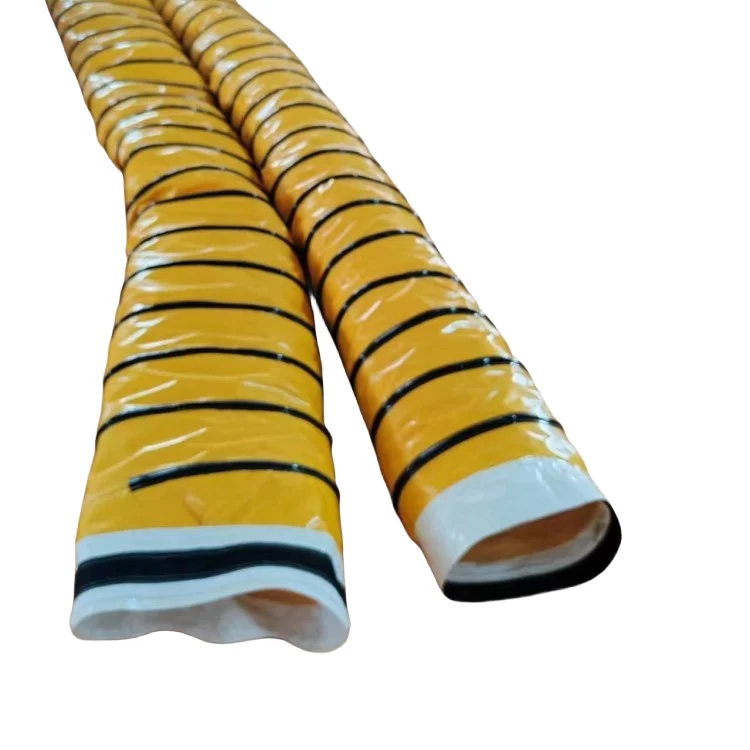
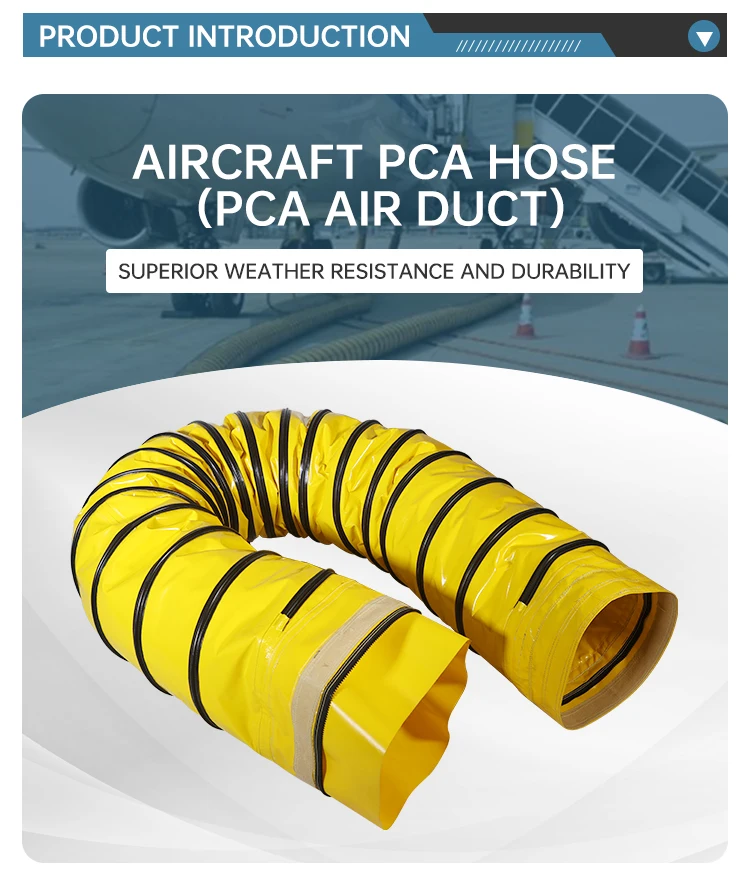
| Product Type | Aviation Air Duct (PCA Hose) |
| Nominal Inner Diameter | 12 Inch |
| Base Fabric | Fabric-reinforced layer |
| Coating Material | PVC |
| Insulation Layer | Aluminum foil bubble film |
| Temperature Range | -30°C to 150°C |
| Connection Method | Zipper and Velcro |
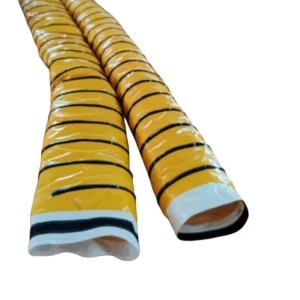
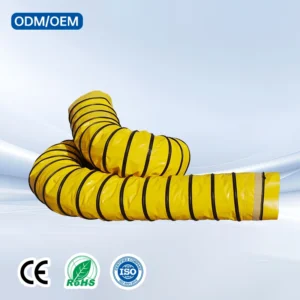
| Outer Color | Yellow-black alternating protective coloring |
| Mildew Resistance | Excellent (test basis not stated — request report) |
| Flame Retardant Grade | Available — confirm the grade required for your aviation site |
| Anti-Static | Available — confirm certification required for your market |
| Standards | ISO, CE (specific standard numbers available on request) |
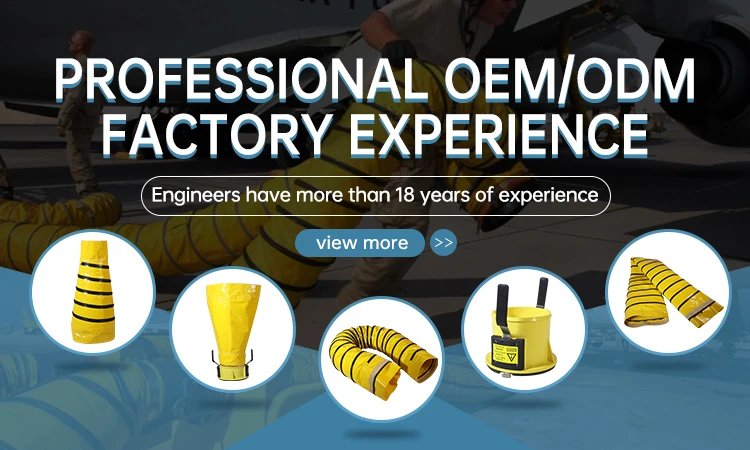
| Customization | Logo, pattern, and outer packaging (MOQ 100) |
Application Suitability
| Application | Exposure & Requirement |
|---|---|
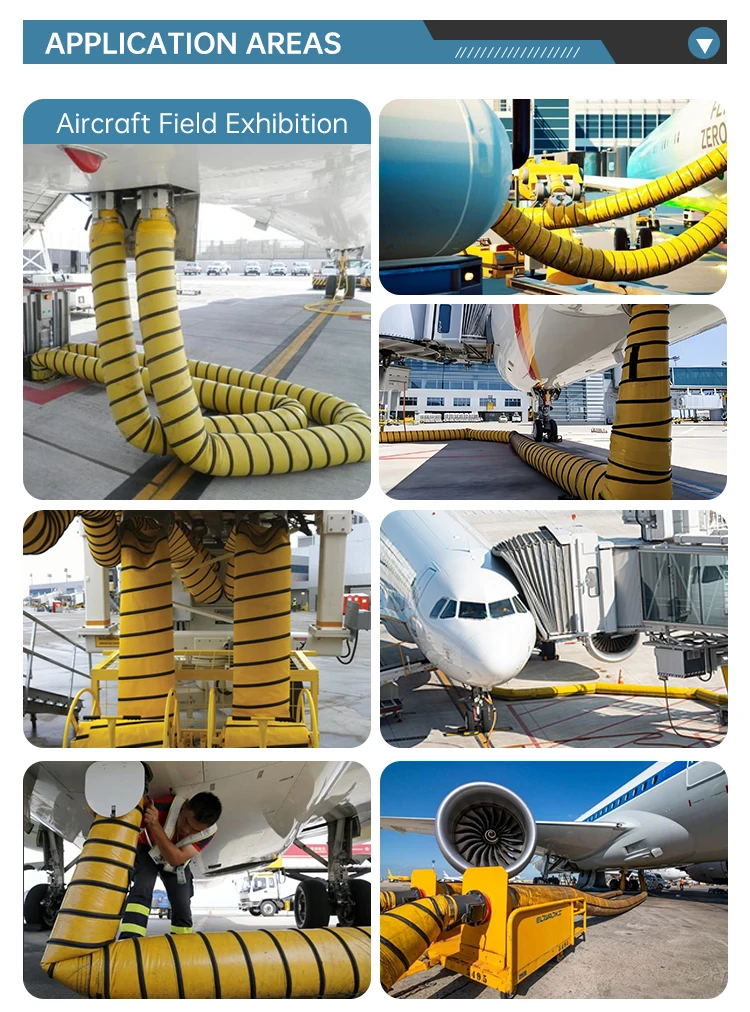
| Airport apron PCA-to-aircraft air transfer | Constant dragging on tarmac, jet blast debris, fuel and hydraulic fluid splashes, daily compression cycles between aircraft turns |
| Ground support equipment (GSE) cart integration | Repeated coiling and uncoiling on mobile units, storage in outdoor equipment yards between shifts |
| Military and regional airport operations | Rapid deployment under field conditions, exposure to sand, dust, and extreme ambient temperature swings |
Why PCA Hoses Fail Before the Fabric Does
The weakest point in a pre-conditioned air hose is almost never the PVC fabric itself — it is the connection zone and the insulation bond.
When a flexible Aviation Air Duct aftermarket supplier ships product without verifying the thermal insulation bond or the seam integrity at zipper junctions, the hose passes air but loses temperature efficiency within the first season of apron use. Ground crews then compensate by increasing PCA unit output, burning more fuel to offset what the duct should be retaining. [NEED_CITE: thermal degradation patterns in flexible air transfer ducting under continuous compression cycles]. A duct that arrives on time but leaks conditioned air at every connection point costs more over a single month than a properly specified unit would have cost upfront.
Thermal Insulation That Holds Temperature Across the Apron
The aluminum foil bubble film insulation layer bonded within the PCA hose structure creates a continuous thermal barrier between the pre-conditioned air stream and the ambient apron environment. This construction enables the duct to transmit air within the -30°C to 150°C range without significant thermal loss, whether the ground unit is delivering chilled air in a Middle Eastern summer or heated air during a Scandinavian winter. The insulation bond to the PVC-coated outer shell must survive repeated flexing without delamination — a failure mode that silently degrades performance before any visible damage appears.
Rapid Deployment Without Sacrificing Seal Integrity
Airport turnaround windows are measured in minutes, not hours. The zipper and Velcro connection system on this Aviation Air Duct allows ground handling crews to link duct segments and attach to the aircraft interface without tools, achieving a functional seal within the time pressure of a commercial turn. The yellow-black alternating outer coloring serves dual duty: high-visibility safety marking on busy aprons where vehicles and personnel operate around the PCA unit, plus a visual reference that helps crews spot damage or wear during pre-use inspection.
How Base Fabric Construction Determines Duct Life on the Tarmac
The fabric-reinforced layer beneath the PVC coating carries the structural load every time the duct is dragged, kinked, or compressed under equipment weight. The denier and weave density of this base fabric determine how the hose resists puncture from debris and abrasion from tarmac surfaces. PVC coating weight and adhesion to the base fabric govern whether the outer shell cracks at low temperatures or softens and becomes tacky at high apron temperatures. [NEED_CITE: relationship between coated fabric base weave density and puncture resistance in industrial ventilation applications]. The aluminum foil insulation layer adds a secondary consideration: if the bond between insulation and base fabric fails under flex cycles, the insulation collapses inward, restricting airflow and reducing the effective diameter available for conditioned air transfer.
What Happens When Duct Specifications Are Chosen on Price Alone
A PCA hose that specifies mildew resistance without a supporting test result may pass incoming inspection but develop fungal growth in humid storage conditions between shifts, contaminating the air stream delivered to aircraft cabins. Ducts supplied without confirmed flame retardant or anti-static certification create compliance risk at airports where ground support equipment must meet specific fire safety standards — a hose that passes visual inspection but fails a site audit shuts down operations until replacement arrives. [NEED_CITE: aviation ground support fire safety requirements for flexible air ducting on airport aprons]. Connection zones that are not stress-tested under repeated zip-and-seal cycles develop air leaks that degrade thermal delivery efficiency incrementally, forcing PCA units to work harder and consume more energy to compensate.
Why Buyers Source This Aviation Air Duct From Jinxiang
Our 10-person R&D team develops custom duct configurations and samples within days, allowing aviation ground support buyers to validate diameter, length, and connection compatibility before committing to volume orders. Dedicated QA/QC inspection at every production stage — including insulation bond verification and connection integrity testing — means the PCA Hose custom orders ship with documented compliance rather than assumed quality. Three full production lines handle bulk container orders for fleet-wide airport deployments while maintaining roll-to-roll consistency across segments. Pre-shipment inspection records accompany every dispatch, giving procurement teams dimensional verification and material traceability before the goods arrive on the apron.
Documentation & Verification
- Material specification sheet detailing base fabric composition, PVC coating weight, and insulation layer construction
- Flame retardant and anti-static test reports aligned to your aviation site compliance requirements
- Pre-shipment inspection record confirming diameter accuracy, connection integrity, and insulation bond quality
- Certificate of origin and customs documentation prepared for international airport project supply chains
Fabrication, Handling & Storage
- Heat-seal zipper connection zones using temperature settings matched to the PVC coating thickness to avoid delamination
- Store coiled ducts in dry, ventilated areas to preserve the mildew-resistant properties of the outer PVC layer
- Avoid storing heavy equipment on top of coiled segments to prevent permanent compression of the aluminum foil bubble film insulation
- Clean outer PVC surface with mild detergent only — solvents may degrade the coating and compromise the yellow-black visibility coloring
- Inspect Velcro and zipper seals before each aircraft turn and replace worn connection segments to maintain thermal seal integrity
Specifying Your PCA Duct Order
Provide the aircraft types and PCA unit models your ground fleet services so we can confirm diameter and connection compatibility. Specify the flame retardant and anti-static certification your airport authority or military base requires for ground support equipment compliance. Confirm whether you need individual duct lengths pre-configured with zipper terminals or continuous segments for field cutting, and indicate your annual volume to determine the most efficient production scheduling.
Frequently Asked Questions
Q: What fire-retardant or anti-static certifications does this PCA duct carry for aviation site compliance?
A: Flame retardant and anti-static grades are available for this Aviation Air Duct — the specific certification depends on your airport authority or military base requirements. We provide test reports aligned to the standard your site mandates. Confirm the required grade during inquiry so we include the correct documentation with your shipment.
Q: How is the temperature range verified, and what insulation construction achieves -30°C to 150°C?
A: The aluminum foil bubble film insulation layer bonded within the duct structure provides the thermal barrier enabling the stated -30°C to 150°C operating range. The PVC-coated fabric-reinforced outer shell maintains structural integrity across this range. Request the insulation performance test report for your specific climate conditions.
Q: Can the duct diameter and length be customized to fit specific PCA unit and aircraft interface configurations?
A: Yes. Our R&D team develops custom diameter and length samples within days for validation against your PCA equipment and aircraft interface specifications. Custom logo, pattern, and outer packaging are supported at MOQ 100. Provide your equipment model details during inquiry for configuration matching.
Q: How do you ensure batch consistency and seam integrity across multiple ducts for a fleet deployment?
A: Every production stage includes dedicated QA/QC inspection, with 100% pre-shipment inspection covering dimensional accuracy, insulation bond quality, and connection integrity. Production across three lines maintains consistency for fleet-scale orders. Inspection records ship with every dispatch for your procurement team’s verification.