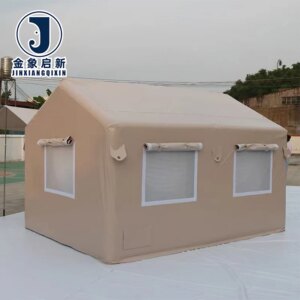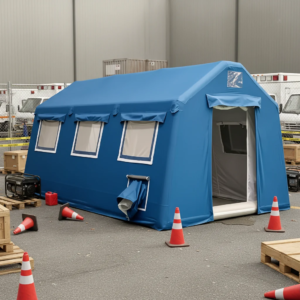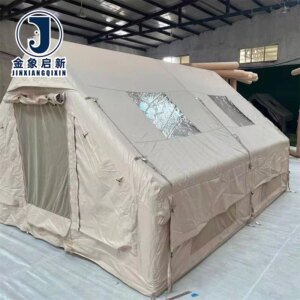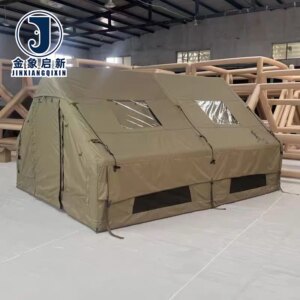
Description
Bulk Output Stability — Three dedicated production lines maintain colour and weight uniformity across every roll in a container load of inflatable tent fabric.
Technical Specifications
| Parameter | Value |
|---|---|
| Product Type | Inflatable Tent Fabric / PVC Tent |
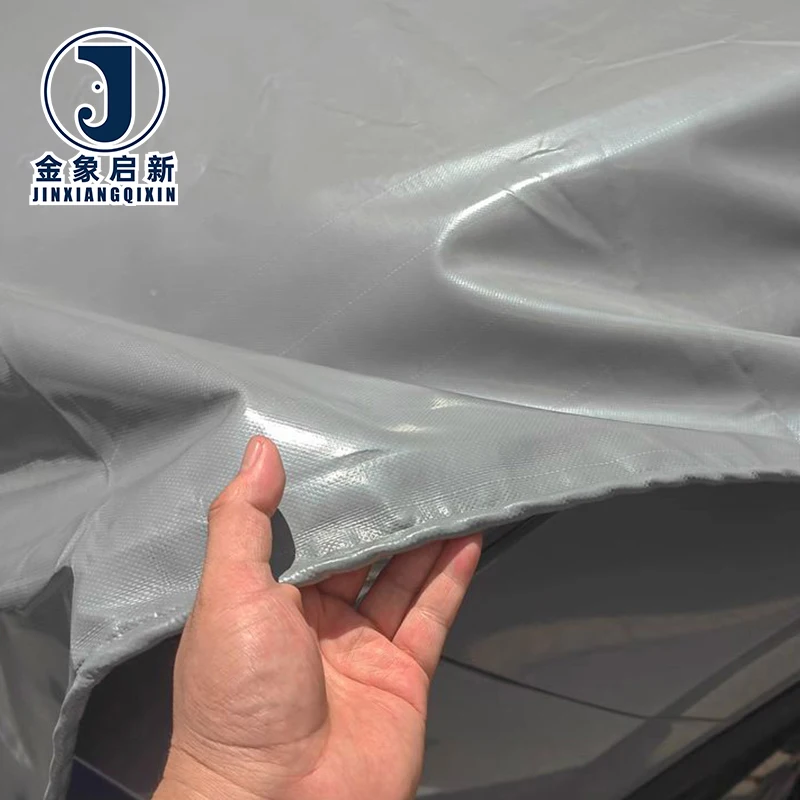
| Core Material | PVC Tarpaulin |
| Key Performance | Waterproof, UV-resistant (test basis not stated in source), Tear-resistant |
| Customization | OEM & ODM — sample customization, pattern printing, size modification, material thickness adjustments |
| Available Finishes | Glossy and matte options |
| Quality System | Full-process inspection with dedicated QA & QC staff |
| Certifications | ISO 9001, ISO 14001, ISO 45001, CE |
Application Suitability
| Application | Exposure & Requirement |
|---|---|
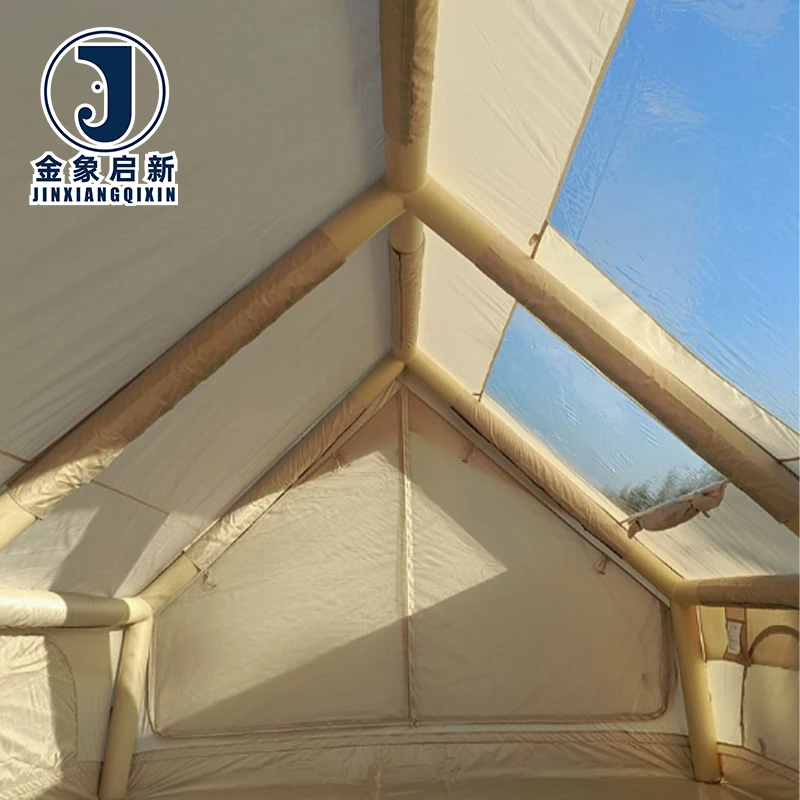
| Inflatable tent and glamping structure manufacturing | Repeated inflation cycles, seam welding at air-beam sleeves, prolonged outdoor weathering |
| Tent and awning fabrication | Consistent thickness for high-frequency welding, batch colour matching across panels |
| Tarpaulin distributor and importer stock | Roll-to-roll uniformity for downstream resale, container-scale volume purchasing |
| Construction site temporary shelters | Wind load, rain ingress, UV exposure, mechanical abrasion from equipment contact |
| Outdoor event enclosures | Rapid deployment and deflation cycles, visual consistency for branded installations |
Why Batch Consistency Matters More Than Stated GSM for Inflatable Tent Fabric
A roll that weighs the right GSM but varies in coating adhesion will fail at the weld before the fabric body does.
When sourcing inflatable tent fabric wholesale, buyers often anchor decisions on a single GSM figure printed on a quotation. In practice, coating weight distribution and base fabric tension across the roll width determine whether a welded air-beam sleeve holds pressure through hundreds of inflation cycles. Rolls that pass a spot GSM check but show uneven coating thickness create weak zones that separate under cyclic stress [NEED_CITE: tensile and tear test methods for coated fabrics per ISO 1421].
Coating Adhesion and Weld Integrity in Air-Beam Construction
Inflatable tent structures rely on welded seams that must contain pressurized air continuously. The PVC tarpaulin used here undergoes controlled coating application across 3 full production lines with 36 sets of professional processing equipment, allowing tight management of coating weight relative to the base fabric. When the coating bond is uniform, high-frequency welding produces a seam whose peel strength matches the fabric body rather than becoming the failure point.
Colour Matching Across a Multi-Roll Container Order
Tent manufacturers cutting panels from sequential rolls need visual continuity. A colour shift between rolls becomes obvious once panels are welded side by side on a finished inflatable structure. Our standardized batching workflow ties each production run to a specific colour reference, so a container load of PVC inflatable tent roll stock ships from a single dye lot. QA staff verify shade consistency before dispatch against the order colour standard.
Reading the Specification Sheet Beyond the GSM Number
GSM alone does not reveal whether a 650-grade fabric uses a high-denier base with lighter coating or a low-denier base loaded with coating filler. The former tears more slowly under point load; the latter may show acceptable weight on a scale but splits when an air-beam sleeve flexes repeatedly. [NEED_CITE: relationship between base fabric denier and tear propagation in coated textiles]. Specifying the base fabric construction alongside the target GSM gives the mill a clear production target and gives the buyer a verifiable incoming inspection checkpoint.
The Hidden Cost of Specifying on Price per Kilogram
Buyers who award orders based on the lowest cost per kilogram of PVC inflatable tent roll often receive material that meets the scale weight but achieves it through heavy filler loading in the coating compound. Filler-heavy coatings become brittle after sustained UV exposure and crack at fold lines during deflation and packing. The resulting warranty claims and replacement costs exceed the initial saving [NEED_CITE: coating formulation impact on low-temperature flexibility in PVC tarpaulins]. Specifying tensile and tear minimums alongside GSM forces the supplier to balance coating chemistry against base fabric selection rather than defaulting to filler.
Why Manufacturers Source Their Inflatable Tent Fabric Here
Consistent bulk output is supported by 3 full production lines operating in a 9,180 m² facility, meaning a multi-container order does not require splitting across different machines with varying tension settings.
OEM and ODM requests — including pattern printing, custom width, and thickness adjustments — are handled by a 10-technician R&D team that develops samples within days rather than weeks.
Every roll passes through dedicated QA and QC checkpoints at each production stage, with 100% pre-shipment inspection recorded against the purchase order specifications.
Certification support includes ISO 9001, ISO 14001, ISO 45001, and CE documentation, structured for buyer audit submission without requiring a separate compliance request.
Documentation & Verification
- Material specification sheet per roll batch listing base fabric denier, coating type, colour reference, and measured GSM
- Pre-shipment inspection record with roll-by-roll weight and visual grading against the approved sample standard
- Roll packing list detailing container loading by roll count, individual weight, and total gross weight for logistics planning
- ISO 9001, ISO 14001, ISO 45001, and CE certificates available for each shipment to support buyer compliance audits
- Certificate of origin and customs documentation prepared per destination country requirements
- Batch-specific test data supplied on request with full supply chain traceability back to the coating run
Fabrication, Handling & Storage
- Confirm high-frequency welding power and dwell time on a sample piece before production to match the PVC coating thickness
- Store rolls horizontally on padded racks to prevent permanent creasing in the PVC coating layer
- Allow rolls to acclimate to workshop temperature before unrolling to avoid cold-cracking at the coating surface
- Use compatible PVC-based adhesive for field repairs on welded seams to maintain bond chemistry consistency
- Plan cutting layout to minimize offcuts, accounting for the usable width after edge trim on each roll
What to Include in Your Inquiry
Provide your target roll width, annual volume, and the inflation pressure range your tent designs operate within so we can recommend the appropriate base fabric construction. Specify any colour or pattern printing requirements along with your destination market compliance needs, such as fire classification or REACH status. Indicate whether you need raw roll stock or pre-cut panels with welded air-beam sleeves, and whether a sample roll should be sent for your own weld testing before bulk production.
Frequently Asked Questions
Q: How is GSM verified per roll, and what documentation accompanies shipment for incoming inspection?
A: Each roll is weighed and measured at the finishing stage, with the recorded GSM logged against the specification sheet. A pre-shipment inspection record accompanies the shipment showing per-roll weight, coating type, and colour reference, giving your receiving team a direct comparison basis for incoming quality checks.
Q: How do you ensure colour consistency across multiple rolls within the same bulk order?
A: All rolls for a single order are produced from one coating batch tied to a specific colour reference. QA staff compare shade under controlled lighting before packing. The roll packing list identifies the batch code so you can trace every roll back to the same dye lot.
Q: What custom widths and roll lengths are available, and what is the MOQ for non-stock sizes?
A: Width and roll length are adjusted to your cutting layout and container loading plan. Custom sizes are produced on dedicated lines with sample confirmation before bulk runs. Contact us with your target dimensions and volume for a production schedule and minimum order discussion.
Q: How are rolls packed and loaded for container shipping to prevent transit damage?
A: Rolls are wrapped in protective film and loaded horizontally or vertically depending on container type, with blocking and bracing to prevent shifting. The packing list details roll count, individual weight, and loading arrangement so your logistics team can plan unloading equipment.
Q: What welding and seaming recommendations apply when fabricating inflatable air-beam structures from this fabric?
A: We provide a fabrication guide with recommended high-frequency welding parameters matched to the specific coating thickness. A sample piece from your batch can be sent for weld testing at our facility, and our R&D team is available to troubleshoot seam peel issues during your production ramp-up.