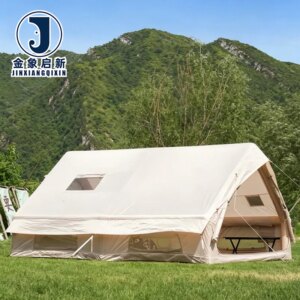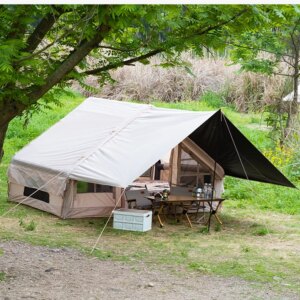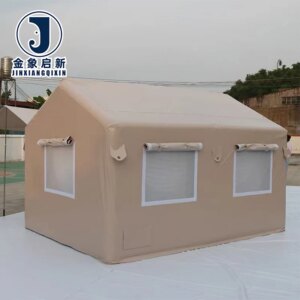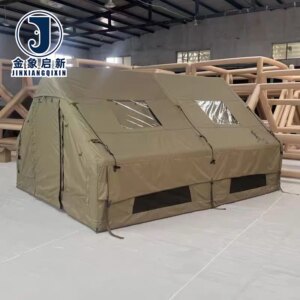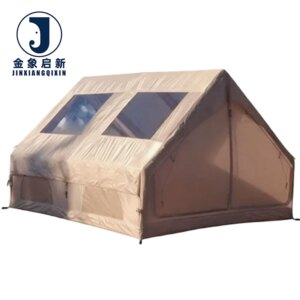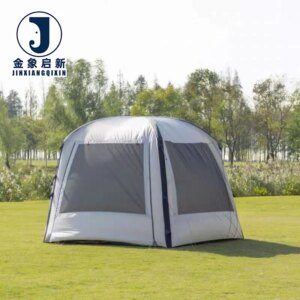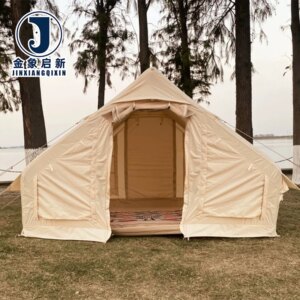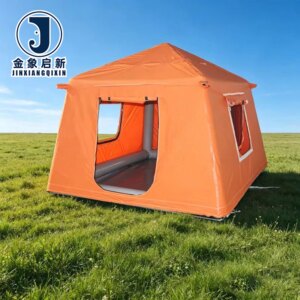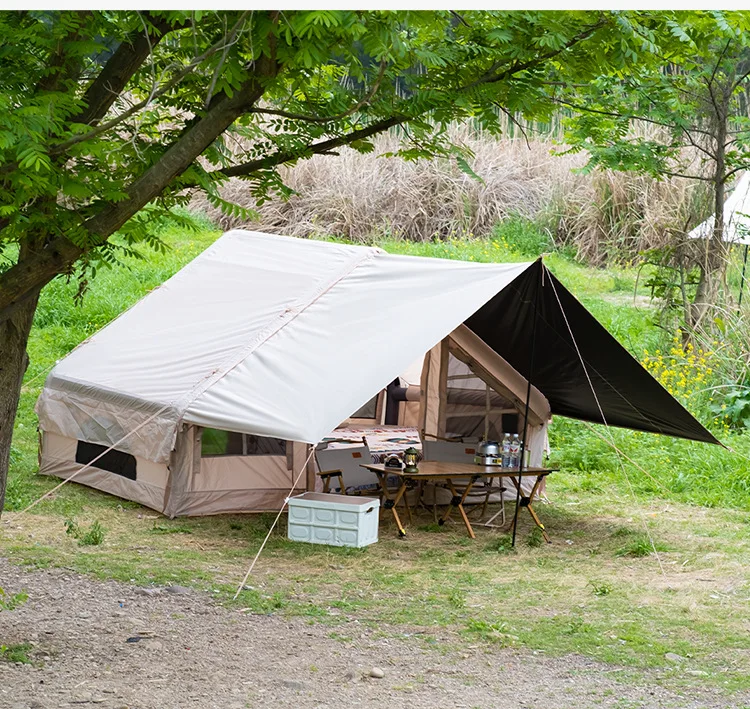
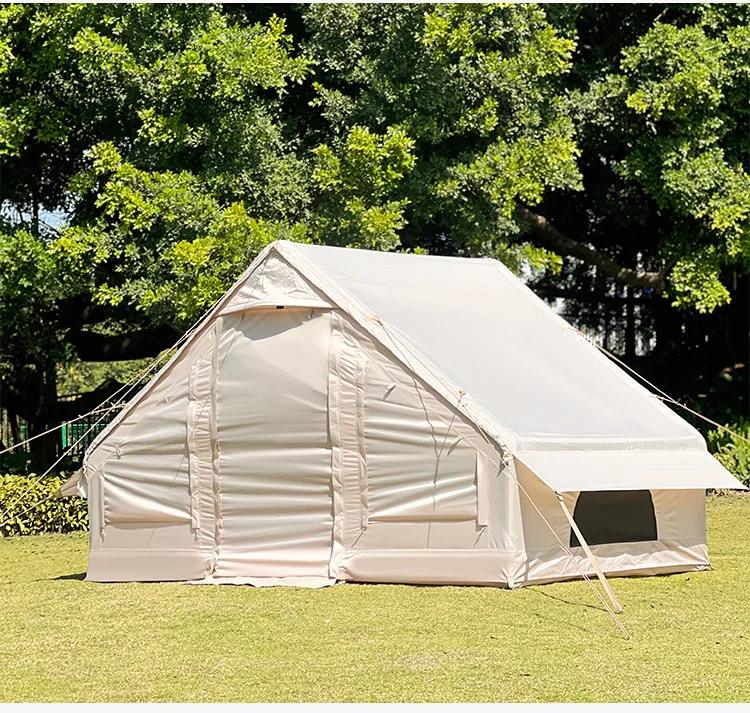
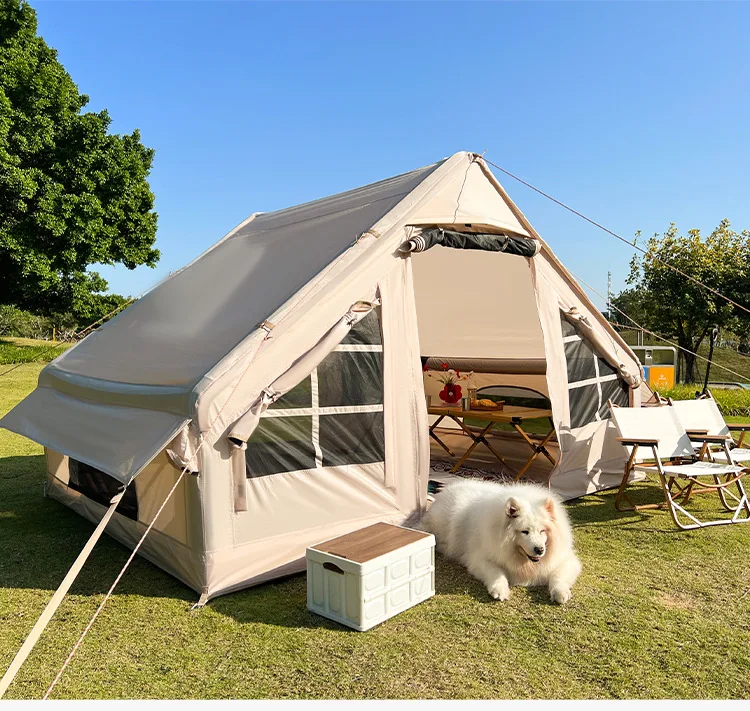
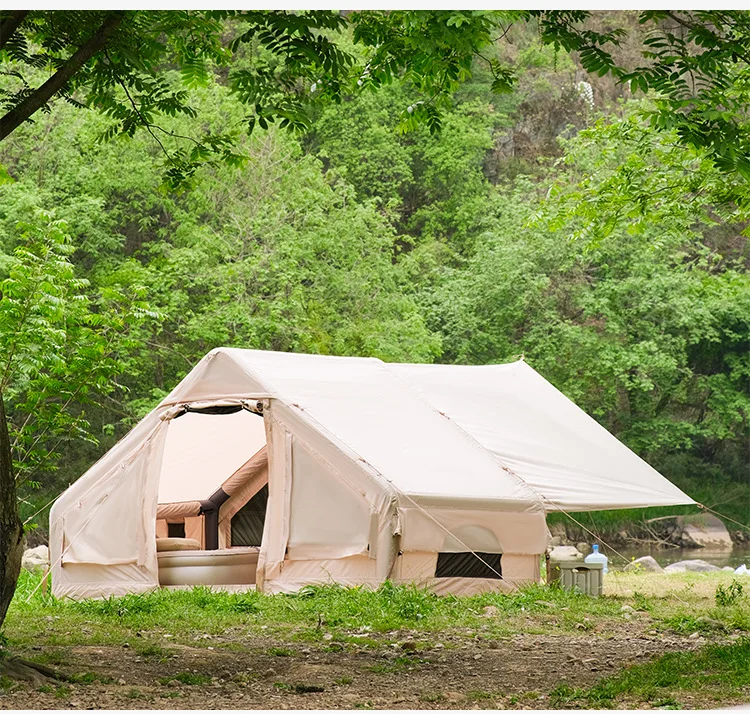
Description
Bulk consistency by design — three full production lines with dedicated QA checkpoints at every coating stage ensure roll-to-roll colour and weight uniformity across your entire container order.
Technical Specifications
| Parameter | Value |
|---|---|
| Product Type | Inflatable Tent Fabric |
| Core Material | PVC coated fabric |
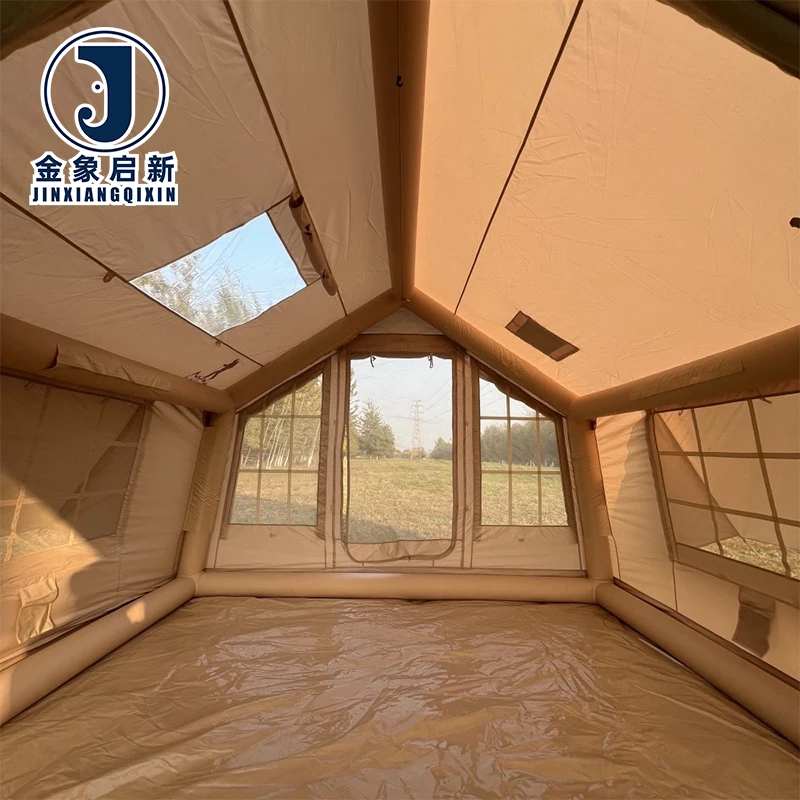
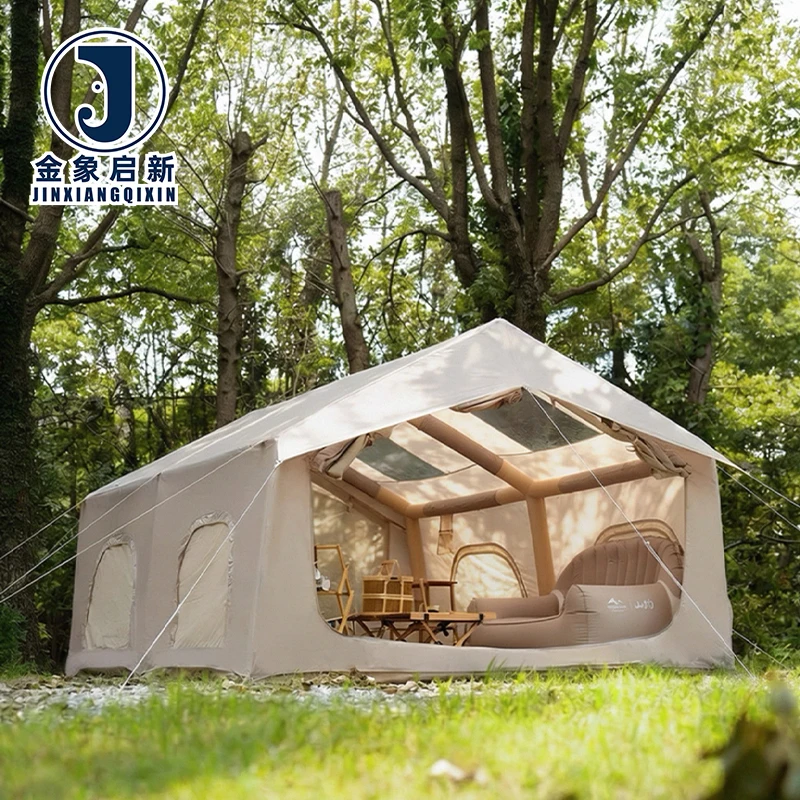
| Product Forms | Inflatable camping tent, 2–3 person capacity |
| Key Performance | Waterproof, UV-resistant (test basis not stated), tear-resistant, quick automatic opening |
| Construction | Single layer |
| Customization | OEM & ODM, sample development, pattern printing, custom sizing |
| Manufacturing Facility | 9,180 m² |
| Production Lines | 3 full lines |
| Processing Equipment | 36 sets of professional equipment |
| R&D Capacity | 10 technicians |
| Quality System | Full-process inspection with dedicated QA & QC staff |
| Certifications | ISO 9001, ISO 14001, ISO 45001, CE |
Application Suitability
| Application | Exposure & Requirement |
|---|---|
| Outdoor event infrastructure | Repeated inflation cycles, crowd contact, weather exposure, rapid deployment between venues |
| Temporary site offices | Wind loading, dust ingress, daily temperature fluctuation, extended occupancy |
| Mobile exhibition spaces | Branded surface clarity, frequent transport abrasion, quick teardown schedules |
| Emergency response shelters | Immediate deployment, variable ground conditions, multi-day weather resistance |
| Logistics portable shelters | Yard exposure, forklift proximity, standardised sizing across multiple depots |
When Roll-to-Roll Colour Drift Costs You an Entire Container
Colour shift between rolls is often caught only after the inflatable tent units are installed side by side on site.
Procurement teams ordering inflatable tent roll stock for seasonal distribution frequently receive rolls that look matched in the warehouse but reveal visible tone differences once inflated and placed adjacent to one another. The problem compounds when pattern printing is involved, as misaligned colour baselines distort brand consistency across a fleet of tents. Batch-level QA at the coating stage — not a final visual spot-check — is the control point that prevents this. [NEED_CITE: coating weight variation tolerance per ISO 1421 for PVC coated fabrics]
How Coating Weight Consistency Holds Across a Container Load
Every roll destined for inflatable tent production passes through in-process QA checkpoints where coating weight is measured against the batch specification. This is not a random sampling exercise — dedicated QC staff verify GSM at intervals across each production run, flagging drift before it propagates into finished rolls. For wholesale buyers distributing across regional markets, this discipline means your customers receive the same specification whether they order in January or July.
Pattern Printing Alignment for Branded Inflatable Units
OEM buyers specifying printed branding on inflatable tent fabric need registration accuracy that survives both the inflation stretch and repeated folding cycles. Our 10-technician R&D team develops print layouts matched to the tent panel geometry, confirming colour matching and pattern repeat before mass production begins. Sample approval is mandatory — no container ships until the printed sample is signed off against your Pantone or physical reference. [NEED_CITE: colour fastness requirements for printed PVC coated textiles]
Why PVC Coated Fabric Outperforms Alternatives for Inflatable Structures
Inflatable tents demand material that holds air pressure without delaminating at the seams, resists puncture during ground contact, and survives repeated fold-unfold cycles without cracking. PVC coated fabric delivers on all three fronts: the coating bonds to the base fabric through controlled adhesion, the single-layer construction keeps weight manageable for transport, and the material’s inherent flexibility accommodates the stress of automatic inflation mechanisms. The tear-resistant construction specification matters particularly at stress points — valve openings, entry zips, and anchoring loops — where concentrated loads challenge the fabric matrix.
The Hidden Cost of Skipping Batch Verification
A common failure pattern in bulk inflatable tent procurement is material that tests correctly on the pre-shipment sample but arrives with different handling characteristics in production. Welding parameters calibrated to the sample’s coating formulation may not transfer cleanly to a batch with slightly different plasticiser content, resulting in seams that fail before the fabric body does. This is not a defect in the traditional sense — it is a process control gap that only full-process QA with batch-specific data can close. [NEED_CITE: thermal welding parameter sensitivity in PVC coated fabric production]
What Separates This Supply Chain From Generic Roll Stock
Three full production lines running simultaneously give us the throughput to fill container-load inflatable tent orders without splitting production across facilities or subcontractors. The 36 sets of processing equipment cover coating, printing, cutting, and welding in-house, eliminating handoff delays between external vendors. A dedicated R&D team handles material selection and sample development, meaning custom width or print requests are engineered rather than approximated. Every shipment carries a pre-shipment inspection record documenting the specific batch data — not a generic certificate that covers an entire product family.
Documentation & Verification
- Material specification sheet stating GSM, base fabric, and coating details per batch
- Pre-shipment inspection record with individual roll data traceable by order number
- Roll packing list detailing container loading by roll count and total weight
- UV and performance test reports provided where applicable to stated grades
- ISO 9001, ISO 14001, ISO 45001, and CE certificates for market compliance
- Certificate of origin and customs documentation for international dispatch
Fabrication, Handling & Storage
- Heat-weld seams using temperature settings matched to this PVC coating formulation — avoid generic parameters
- Store rolls vertically on pallets to prevent flat-spot creasing on the coated surface
- Allow cold-stored rolls to reach ambient temperature before unrolling to prevent coating micro-cracking
- Use PVC-compatible cleaners only — solvent-based products degrade the coating bond over time
- Field-repair punctures with matching PVC patches welded at the same temperature as primary seams
- Plan cutting layouts to minimise off-cuts and reduce seam count across large inflatable panels
Request a Specification Match for Your Market
Tell us the inflatable tent dimensions you are producing, the climate zone your end users operate in, and any fire classification your local regulations require. If you need pattern printing, provide artwork files and Pantone references so we can develop a printed sample for your approval before production scheduling begins.
Frequently Asked Questions
Q: How can I verify PVC fabric GSM matches the quotation on arrival?
A: We supply a material specification sheet with each batch stating the exact GSM, base fabric, and coating weight. On arrival, weigh a cut sample of known dimensions and compare against the stated value. Our pre-shipment inspection record documents the measurement taken at the factory before dispatch, giving you a baseline for any discrepancy discussion.
Q: How do you control colour consistency across a full container order?
A: Colour is monitored at the coating stage, not just at final inspection. Dedicated QA staff check tone against the approved reference at intervals throughout the production run. Rolls that drift outside tolerance are pulled before packing. This process-level control ensures uniform appearance when multiple inflatable tent units are installed side by side.
Q: What customisation options exist for dimensions and printing?
A: Our R&D team supports OEM and ODM development including custom sizing, pattern printing, and colour matching. We produce a physical sample for your approval before mass production. Provide your tent panel dimensions, print artwork, and Pantone references so we can align the sample to your specifications.
Q: How is roll stock packed for container shipping?
A: Each roll is packed with protective wrapping to prevent surface abrasion during transit. The packing list details roll count, individual weight, and container loading plan. This documentation supports your receiving inspection and helps warehouse teams plan storage before the container arrives at your distribution point.
Q: What is the sample approval process before production?
A: We develop a sample based on your specification within days of receiving requirements. You review the sample for coating feel, colour accuracy, print registration, and welding behaviour. Only after written approval do we schedule the full production run, ensuring the container matches the sample you validated in hand.