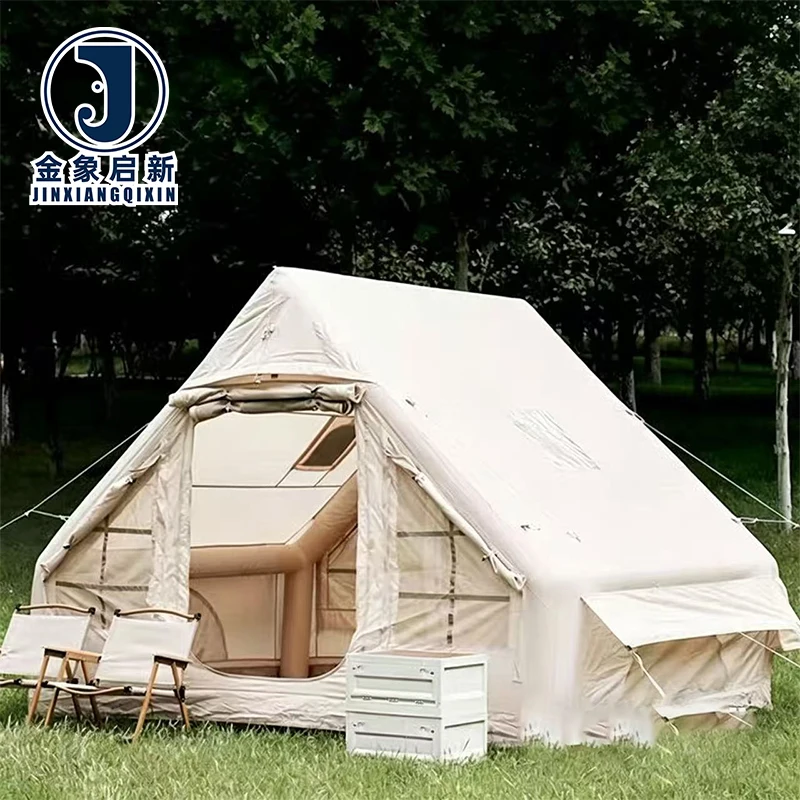
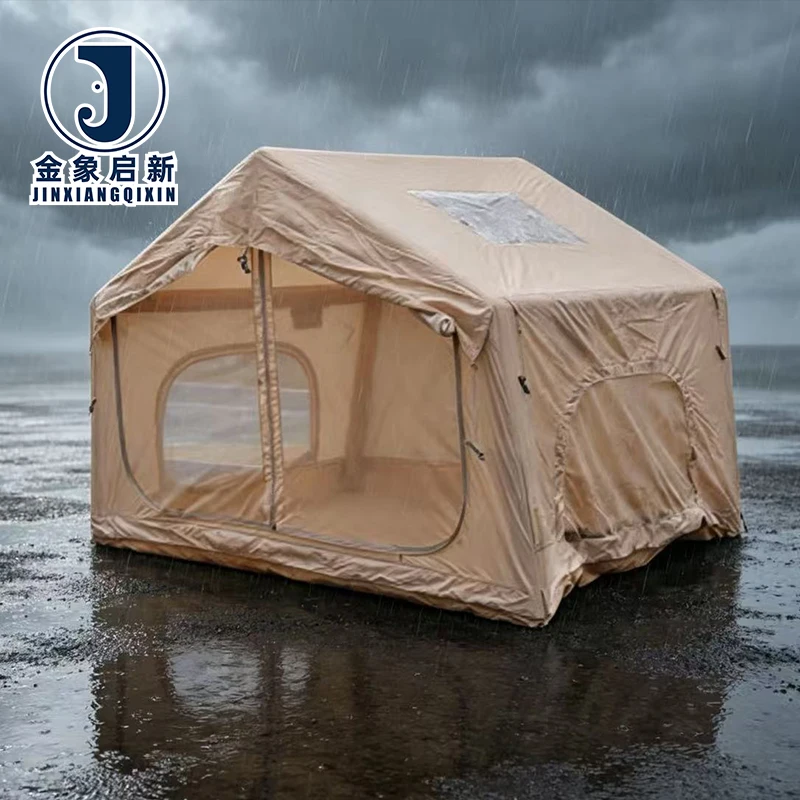
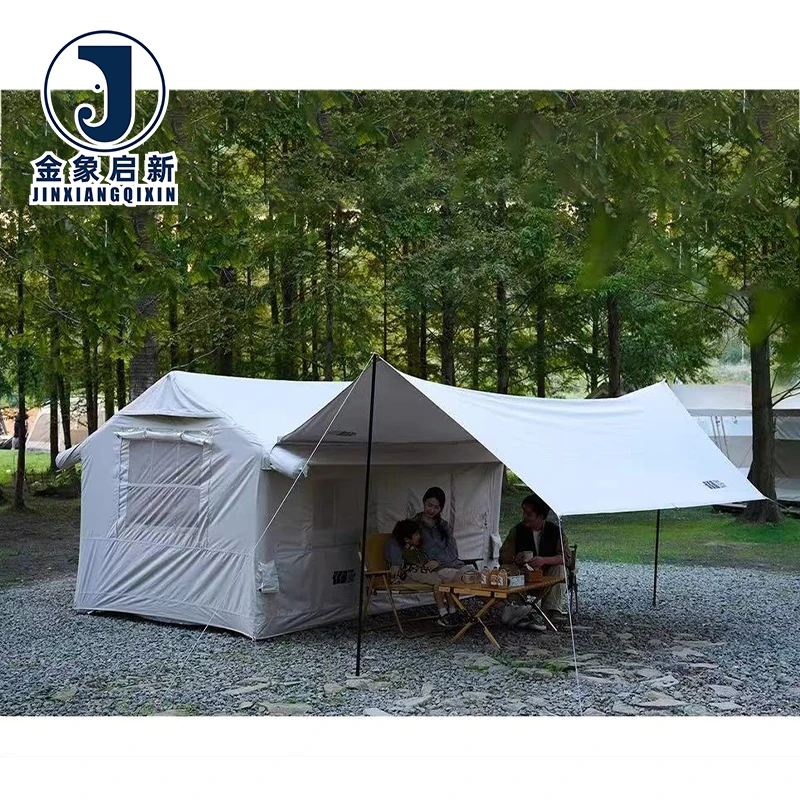
Description
Reliable Roll Consistency — Batch colour and coating weight held uniform across multi-roll inflatable tent fabric orders through dedicated stage-by-stage QA oversight.
Technical Specifications
| Parameter | Value |
|---|---|
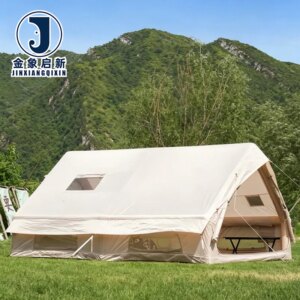
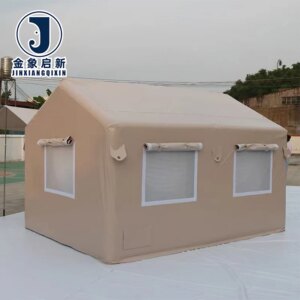
| Product Type | PVC Inflatable Camping Tent |
| Core Material | PVC Tarpaulin |
| Capacity | 4-6 Person |
| Key Features | Waterproof, UV-resistant (test basis not stated in source), Tear-resistant |
| Construction | Single layer inflatable structure |
| Deployment | Quick automatic opening |
| Certifications | ISO 9001, ISO 14001, ISO 45001, CE |
| Customization | OEM & ODM, sample customization, pattern printing |
| Quality Control | Full-process inspection with dedicated QA/QC staff |
Application Suitability
| Application | Exposure & Requirement |
|---|---|
| Commercial outdoor equipment manufacturing | Repeated inflation cycles, seam stress at air channels, consistent batch colour for branded product lines |
| Commercial expedition services | Rapid deployment in remote terrain, abrasion from ground contact, UV exposure across multi-day operations |
| Temporary site accommodation for industrial projects | Weather exposure on active construction sites, frequent relocation, compliance documentation for site audits |
| Equipment rental fleet inventory | High-frequency setup and teardown, handling wear from untrained users, uniform appearance across fleet units |
| Commercial event logistics | Short-notice deployment, visual consistency across multiple adjacent units, tear resistance during transport |
Why Batch Colour Drift Ruins Inflatable Tent Product Lines
Colour matching at the sample stage means nothing if roll-to-roll consistency breaks down in production.
Manufacturers who source PVC inflatable tent fabric roll stock in volume frequently encounter a problem that only surfaces after cutting: rolls from the same purchase order show visible shade variation when panels from different rolls are welded side by side. For brands selling finished inflatable camping tents to consumers or rental operators, this inconsistency triggers returns, forces panel sorting that slows fabrication, and erodes trust with downstream buyers. The root cause is typically uneven pigment dispersion during the coating stage or temperature fluctuations across the production line width. [NEED_CITE: coating consistency standards for PVC tarpaulin per industry test methods]
Maintaining Chromatic Uniformity Across a Multi-Roll Shipment
Achieving consistent colour across an entire container load of PVC inflatable tent fabric requires process discipline that begins at the pigment mixing stage and continues through every metre of coated output. Our production protocol locks the colour reference at sample approval and holds that formulation constant through the full order, with in-line checks comparing against the master swatch at defined intervals. For inflatable tent manufacturers running branded product lines, this eliminates the panel-sorting step that adds labour cost and delays assembly schedules.
How Coating Weight Control Affects Inflation Performance
The single-layer inflatable structure depends on uniform coating weight to maintain air retention across every panel of the finished tent. A thin spot in the PVC coating becomes a leak path under inflation pressure, while an over-coated section adds dead weight without contributing to strength. Our three full production lines maintain coating thickness within defined tolerances, verified at intervals by dedicated QA staff. This control is what allows quick automatic opening to function reliably — the air channels inflate evenly because the fabric responds consistently across its entire surface area. [NEED_CITE: relationship between coating uniformity and air retention in inflatable structures]
Reading Beyond the Specification Sheet for Inflatable Tent Fabric
When evaluating PVC tarpaulin for inflatable tent applications, the interaction between base fabric construction and coating weight determines how the material behaves during inflation and under wind load. A high-denier base fabric with loose weave may show acceptable tensile values on a strip test yet allow air leakage through gaps between yarns that the coating fails to fully bridge. Conversely, a tightly woven lighter base fabric fully encapsulated by coating can deliver superior air retention despite lower nominal tensile figures. The tear resistance of the finished inflatable tent fabric roll depends on how well the coating locks the yarn intersections — if adhesion between coating and base fabric is weak, a small puncture propagates rapidly as yarns pull free rather than sharing the load across the weave. Waterproof performance in single-layer inflatable construction relies entirely on the coating acting as a continuous barrier with no pinholes or thin areas, making in-process inspection far more meaningful than a laboratory hydrostatic head value quoted from a perfect sample.
The Real Cost of Overlooking Roll-to-Roll Verification
Accepting a shipment of inflatable tent fabric without verifying each roll against the specification creates downstream exposure that compounds through the fabrication process. A roll that arrives lighter than the stated coating weight may pass visual inspection yet fail to hold air at the operating pressure required for the tent’s structural rigidity, leading to field complaints that are expensive to trace back to a single non-conforming roll. Batch colour variation discovered after panels are cut and welded forces the manufacturer into costly rework or scrapping of partially assembled units. When UV-resistant treatment is claimed without a supporting test report, the finished tents may show premature fading or embrittlement after one season of rental use, destroying the brand reputation of the equipment manufacturer. [NEED_CITE: field failure analysis of coated fabric products linked to incoming material inconsistency]
Why Volume Buyers Source Inflatable Tent Fabric Here
Thirty years focused on coated fabric production has built process knowledge that directly translates to reliable PVC inflatable tent fabric roll quality. Three full production lines and 36 sets of professional equipment support the batch capacity that commercial inflatable tent manufacturers require for uninterrupted production schedules. A 10-person R&D team handles custom width, pattern printing, and sample development, with samples turned around within days rather than weeks. Every roll undergoes inspection by dedicated QA/QC staff at each production stage, with 100% pre-shipment verification against the order specification. ISO 9001, ISO 14001, ISO 45001, and CE certifications accompany shipments, providing the compliance documentation that commercial buyers need for their own quality systems and customer audits.
Documentation & Verification
- Material specification sheet stating coating weight, base fabric construction, and colour reference for each roll
- UV-resistant and performance test documentation available upon confirmation of grade required
- Roll packing list with batch-level traceability for every unit in the shipment
- ISO 9001, ISO 14001, ISO 45001, and CE certificates provided with customs documentation
- Certificate of origin and customs support documentation for international shipments
- Pre-shipment inspection record confirming 100% verification against order parameters
Fabrication, Handling & Storage
- Heat-weld air channels at temperatures matched to the PVC coating grade to prevent seam failure under inflation pressure
- Store rolls horizontally on racks to prevent flat-spot deformation that affects panel cutting accuracy
- Allow cold-transported rolls to reach ambient temperature before unrolling to avoid coating micro-cracking
- Use compatible PVC adhesive for field repairs on single-layer inflatable panels to maintain air retention
- Plan panel layout to maximise yield per roll and minimise welded seam count in the finished inflatable structure
- Clean with mild detergent only — verify chemical compatibility if solvents are used near welded seams
What We Need to Quote Your Inflatable Tent Fabric Order
Provide the target width and roll length you need, along with your annual volume estimate so we can structure production runs for maximum batch consistency. Share your finished tent’s operating inflation pressure and deployment environment so we can recommend the appropriate coating weight and base fabric construction. If your product line requires branded pattern printing or specific colour references, send Pantone or RAL codes with your initial enquiry to accelerate sample development.
Frequently Asked Questions
Q: How do you control batch colour consistency across multiple rolls in one order?
A: We lock the pigment formulation at sample approval stage and hold it constant through the entire production run. In-line colour checks against the master swatch occur at defined intervals on every production line. Each roll is tagged with its batch reference, and the pre-shipment inspection verifies shade uniformity across the complete order before dispatch.
Q: What custom width and pattern printing options are available for inflatable tent fabric?
A: Custom widths are produced to match your panel cutting layout, reducing waste and seam count in the finished tent. Pattern printing is handled by our R&D team who develop samples within days of receiving your artwork. Both options require sample approval before full production begins, ensuring the output matches your design specification exactly.
Q: How is container loading optimised for bulk inflatable tent fabric roll shipments?
A: We calculate roll count and total weight against container capacity to maximise utilisation while protecting rolls from transit damage. The roll packing list details each unit’s position in the container, simplifying receiving and warehouse staging at your facility. Loading plans are shared for approval before the container is sealed.
Q: What MOQ and lead time apply to custom colour and print orders?
A: Minimum quantities depend on the specific width and colour combination requested. Custom colour orders require pigment formulation and a sampling phase before bulk production begins. We provide confirmed lead times at quotation stage based on current production scheduling, and we communicate any schedule changes proactively rather than letting delivery dates slip without notice.
Q: How can I verify roll-to-roll coating weight when the shipment arrives?
A: Each shipment includes a material specification sheet stating the coating weight and base fabric details per roll. We conduct 100% pre-shipment inspection with dedicated QA/QC staff, and the inspection record ships with your documentation. If you require independent verification, we support third-party inspection at our facility before container loading.