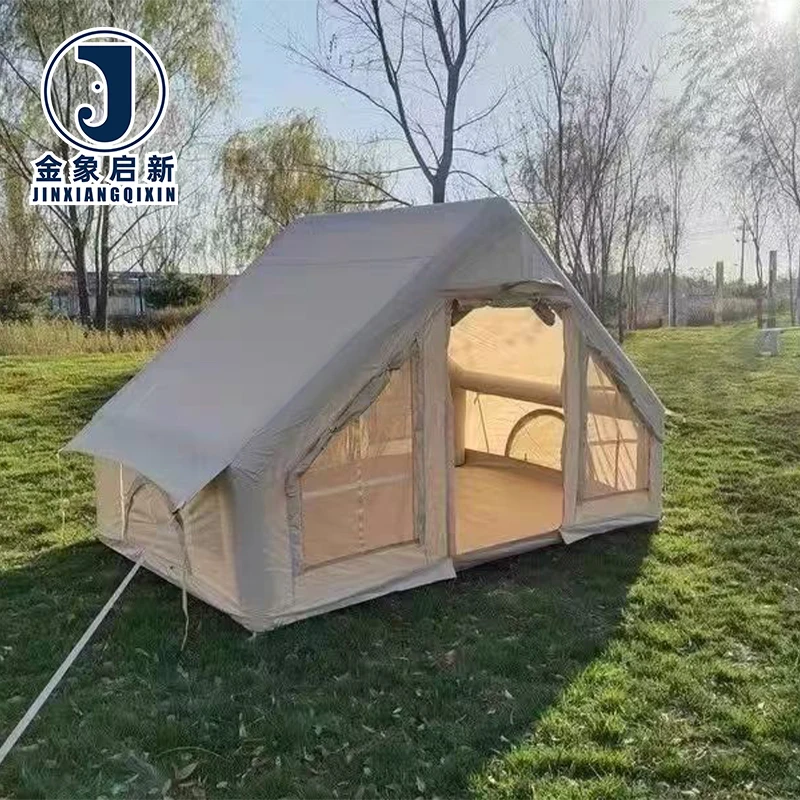
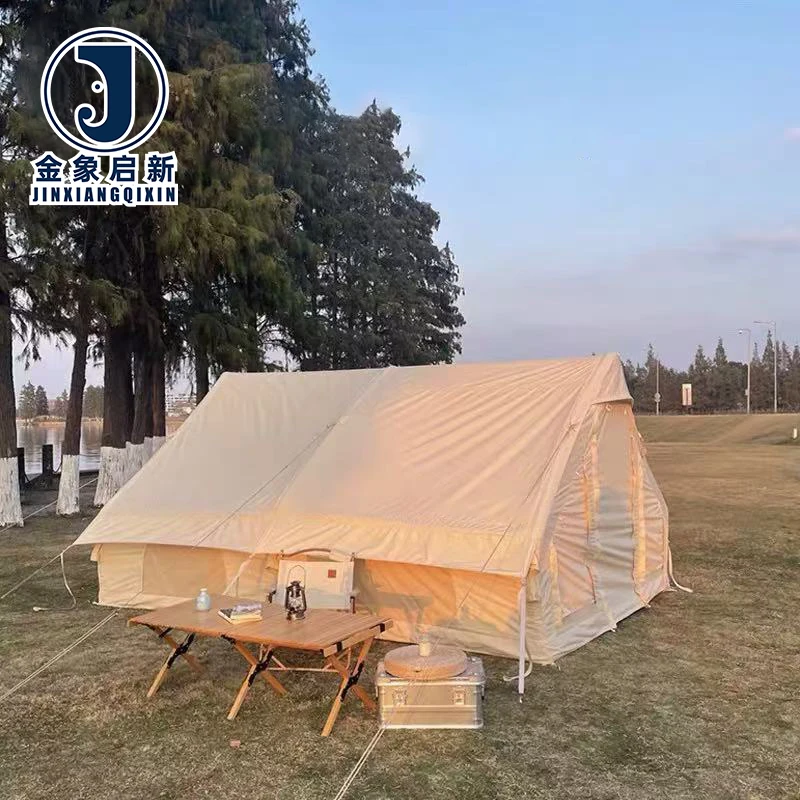
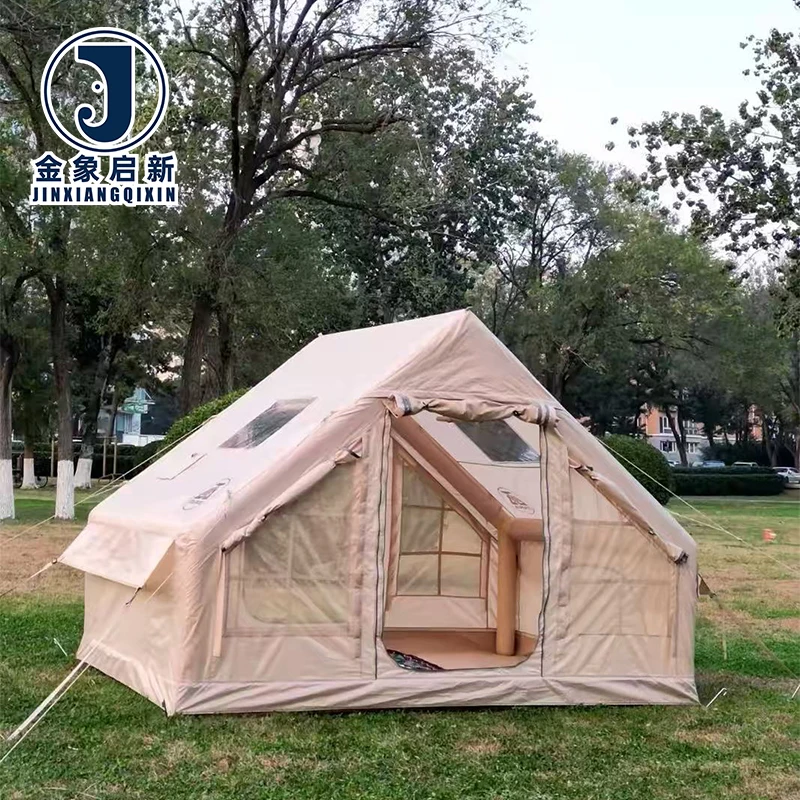
Description
Roll-to-Roll Consistency — coating thickness held within ±0.02mm across every production run, verified before dispatch.
Technical Specifications
| Parameter | Value |
|---|---|
| Product Type | Inflatable Tent Fabric |
| Core Material | PVC Tarpaulin |
| Flame Retardant Grade | DIN 4102 B1 |
| Waterproof Rating | 500mm water column for 24 hours |
| Coating Thickness Tolerance | ±0.02mm |
| Seam Strength | 150N/cm |
| UV Treatment | Anti-UV (service life depends on exposure conditions) |
| Anti-Static | Available — confirm the grade required for your market |
| Size Range | 5㎡ to 100㎡ (customizable) |
| Color | Standard RAL color chart (customizable) |
| Pattern Printing | Available |
| Production Lead Time | 15–30 days depending on order volume |
| Sample Lead Time | 7–10 days |
| Inflation Testing | 48-hour airtightness test before shipment |
| Standards | ISO 9001, ISO 14001, ISO 45001, CE, DIN 4102 B1 |
Application Suitability
| Application | Exposure & Requirement |
|---|---|
| Inflatable emergency shelters for disaster relief | Rapid deployment, repeated inflation cycles, wind load on welded seams, weather exposure |
| Temporary site offices on infrastructure projects | Extended outdoor siting, UV exposure, interior climate control demands |
| Equipment storage shelters in remote construction areas | Puncture and abrasion from stored machinery, moisture ingress prevention |
| Emergency response stations for industrial accident management | Flame retardant compliance, quick assembly under pressure, high visibility |
When the Rolls Arrive and the Colour Does Not Match
Buying inflatable tent fabric by the roll for a multi-unit production run only to find shade variation between consecutive rolls once the panels are laid out on the cutting table. That mismatch becomes visible the moment two panels from different rolls are welded side by side on the same shelter. Batch consistency is not a cosmetic concern — it determines whether a full container load is usable or becomes a write-off. [NEED_CITE: colour tolerance standards for coated textile batches]
Consistent colour starts at the coating line, not at final inspection.
Batch-to-Batch Colour Control Across the Inflatable Tent Fabric Roll Range
Maintaining shade uniformity across an inflatable tent fabric roll order requires control at the pigment dosing stage rather than relying on visual sorting after production. Each batch of PVC compound is mixed to a defined formula tied to the RAL reference specified at order placement, and the coating line parameters remain locked for the full run. This approach prevents the drift that typically shows up when a second production run is scheduled months later to replenish stock.
Coating Weight and Adhesion for Reliable Welded Joints
The structural integrity of an inflatable shelter depends entirely on welded seams holding under internal air pressure and external wind load. Coating adhesion to the base fabric must be uniform so that heat welding produces a bond that matches or exceeds the base material strength. Our seam strength is tested to 150N/cm, which addresses the critical junction where inflatable tubes bend and flex during deployment. The 48-hour inflation test conducted before shipment catches airtightness failures before the material leaves the facility. [NEED_CITE: welded seam performance in PVC inflatable structures]
Understanding What the Specification Sheet Actually Tells You
Flame retardant rated to DIN 4102 B1 means the material has passed a defined ignition and flame spread test relevant to temporary structures used in industrial and disaster relief contexts — this is not a generic claim but a classification tied to a specific European standard. Coating thickness tolerance of ±0.02mm directly affects how the material behaves during high-frequency welding: too much variation and the weld energy either burns through thin spots or fails to fuse thick spots. Waterproof performance rated at 500mm water column for 24 hours indicates sustained resistance to hydrostatic pressure, which matters when inflatable shelters sit on wet ground during extended emergency deployments. The anti-UV treatment extends service life under sun exposure, though actual longevity depends on latitude, installation angle, and seasonal intensity — always request the test basis for your specific market requirements.
What Happens When Material Specs Are Not Verified Before Production
Ordering inflatable tent fabric based on a quotation that states a particular flame retardant grade without receiving the corresponding test report means the shelter may fail site inspection when the safety officer asks for documentation. Coating thickness that varies beyond tolerance leads to inconsistent weld quality across the production floor, forcing fabricators to adjust heat settings roll by roll — a process that introduces human error and increases reject rates. Colour inconsistency discovered after cutting wastes both material and labour, particularly when the order is for branded emergency shelters where visual uniformity is a contract requirement. [NEED_CITE: rework costs from material inconsistency in coated fabric fabrication]
Why Procurement Teams Source This Material Here
Three full production lines with 36 sets of processing equipment support volume orders while maintaining the parameter control needed for consistent inflatable tent fabric roll output. A 10-person R&D team handles custom width, colour matching, and pattern printing development, with samples turned around within days rather than weeks. Every production stage includes dedicated QA/QC checkpoints, and 100% pre-shipment inspection means the roll packing list matches what actually arrives at the destination port. ISO 9001, ISO 14001, and ISO 45001 certifications are maintained across the production system, providing a documented quality framework for buyers who need to demonstrate supply chain compliance. The 9,180 m² facility is configured for coated fabric processing specifically, not repurposed from unrelated textile production.
Documentation & Verification
- Material specification sheet stating base fabric, coating composition, and DIN 4102 B1 classification per roll
- Pre-shipment inspection record covering coating thickness, colour consistency, and seam strength verification
- Roll packing list with individual roll weight and container loading plan for inflatable tent fabric roll shipments
- Flame retardant and waterproof test reports matched to production batch number
- Certificate of origin and customs documentation for international dispatch
Fabrication, Handling & Storage
- Set high-frequency welder energy to match the ±0.02mm coating thickness tolerance for uniform seam fusion
- Allow welded seams to cure fully before deflating test units to preserve the 150N/cm bond strength
- Store rolls upright on pallets to prevent flat spots that cause tracking issues during unrolling and cutting
- Avoid storing PVC tarpaulin rolls below freezing to prevent coating stiffening and crack risk during handling
- Use mild detergent for cleaning — solvents can degrade the anti-UV treatment on the coating surface
- Plan panel cutting layout to minimize offcuts from the custom-width inflatable tent fabric roll stock
What We Need to Quote Your Requirement
Provide the target market so we can confirm which flame retardant and safety standards apply to your inflatable shelter end-use. Specify the roll width and estimated annual volume to determine production scheduling and container loading efficiency. Indicate whether you require standard RAL colours or custom matching with pattern printing, and whether sample approval is needed before full production release.
Frequently Asked Questions
Q: How is roll-to-roll colour consistency maintained across a bulk inflatable tent fabric order?
A: Pigment formulation is locked to the specified RAL reference at the compounding stage, and coating line parameters remain unchanged throughout the production run. Each roll is checked against the master colour standard before packing. For orders placed across multiple production batches, we retain the formulation record to match the original shade.
Q: How should roll width be selected for inflatable tent panel cutting efficiency?
A: Wider rolls reduce the number of welded seams needed for large shelter panels but may generate more offcut waste if the panel geometry is narrow. Share your cutting layout with us during the sample stage so we can recommend a roll width that balances material utilization against weld labour on your production floor.
Q: How is GSM verified when the inflatable tent fabric roll arrives at our facility?
A: Each roll is weighed and measured before dispatch, and the pre-shipment inspection record documents the actual weight per square metre. On arrival, take a sample cut of known dimensions from the roll end and weigh it on a calibrated scale to confirm the value matches the specification sheet provided with the shipment.
Q: What welding parameters work best for airtight inflatable structure seams?
A: High-frequency welding energy must be calibrated to the coating thickness tolerance of ±0.02mm to achieve uniform fusion without burning through the material. Seam strength tested to 150N/cm confirms the weld integrity. We recommend running test welds on a sample piece before starting full production to dial in the exact settings for your equipment.
Q: How are rolls packed and protected for international container shipment?
A: Each roll is wrapped in protective film to prevent surface abrasion during transit and loaded according to a container plan that accounts for roll count and weight distribution. The roll packing list details the loading sequence so that rolls can be unloaded efficiently at the destination without unnecessary handling that could damage the coating surface.