



Description
Verified Roll Consistency — every container of PVC inflatable tent fabric ships with batch-controlled GSM and colour uniformity, supported by dedicated QA at each production stage.
Technical Specifications
| Parameter | Value |
|---|---|
| Product Type | PVC Inflatable Tent |
| Core Material | PVC knife-coated fabric |
| Product Form | Inflatable structure, single layer construction |
| Key Features | Waterproof, tear-resistant, UV-resistant (test basis not stated), fire-retardant (grade not stated), anti-static (surface resistance not stated) |
| Customization | OEM & ODM — sample customization, pattern printing, size adjustments, color options |
| Certifications | ISO 9001, ISO 14001, ISO 45001, CE |
Application Suitability
| Application | Exposure & Requirement |
|---|---|
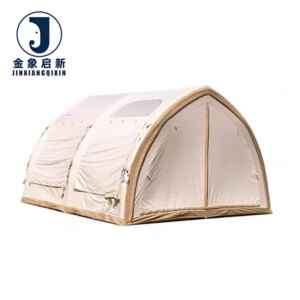
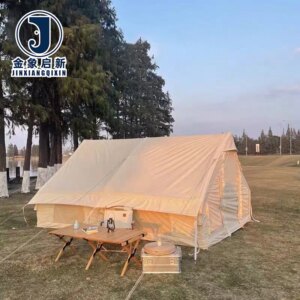
| Inflatable glamping tent manufacturing | Repeated inflation cycles, outdoor weather exposure, guest-facing surface quality |
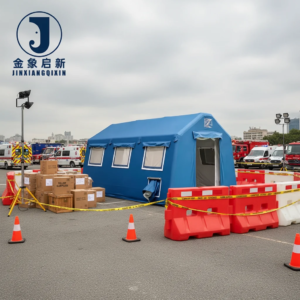
| Disaster relief rapid deployment shelters | Harsh environment deployment, urgent setup timelines, fire safety compliance in camps |
| Temporary construction site storage | Abrasion from ground contact, dust and water ingress, wind loading on membrane |
| Emergency command centers | Extended occupancy, climate exposure, electrical safety near communication equipment |
| Equipment storage and material processing areas | Mechanical wear from load handling, chemical splash resistance, structural membrane tension |
Why Batch Colour Drift Ruins an Entire Container of Inflatable Tent Fabric
Visible shade variation between rolls forces manufacturers to reject full production runs after cutting has already begun.
When sourcing PVC inflatable tent roll stock in bulk, buyers frequently receive containers where rolls from different dye lots sit side by side on the warehouse floor. The colour difference may be invisible on a single sample swatch but becomes glaring once two adjacent panels are welded together on the factory table [NEED_CITE: colour consistency standards for coated textile batches]. For inflatable tent manufacturers running continuous production, this means wasted material, delayed shipments, and disputes with downstream clients who expect uniform appearance across an entire event or relief camp installation.
Roll-to-Roll Uniformity Controls for Wholesale Buyers
Consistency across a bulk PVC inflatable tent order starts with raw material batching and carries through every coating pass. Our process locks dye lot and base fabric source to a single production run, so every roll within a container shares the same coating weight, colour reference, and surface finish. Wholesale buyers and tarpaulin distributors stocking PVC inflatable tent material for regional resale can pull from inventory knowing each roll will behave identically on the cutting table and under the heat welder.
Container-Load Availability and Dispatch Planning
Three full production lines and 36 sets of professional processing equipment allow us to schedule dedicated runs for large-volume PVC inflatable tent fabric orders. This capacity means buyers procuring by the container load receive material from a single production window rather than accumulated stock from multiple shifts. For distributors managing regional inventory and inflatable manufacturers planning seasonal production peaks, this translates into predictable material flow and simplified incoming quality checks [NEED_CITE: production scheduling practices for coated fabric bulk orders].
Reading the Specification Sheet Beyond GSM
Knife-coated PVC fabric relies on the interplay between base fabric denier, weave density, and coating weight to deliver tensile and tear performance. A heavier coating alone does not guarantee a stronger material if the base fabric uses a loose weave with low yarn count — the coating fills gaps but cannot compensate for weak yarns under tension. For inflatable tent structures that must hold internal air pressure and resist wind-induced membrane stress, specifying base fabric construction alongside GSM provides a far more reliable predictor of field performance. Surface finish selection also matters: glossy surfaces shed dirt and allow heat-welded seams to form cleanly, while matte finishes reduce glare in glamping environments. Fire-retardant grades are available in multiple classifications — confirm the specific grade required for your destination market before placing an order, as regulatory frameworks vary significantly between regions [NEED_CITE: fire classification standards for temporary membrane structures].
The Hidden Cost of Specifying Inflatable Tent Fabric on Price Per Roll Alone
Rolls that arrive lighter than the quoted GSM shift the cost burden downstream — manufacturers discover thinner material only after cutting, welding, and inflating reveal weak seams and premature surface cracking. Inflatable tents built from underweight fabric fail at stress concentration points where air beams meet the ground sheet, requiring warranty replacements that erase any initial savings. Batch-to-batch GSM drift also means welding parameters calibrated on one roll burn through the next, creating scrap and production delays [NEED_CITE: weld failure modes in PVC coated fabrics under cyclic inflation loads]. Anti-static and fire-retardant treatments claimed without supporting test reports leave buyers exposed when site inspectors or customs authorities demand documentation.
Why Procurement Teams Source PVC Inflatable Tent Fabric Here
Dedicated QA and QC checkpoints at every production stage ensure 100% inspection before any roll leaves the facility, with pre-shipment records specific to each batch. Our 10-person R&D team handles material selection, custom colour matching, and pattern printing development, delivering samples within days for buyer approval before bulk runs commence. Three full production lines running in parallel provide the throughput needed for container-load PVC inflatable tent fabric orders without sacrificing coating consistency. Deep process control over coating weight and adhesion — built through nearly 30 years focused on coated fabric — means the material you sample is the material you receive in production. Full documentation accompanies every shipment, from material specification sheets to test reports where applicable, so compliance audits and incoming inspections proceed without delay.
Documentation & Verification
- Material specification sheet stating GSM, base fabric denier, coating method, and colour reference per roll batch
- Pre-shipment inspection record with 100% roll-by-roll verification before container loading
- Roll packing list detailing container load plan by roll count and net weight for logistics planning
- Test reports for fire-retardant and anti-static properties provided with applicable grades
- Certificate of origin and customs documentation supporting international trade compliance
Fabrication, Handling & Storage
- Heat welding parameters must be calibrated to the specific PVC knife-coated fabric thickness and surface finish before production runs
- Store rolls upright on pallets in climate-controlled conditions to prevent creasing and coating adhesion loss
- Unroll and allow material to relax at ambient temperature before cutting to release tension from storage winding
- Use compatible PVC adhesive for field repairs, matching coating chemistry to maintain bond integrity on inflatable structures
- Plan cutting layouts to minimize off-cuts, accounting for seam allowance at air beam junctions and ground sheet edges
What We Need to Quote Your PVC Inflatable Tent Fabric Order
Share your target roll width, annual volume requirement, and whether you need stock grades or custom colour runs. Let us know the fire-retardant or anti-static classification your destination market requires so we can align test documentation before production. If pattern printing or OEM branding is part of your specification, provide artwork files and colour references for sample development and approval.
Frequently Asked Questions
Q: How do I verify the GSM of PVC inflatable tent roll stock when it arrives at my factory?
A: We provide a material specification sheet stating the exact GSM, base fabric construction, and coating method for every batch. Upon arrival, you can conduct a standardized weight-per-area test using a calibrated scale and sample cutter. Our pre-shipment inspection records document 100% roll-by-roll verification, giving you a baseline to compare against your incoming check results.
Q: How is colour consistency controlled across multiple rolls in a single bulk order?
A: All rolls within one order are produced from a single dye lot and coating batch, processed consecutively on the same production line. Our QA team checks colour reference values at multiple points during the run. The pre-shipment inspection record confirms batch uniformity, and rolls are packed sequentially so you can trace each one back to its production window.
Q: What roll widths and lengths are available for inflatable tent manufacturing efficiency?
A: We supply PVC inflatable tent fabric in custom widths and lengths aligned with your cutting table dimensions and panel layout. Wider rolls reduce the number of welded seams in large membrane panels, improving both production speed and structural integrity. Share your tent design dimensions and we will recommend the optimal roll format to minimize waste.
Q: How are rolls packed for container shipping to prevent transit damage?
A: Each roll is wrapped in protective film and packed vertically on pallets to prevent crushing and surface marking during transit. The roll packing list details the loading plan by roll count and weight distribution within the container. This method protects the PVC knife-coated surface from abrasion and ensures rolls arrive in production-ready condition.
Q: What fire-retardant documentation is provided with each shipment?
A: Where fire-retardant treatment is specified, we supply test reports confirming the grade achieved. However, fire safety regulations for inflatable and temporary membrane structures vary by country and application. Provide your destination market and intended use so we can confirm the correct grade and ensure documentation aligns with local compliance requirements before production begins.