
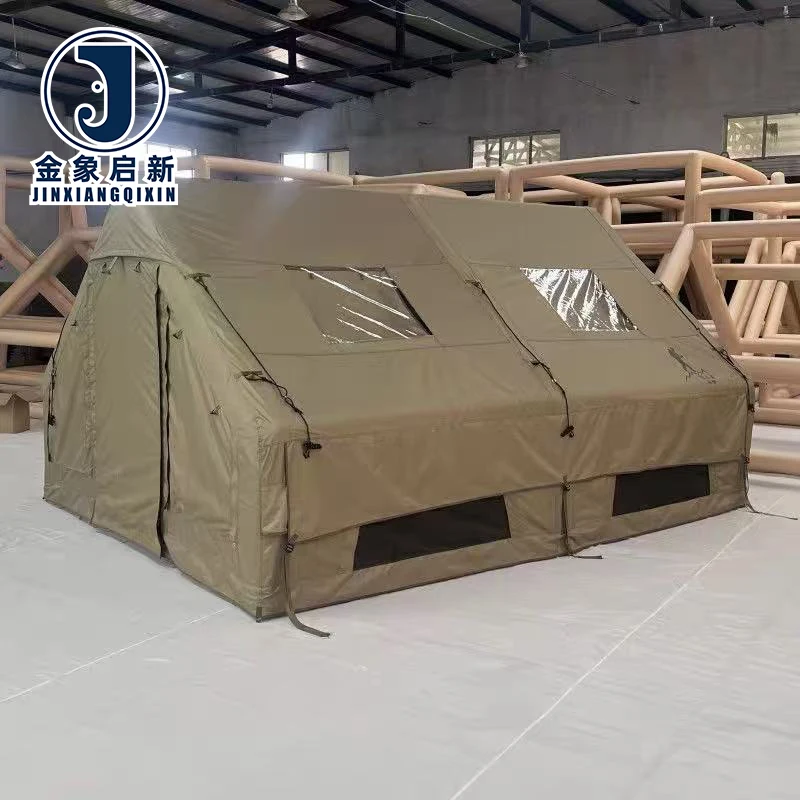
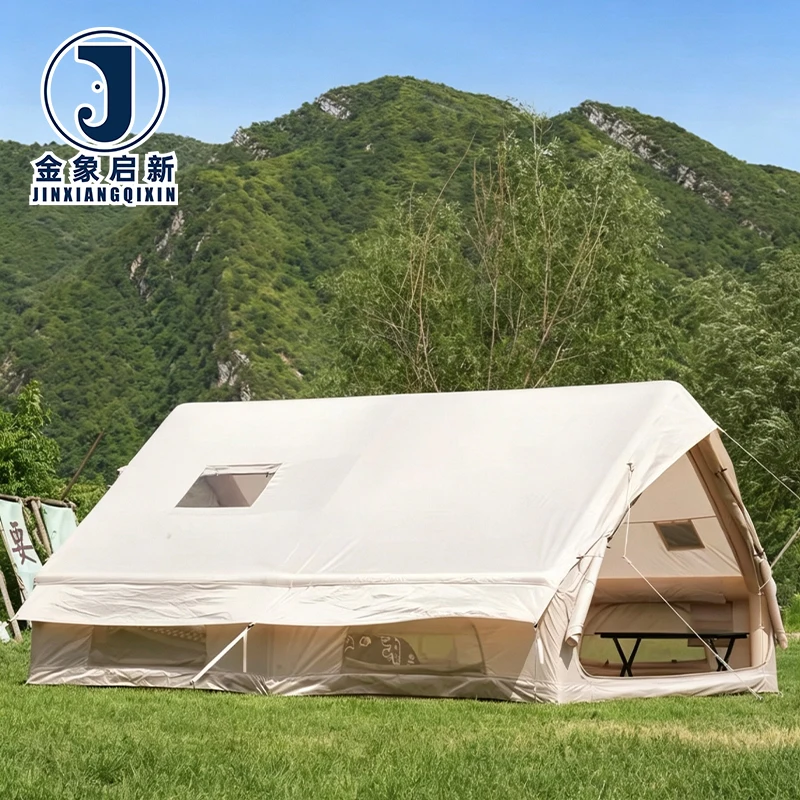
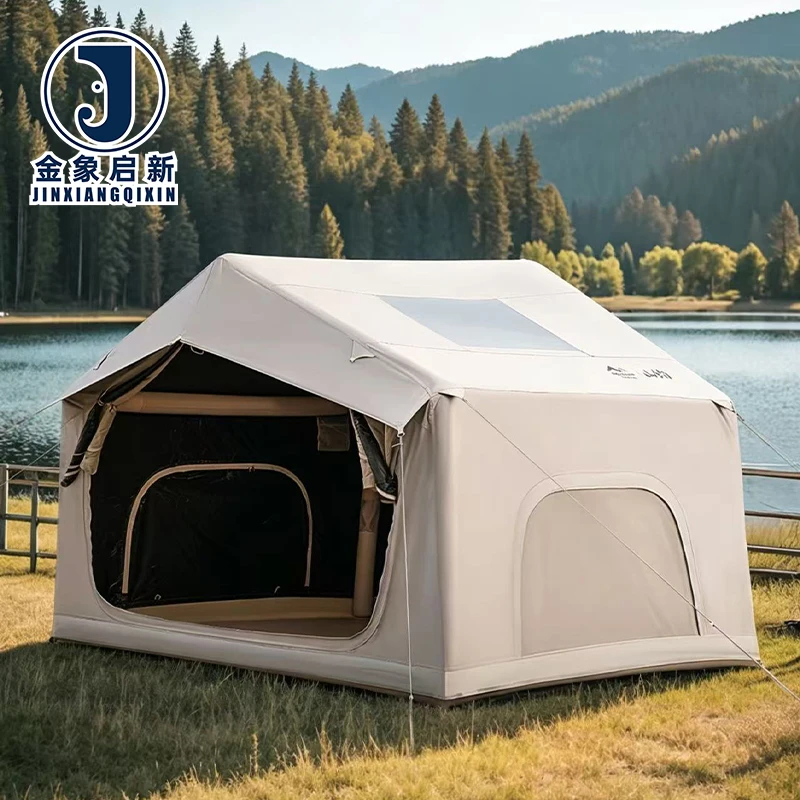
Description
Roll-to-Roll Consistency — Batch-specific colour reference and thickness tolerance of ±0.02mm verified before dispatch, ensuring uniform appearance and performance across container-load volumes of inflatable tent fabric.
Technical Specifications
| Parameter | Value |
|---|---|
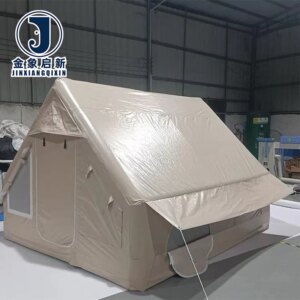
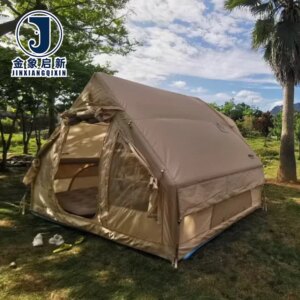
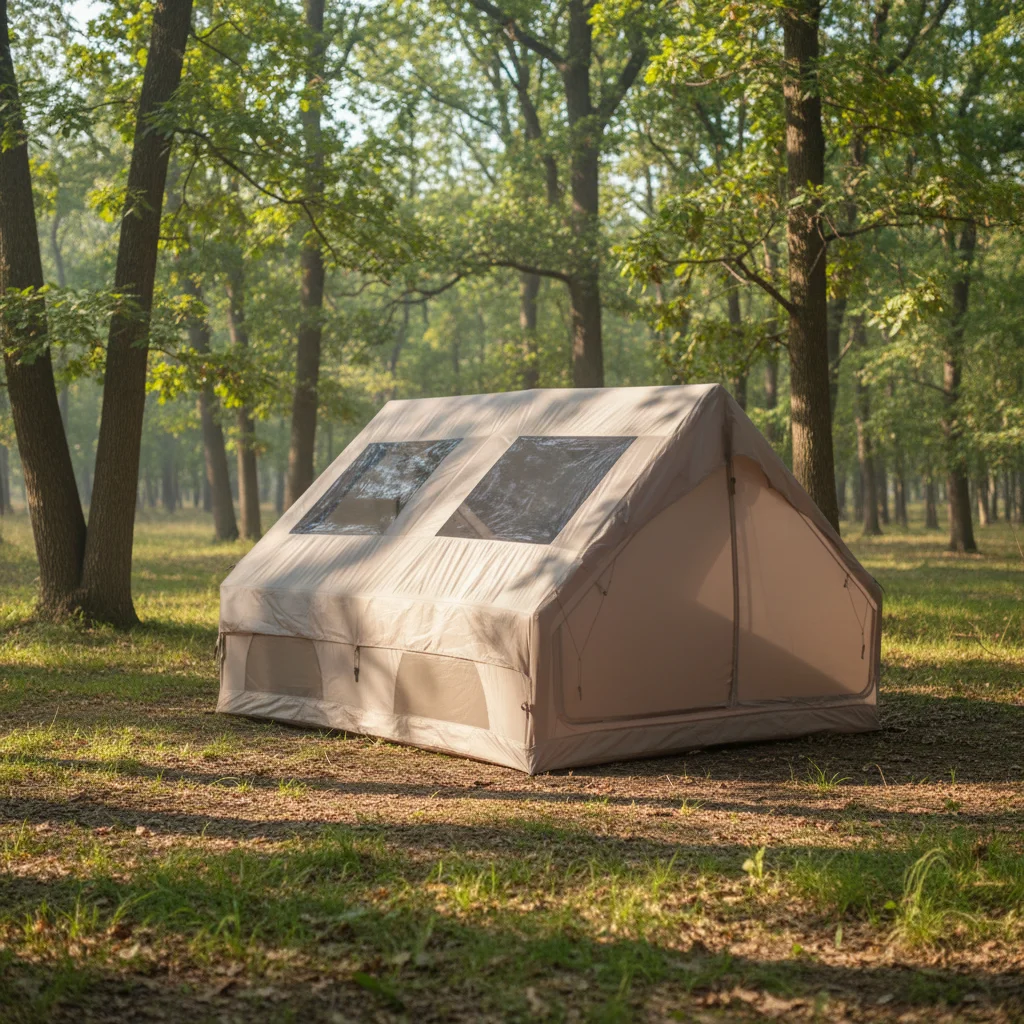
| Product Type | Inflatable Tent |
| Core Material | PVC tarpaulin |
| Waterproof Rating | 3000mm water column |
| Season Suitability | 4-season |
| Deployment Mechanism | Quick automatic opening |
| Setup Time | 2-minute (source value — verify against manufacturer catalog) |
| Deployment Cycles Tested | 500+ (source value — verify against manufacturer catalog) |
| Capacity | 2-8 person |
| Structure Type | Inflatable structure, extended type |
| Tear Resistance | ≥300N (test standard not stated) |
| Flame Retardancy | EN 13501-1 |
| Coating Thickness Tolerance | ±0.02mm |
| UV Resistance | Minimal degradation after 12+ months outdoor exposure (source value — verify against manufacturer catalog) |
| Seam Strength | 250N (test standard not stated) |
| Production Facility Area | 9180 square meters |
| Production Lines | 3 |
| Processing Equipment | 36 sets |
| R&D Team | 10 technicians |
| Standards | ISO 9001, ISO 14001, ISO 45001, CE, EN 13501-1 |
Application Suitability
| Application | Exposure & Requirement |
|---|---|
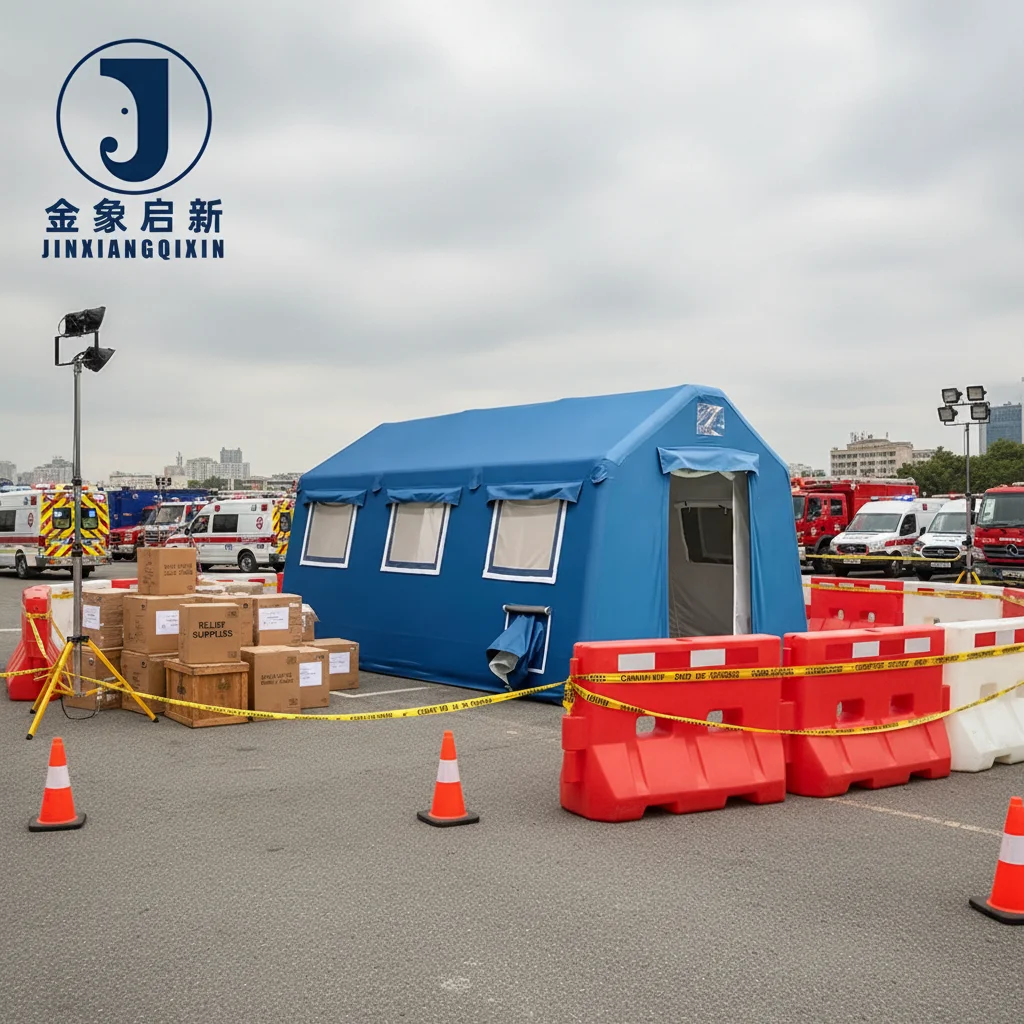
| Disaster relief temporary shelter | Rapid deployment under extreme weather, waterproof integrity, batch colour consistency across clustered units |
| Field command centers | Extended outdoor occupation, UV and temperature cycling, reliable structural inflation retention |
| Emergency equipment storage in disaster zones | Constant moisture exposure, ground abrasion, flame retardant compliance for populated areas |
| Material distribution hubs in crisis areas | High foot traffic, repeated inflation and deflation cycles, 4-season thermal performance |
| Industrial logistics coordination in exposed locations | Wind loading on inflated structures, tear propagation resistance at seam junctions |
Why Batch Colour Varies Across Inflatable Tent Orders — And How to Prevent It
Colour drift between rolls is a coating process control issue, not a supplier willingness issue.
When procurement teams order inflatable tent fabric in bulk for disaster relief staging, they often assume that a Pantone or RAL reference on the purchase order guarantees visual consistency across the entire shipment. The reality is that PVC coating colour shifts with mixing temperature, pigment dispersion time, and the interval between batches run on different days. A disaster site with twenty tents deployed side by side will show every shade variation immediately, undermining the professional appearance that government and NGO programs require. Controlling this at the coating stage — not at final inspection — is the only effective intervention point [NEED_CITE: coating batch consistency protocols for PVC tarpaulin].
How Wholesale Inflatable Tent Procurement Demands Tighter Process Control
Buying inflatable tent roll stock in bulk means your risk exposure multiplies with every container. A single defective roll buried in a pallet of forty may not surface until the fabricator has already cut and welded multiple units, turning a material replacement into a finished-goods loss. The inflatable tent aftermarket supplier must demonstrate process control through in-line thickness monitoring, coating weight verification at defined intervals, and seam strength testing that mirrors the stresses the finished structure will encounter during inflation and wind loading.
The Relationship Between Roll Inventory Strategy and Deployment Readiness
Emergency procurement programs cannot wait for custom production runs when disaster strikes. Maintaining container-ready stock of inflatable tent fabric requires forecasting demand across climate zones and structure sizes, which means the supplier must understand how PVC formulation changes between a 4-season compound and a tropical-grade variant affect shelf life, weld compatibility, and inflation pressure retention. Distributors building inventory need assurance that rolls stored for extended periods will retain coating adhesion and flexibility without blocking or surface tackiness [NEED_CITE: PVC tarpaulin shelf storage and coating adhesion retention].
Reading the Specification Sheet Beyond the Headline Numbers
A waterproof rating of 3000mm water column confirms that the coated fabric will resist hydrostatic penetration under sustained rainfall and ground contact, but this number alone does not predict how the material behaves at welded seams where the coating is thermally disrupted. Tear resistance at ≥300N indicates the force required to propagate an existing cut, yet the base fabric denier and weave density determine whether a puncture from sharp ground debris stays localised or runs across the panel. The seam strength of 250N must be evaluated against the internal inflation pressure and the wind uplift forces the deployed structure will face — a joint that fails before the fabric itself is a design and process failure, not a material failure. Coating thickness tolerance of ±0.02mm across the roll width ensures that heat sealing parameters remain consistent from the first panel to the last, reducing the reject rate during fabrication [NEED_CITE: tensile and tear test methods for coated fabrics per ISO 1421].
The Hidden Cost of Accepting Generic Material Specifications
Procurement officers who accept a supplier’s standard specification without verifying batch-specific test records expose their programs to failures that appear only in the field. A flame retardant grade listed on the quotation but unsupported by a test certificate from the specific production batch means the tent may not pass site safety audits at the disaster staging area. Coating weight that falls below the quoted GSM on arrival — detectable only through incoming inspection — translates directly to reduced abrasion resistance at ground contact points and faster UV degradation on the outer surface. Weld failures at inflation chambers that develop during deployment exercises rather than during pre-shipment testing indicate that the supplier’s seam parameters were calibrated for a different material grade entirely [NEED_CITE: EN 13501-1 fire classification for construction and temporary shelter materials].
Why Sourcing Inflatable Tent Fabric Here Reduces Verification Burden
Three full production lines operating under a single quality management system mean that your inflatable tent roll stock comes from a facility where coating formulation, base fabric sourcing, and finishing parameters are controlled end-to-end rather than assembled from subcontracted stages. The 10-person R&D team develops sample panels with your specified colour, thickness, and flame retardant grade before bulk production begins, eliminating the guesswork of committing container volumes to an unverified material. Full-process quality inspection covers 7 critical manufacturing stages, with 24-hour pressure retention testing performed on finished inflatable structures before shipment to confirm seam integrity and coating adhesion under sustained load. Dedicated QA and QC staff inspect every roll against the batch-specific material specification sheet, so the documentation you receive reflects the actual material shipped, not a generic template. Custom sizing, pattern printing, and OEM configuration are handled within the same facility, keeping lead times predictable and eliminating the communication gaps that arise when cutting, printing, and packing happen at separate locations.
Documentation & Verification
- Material specification sheet stating PVC formulation, colour reference, and coating thickness per roll batch
- Pre-shipment inspection record with waterproof performance, seam strength, and thickness data for each lot
- EN 13501-1 flame retardant test report matched to the production batch number
- Roll packing list detailing container loading by unit count, weight, and roll position
- Certificate of origin and customs documentation supporting international emergency procurement programs
Fabrication, Handling & Storage
- Heat sealing parameters must account for the ±0.02mm coating thickness tolerance to maintain consistent weld penetration across all panels.
- Inflation chamber seams require double-weld construction given the 250N seam strength rating and cyclic pressure loading during deployment.
- Store rolls upright on pallets in climate-controlled space to prevent PVC coating blocking and permanent crease marks on the inflatable tent fabric.
- Low-temperature transport requires gradual warming before unrolling to prevent coating micro-cracking on 4-season PVC formulations.
- Field repair of punctures should use compatible PVC adhesive patches tested against the specific coating formulation to ensure bonding integrity.
Requesting a Quotation That Matches Your Program Requirements
Provide the intended deployment climate zone, expected wind loading conditions, and the flame retardant classification required by your target market’s regulatory framework. Specify the roll widths and lengths that align with your fabrication equipment, along with annual volume estimates so that batch scheduling can be planned around your deployment calendar. Indicate whether you require finished inflatable tent structures with OEM branding or raw roll stock for your own production line.
Frequently Asked Questions
Q: How is batch-to-batch colour consistency controlled across large inflatable tent orders?
A: Each production batch is matched against a master colour reference under controlled lighting before coating begins. In-line monitoring tracks pigment dispersion and coating thickness throughout the run, and a physical sample from each batch is retained for comparison against the material specification sheet shipped with your order.
Q: What documentation accompanies each shipment for customs and compliance verification?
A: Every dispatch includes a batch-specific material specification sheet, pre-shipment inspection record with waterproof and seam strength data, EN 13501-1 test certificate, roll packing list with container loading details, certificate of origin, and any additional customs documentation required for the destination country.
Q: What are the minimum order quantities and lead times for custom-sized inflatable tents?
A: Minimum quantities depend on the specific colour, width, and flame retardant grade requested. Custom sample development is completed within days for approval before bulk production is scheduled, and typical multi-week lead times apply for non-stock configurations across the three production lines.
Q: How are roll packing and container loading optimized to prevent transit damage?
A: Rolls are packed upright on pallets with protective end caps and separated by interleaving material to prevent coating contact. Container loading plans account for roll diameter and weight distribution to eliminate shifting during transit, with the packing list documenting each roll’s position for traceability.
Q: What sample development process is available before committing to bulk orders?
A: The R&D team produces sample panels in your specified colour, coating thickness, and flame retardant grade for weld testing and visual approval. These samples use production-grade materials from the same supply chain, so approval results translate directly to bulk manufacturing performance.