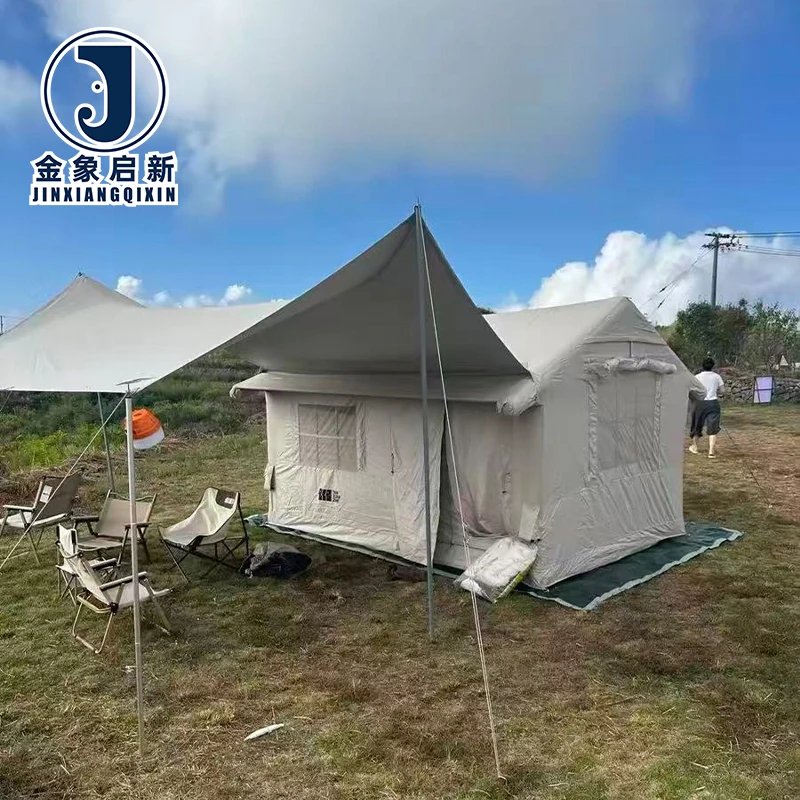
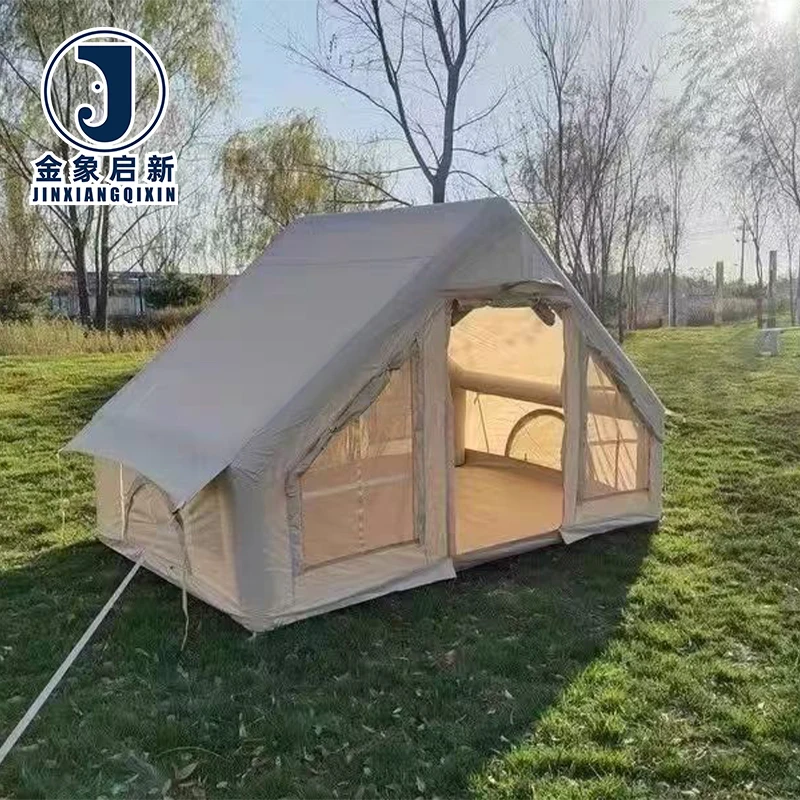
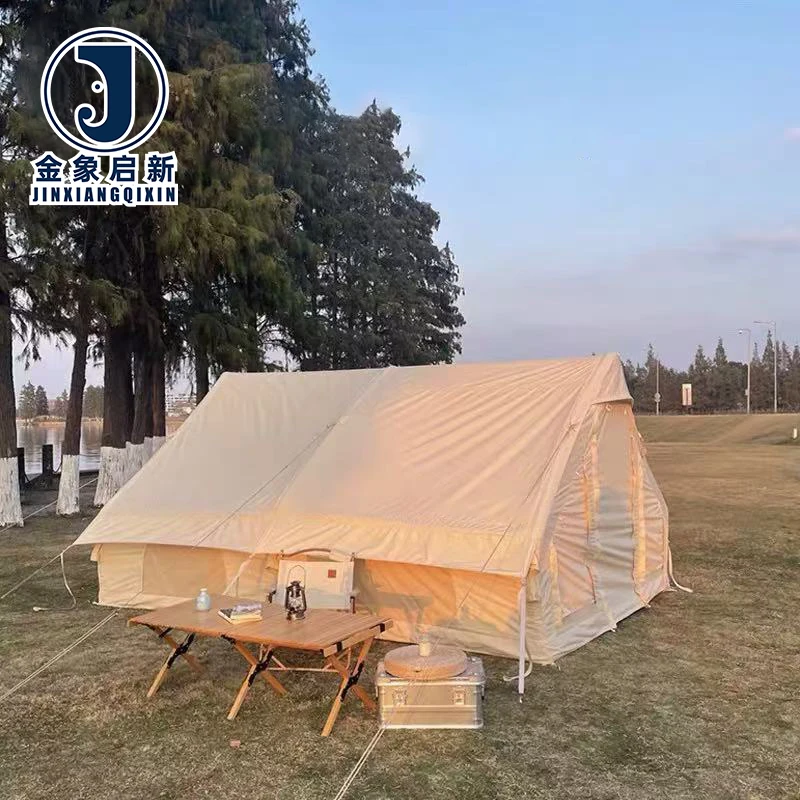
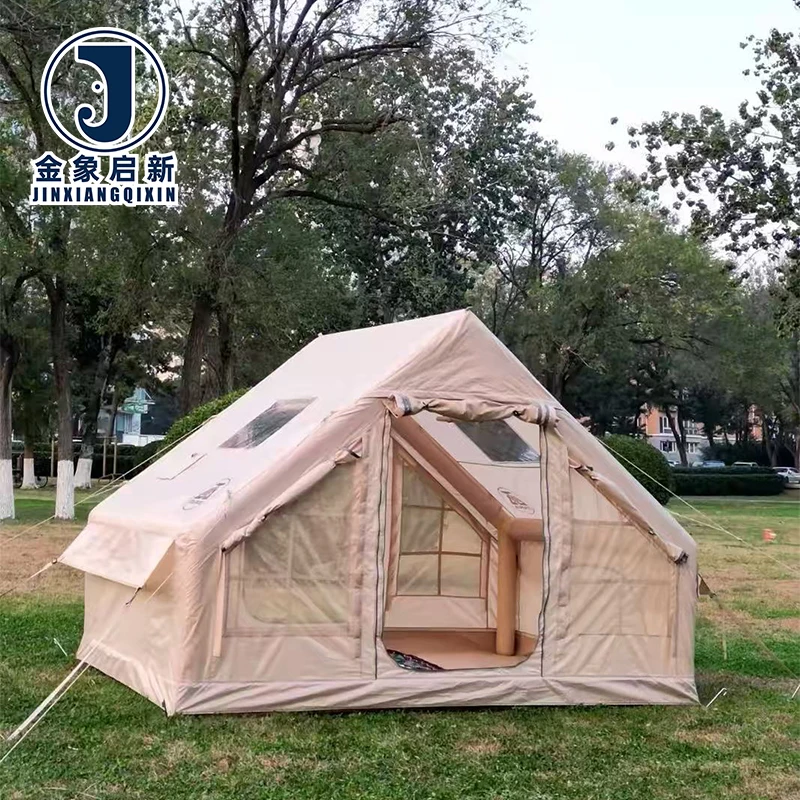
Description
Roll-Stock Consistency — Three dedicated production lines maintain coating thickness within ±0.02mm across every roll of PVC inflatable tent fabric, ensuring uniform air-holding performance when manufacturers cut and weld multiple rolls into finished shelters.
Technical Specifications
| Parameter | Value |
|---|---|
| Product Type | Inflatable Tent |
| Core Material | PVC Tarpaulin |
| Waterproof Rating | 500mm water column for 24 hours |
| Flame Retardant Grade | DIN 4102 B1 |
| Anti-Static | Yes (surface resistance value — verify against test report) |
| Coating Thickness Tolerance | ±0.02mm |
| Seam Strength | 150N/cm |
| UV Treatment | Anti-UV (test basis not stated in source) |
| Custom Size Range | 5㎡ to 100㎡ |
| Colour Customisation | RAL colour chart |
| Pattern Printing | Available (OEM/ODM) |
| Pre-shipment Test | 48-hour inflation airtightness verification |
| Raw Material Standard | GB/T 12582-2008 (PVC resin) |
| Standards & Certifications | ISO 9001, ISO 14001, ISO 45001, CE |
Application Suitability
| Application | Exposure & Requirement |
|---|---|
| Disaster relief rapid deployment shelters | Continuous outdoor UV exposure, wind loading, rapid inflation cycles, fire safety compliance in camp settings |
| Temporary site offices for infrastructure projects | Abrasion from daily foot traffic, dust ingress, temperature fluctuation, extended standing duration |
| Equipment storage shelters in remote construction areas | Prolonged weathering, precipitation, ground moisture, mechanical contact with stored machinery |
| Emergency response stations for industrial accident management | Chemical splash resistance, rapid deployment, certified flame retardancy, anti-static environment for sensitive instruments |
Why Batch Colour Drift Matters When Sourcing Wholesale Inflatable Shelter Fabric
Shade variation across rolls in a single order becomes a visible defect the moment tents are deployed side by side at a relief camp or project site.
Purchasing managers specifying PVC inflatable tent roll for large-scale shelter contracts often discover too late that the colour tone shifts between production batches. When fifty tents are erected in a grid layout, even minor hue differences stand out against one another, prompting client complaints and rework costs that exceed the original material savings. This issue traces directly to inconsistent pigment dosing during the coating stage, where inadequate process control allows colour concentration to drift across the production run [NEED_CITE: coating consistency challenges in PVC tarpaulin manufacturing].
Manufacturers who buy inflatable tent fabric by the roll need assurance that every roll in a container load shares the same colour reference, not just the same GSM. Without batch-level colour verification at the coating head, the finished shelters will show visible banding once installed in the field.
Controlling Shade Uniformity Across Roll Orders
Roll-to-roll colour consistency starts at the pigment mixing station and must be verified at multiple points before the coated fabric leaves the production line. For wholesale inflatable shelter fabric buyers ordering container quantities, this means requesting a colour measurement report tied to the batch number printed on each roll label.
Our QA protocol checks colour reference against the agreed RAL standard at the coating stage, after curing, and again before roll packing. This three-point verification prevents shade drift from reaching the cutting table, where fabricators would otherwise discover inconsistencies only after welding panels together.
Coating Thickness and Air-Holding Reliability
Inflatable tent structures depend on consistent air retention across every welded seam and panel. Coating thickness variation directly affects how well the fabric holds pressure during sustained inflation, particularly at seam junctions where the material experiences concentrated stress during the 48-hour airtightness test.
Maintaining coating thickness within ±0.02mm across the full roll width means that fabricators can set their heat welding parameters once and achieve uniform seam strength throughout the production run. When thickness varies, welders must adjust temperature and dwell time for each panel, increasing the risk of under-welded seams that leak or over-welded zones that become brittle [NEED_CITE: heat welding parameters for PVC coated fabrics].
Understanding What the Specification Sheet Actually Tells You
The relationship between base fabric construction and coating weight determines how the PVC inflatable tent roll performs under inflation pressure. A heavier coating does not automatically mean higher tear resistance — the base fabric denier and weave density carry the structural load, while the coating provides airtightness and environmental protection.
Flame retardant certification to DIN 4102 B1 indicates the material has passed a defined burn behaviour test relevant to European construction and temporary structure codes, but buyers in other markets must confirm whether DIN 4102 B1 maps to their local fire safety requirements before specifying it on purchase orders. The waterproof rating of 500mm water column for 24 hours describes sustained hydrostatic resistance, which differs from splash resistance or short-duration rain exposure ratings [NEED_CITE: hydrostatic head testing standards for coated fabrics].
Seam strength at 150N/cm reflects the bonded joint’s resistance to peeling forces, which is the failure mode most relevant to inflatable structures where internal pressure pushes panels apart at the weld line.
The Cost of Specifying Inflatable Tent Fabric Without Verified Data
When a quotation states a flame retardant grade without an accompanying test report, the buyer assumes compliance that may not exist. Relief shelters erected at a disaster site or construction camp can fail fire safety inspection if the material does not carry the certified grade required by local authorities, forcing replacement at significant logistical cost.
Coating thickness that falls outside the stated tolerance range creates unpredictable welding behaviour on the fabrication floor. Panels from one roll may weld cleanly at standard settings while adjacent rolls produce weak seams that fail during the pre-shipment inflation test, causing production delays and material waste [NEED_CITE: seam failure modes in inflatable PVC structures].
Colour inconsistency discovered after fabrication means the manufacturer must either accept a visually mismatched batch of tents or scrap the finished product entirely — an outcome that erodes margins far more than investing in verified roll-stock from the outset.
What This Supply Arrangement Delivers for Roll Buyers
Dedicated QA at every coating and finishing stage catches thickness deviation and colour drift before rolls are packed, rather than relying on end-of-line sampling that misses mid-run variation.
Three full production lines enable container-volume orders to be fulfilled within a single production window, reducing the number of separate batches that introduce colour and thickness variables into the shipment.
A 10-person R&D team handles custom colour matching to RAL references and pattern printing for project branding, developing samples within days so fabricators can approve material before committing to bulk production.
Full documentation accompanies each roll — specification sheet, test reports for flame retardant and UV treatment, batch-numbered packing list — providing the traceability that procurement teams need for audit and compliance records.
Documentation & Verification
- Material specification sheet confirming GSM, base fabric construction, and coating type per roll batch
- DIN 4102 B1 flame retardant test report included with each shipment for compliance-sensitive projects
- Roll packing list with batch number enabling colour consistency traceability across the order
- Pre-shipment inspection record documenting coating thickness tolerance and seam strength results
- Certificate of origin and customs documentation for international roll-stock shipments
Fabrication, Handling & Storage
- Heat welding parameters should be validated against the ±0.02mm coating thickness tolerance before production begins
- Store PVC inflatable tent rolls vertically on pallets to prevent permanent creasing at the core
- Allow rolls to acclimatise to workshop temperature before unrolling to avoid surface cracking in cold conditions
- Use compatible PVC adhesive for field repairs on seams and puncture points
- Plan cutting layout to minimise offcuts and maximise roll utilisation across panel sizes
Requesting a Quotation for Inflatable Tent Fabric Rolls
To receive an accurate specification recommendation, provide your target shelter size range, annual roll consumption volume, and the flame retardant or fire safety grade required in your destination market. If your fabrication process requires a specific roll width or colour matched to a RAL reference, include these details along with whether you need plain stock or printed branding on the outer surface.
Frequently Asked Questions
Q: How is GSM verified on arrival and what tolerance should buyers expect per roll?
A: Each roll ships with a batch-specific weight verification recorded during production. Buyers can conduct their own GSM check by cutting a measured sample from the roll end and weighing it on a calibrated scale. We recommend specifying the acceptable tolerance range in your purchase contract and requesting the pre-shipment inspection record that documents the measured values before dispatch.
Q: What flame retardant grade is available and how does DIN 4102 B1 map to local fire codes?
A: The fabric carries flame retardant certification to DIN 4102 B1, which is widely recognised across European and Middle Eastern construction and temporary structure regulations. Buyers in markets governed by NFPA, BS, or national standards should confirm equivalence with their local authority before specifying. Test reports are supplied with each shipment to support compliance submissions.
Q: How do you control batch-to-batch colour consistency across large roll orders?
A: Colour is verified at three stages — pigment mixing, post-coating, and pre-packing — against the agreed RAL reference. Each roll carries a batch number linked to the colour measurement record. For container-volume orders, we recommend requesting the colour consistency report to confirm all rolls in the shipment fall within the agreed shade tolerance before fabrication begins.
Q: What custom widths, roll lengths and minimum order quantities apply to inflatable tent fabric?
A: Standard widths and roll lengths are available from stock, with custom dimensions produced to order based on your cutting table requirements and container loading plan. Minimum order quantities depend on whether the order uses a standard colour from the RAL chart or requires a custom pigment mix. Confirm your required width and estimated annual volume so we can advise the applicable terms.
Q: What roll packing and container loading options are available for bulk shipment?
A: Rolls are packed on pallets with protective wrapping to prevent transit damage and surface marking. Container loading plans are calculated based on roll diameter and length to maximise the number of linear metres per container. A detailed packing list with batch numbers is provided before dispatch so buyers can verify the shipment against the purchase order on arrival.