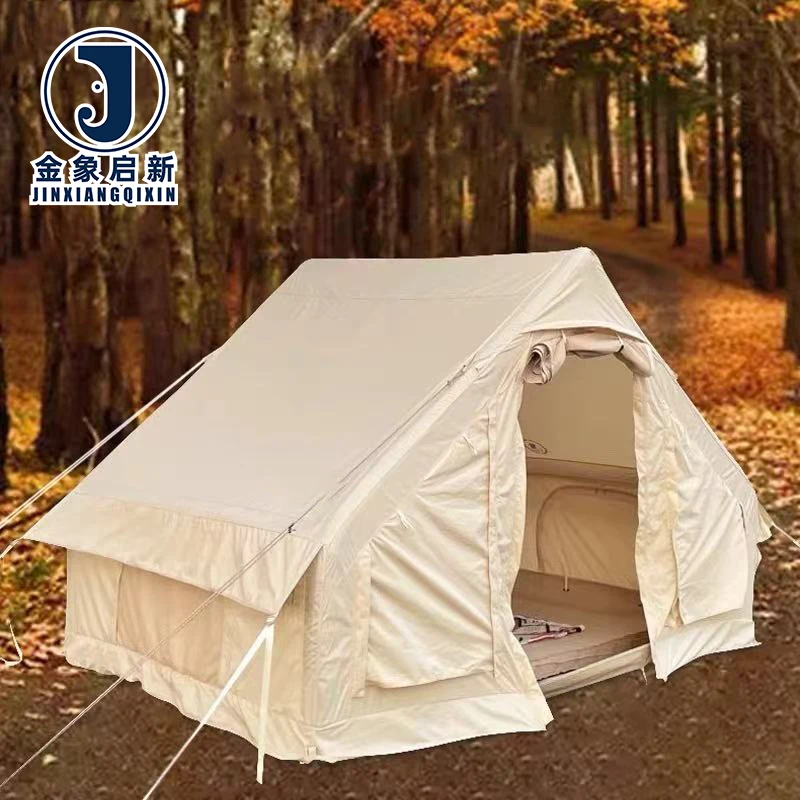
Description
Batch-Matched Output — every roll of inflatable tent fabric verified against quoted GSM and Pantone reference before dispatch, eliminating shade variation across your production run.
Technical Specifications
| Parameter | Value |
|---|---|
| Product Type | Inflatable Tent |
| Core Material | UV Water-resistant PVC Fabric |
| Hydrostatic Head | ≥5000mm |
| UV Protection | 50+ rating (test standard not stated in source) |
| Tear Strength | ≥300N warp and weft (test standard not stated in source) |
| Thickness Range | 0.3mm–0.8mm |
| Season Suitability | Four-season use |
| Customization | Pantone color matching, heat transfer printing, structural modifications |
| Standards | ISO9001, ISO14001, ISO45001, CE |
Application Suitability
| Application | Exposure & Requirement |
|---|---|
| Commercial inflatable tent production lines | Roll-to-roll consistency for automated cutting and high-frequency welding |
| Private-label outdoor gear brands | Pantone-matched fabric for branded product lines with logo integration |
| Disaster relief and military shelter procurement | Rapidly deployable four-season structures with certified compliance documentation |
| Expedition company equipment fleets | Repeated inflation cycles, abrasion at ground contact points, UV degradation |
| Large-scale outdoor event temporary shelters | High-volume orders requiring identical appearance across dozens of installed units |
Why Colour Drift Between Rolls Destroys Tent Production Yield
Shade variation across rolls in a single shipment is the number one cause of batch rejection at the installation stage.
When a tent maker cuts panels from three different rolls and the slight colour shift becomes visible once the panels are welded together, the entire unit is downgraded or scrapped. This is not a raw material defect in the coating chemistry — it is a failure of process control at the coating line. Inflatable tent fabric sourced from facilities without batch-to-batch colour management forces the buyer into 100% incoming inspection, adding labour cost and delay to every container received. [NEED_CITE: batch consistency challenges in PVC coated fabric production]
Matching Fabric Thickness to Tent Design Purpose
Selecting the right thickness within the 0.3mm–0.8mm range determines the balance between pack weight and structural rigidity. Lighter inflatable tent fabric at the lower end suits backpacking-oriented products where every gram of carried weight matters to the end user. Heavier grades at the upper end hold air beam geometry under sustained internal pressure across four-season conditions, including snow loading and high-wind exposure. OEM buyers developing multiple product tiers from a single supplier can standardise on coating chemistry while varying thickness to differentiate product lines.
Pantone Matching and Brand Integration Across Large Orders
Outdoor gear brands launching private-label inflatable ranges require exact colour alignment with their seasonal palette. Our coating line accepts Pantone references and produces test swatches for approval before the full production run begins. Heat transfer printing is applied at the roll stage, allowing brand logos and identification markers to be positioned before the fabric reaches the cutting table. This approach eliminates post-assembly print registration errors and reduces secondary processing steps at the tent factory. [NEED_CITE: heat transfer printing adhesion on PVC coated textiles]
Understanding How GSM and Base Fabric Weave Interact
A stated GSM value alone does not predict how inflatable tent fabric will perform under inflation pressure. The base fabric denier and weave density determine how load distributes across the yarn structure before the coating transfers stress to adjacent fibres. A heavier coating on a loosely woven base adds weight without proportional tear resistance. Conversely, a tightly woven lighter base with moderate coating weight can outperform a heavier loosely constructed alternative in both warp and weft tear strength. The ≥500N tear rating on this fabric reflects the combined specification of yarn count, weave density, and coating adhesion — not coating weight alone. Specifying fabric for inflatable tent applications requires reviewing the full material specification sheet rather than comparing GSM figures in isolation.
The Hidden Cost of Underspecifying Weld Strength
Buyers who approve fabric based solely on GSM and colour often discover the failure point after the tent is inflated and under load. Welded seams on inflatable air beams carry continuous internal pressure, and the heat-affected zone must maintain peel strength equal to or greater than the parent fabric. When coating formulation is not matched to the welding parameters used on the factory floor, the weld line degrades before the fabric body does — typically at the flex point nearest the valve fitting. [NEED_CITE: weld peel strength requirements for inflatable PVC structures per ISO 1421]
What Process Control Means for Roll-Stock Buyers
Three dedicated production lines run simultaneously, allowing bulk inflatable tent fabric orders to be completed within a single production window rather than split across multiple start-ups. A 10-person R&D team develops custom formulations when standard grades do not meet specific flame-retardant or anti-static requirements for a given market. Every roll passes dedicated QA and QC checkpoints, with GSM and colour measured against the batch reference before packing. Sample development is completed within 7 to 14 days, giving buyers the opportunity to validate thickness, weld behaviour, and colour accuracy before committing to full production volume.
Documentation & Verification
- Material specification sheet stating GSM, base fabric, coating weight, and thickness reference
- Batch-specific test reports for UV protection and hydrostatic head with order traceability
- Pre-shipment inspection record covering GSM verification and colour measurement per roll
- ISO9001, ISO14001, ISO45001, and CE certificates included in the shipping document set
- Pantone colour reference card matched to the approved sample retained on file
- Certificate of origin and customs documentation prepared per destination country requirements
Fabrication, Handling & Storage
- High-frequency welding parameters must be validated per thickness grade before full production runs begin
- Store rolls horizontally on pallets in climate-controlled areas to prevent flat-spotting on the coating surface
- Allow cold-stored rolls to reach workshop temperature before unrolling to avoid coating micro-cracking
- Use PVC-compatible solvent cleaners only; aggressive alkaline agents degrade the water-resistant coating finish
- Cutting layout should account for fabric width tolerance to minimise off-cut waste on air beam panels
- Store finished rolls away from direct sunlight to preserve UV additive efficacy before fabrication
Starting Your Inflatable Tent Fabric Enquiry
Provide your target fabric thickness, annual volume, and the welding technology used on your production line so the material formulation can be matched to your process. If your market requires specific flame-retardant or anti-static certification, state the applicable standard and we will confirm available grades. Specify whether you need standard widths or custom roll lengths to optimise your cutting table utilisation, and indicate whether Pantone colour matching or heat transfer branding is required.
Frequently Asked Questions
Q: What GSM and thickness options are available for inflatable tent fabric?
A: Fabric thickness is customisable from 0.3mm to 0.8mm, covering pack-weight-sensitive designs through to heavy-duty four-season applications. GSM varies with the selected thickness and base fabric weave. We supply a material specification sheet for each grade stating exact GSM, base fabric construction, and coating weight so buyers can compare options on verified data.
Q: Can you guarantee colour consistency across multiple rolls in one order?
A: Every roll in a single production batch is measured against the approved Pantone reference during pre-shipment inspection. Colour data is recorded per roll and included in the batch quality report. If your order requires fabric from different production runs, we flag this at the quotation stage and recommend sampling both batches before full approval.
Q: Do you supply test reports for UV resistance and hydrostatic head with each batch?
A: Yes. Each shipment includes batch-specific test reports documenting the UV 50+ rating and hydrostatic head ≥5000mm. These reports carry the batch reference number for traceability. If your downstream product certification requires testing to a specific standard, confirm the required standard at the enquiry stage so testing can be arranged accordingly.
Q: What is the lead time and MOQ for custom Pantone colour or custom width rolls?
A: Standard samples are developed within 7 days and custom formulations within 10 to 14 days for your approval. Production lead time depends on order volume and customisation complexity. We provide the exact lead time and minimum order quantity at the quotation stage once your thickness, colour, and width requirements are confirmed.
Q: Can you develop a custom fabric formulation for a specific tent application?
A: Yes. The R&D team formulates custom grades when standard options do not meet project requirements, including added flame-retardant or anti-static treatments. We develop samples for your testing and weld validation before full production. Confirm your target market compliance standard and any special performance requirements at the enquiry stage so the formulation can be aligned from the outset.