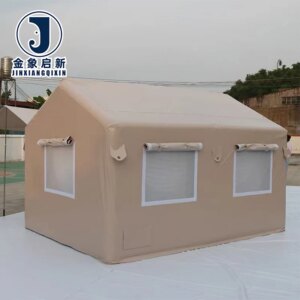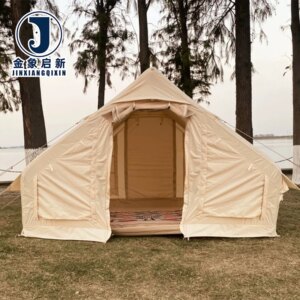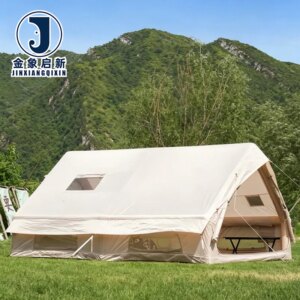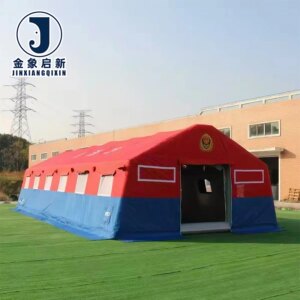
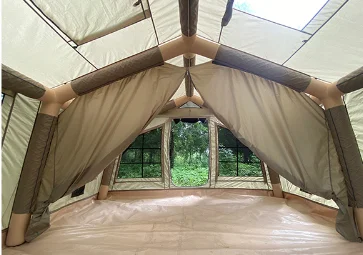
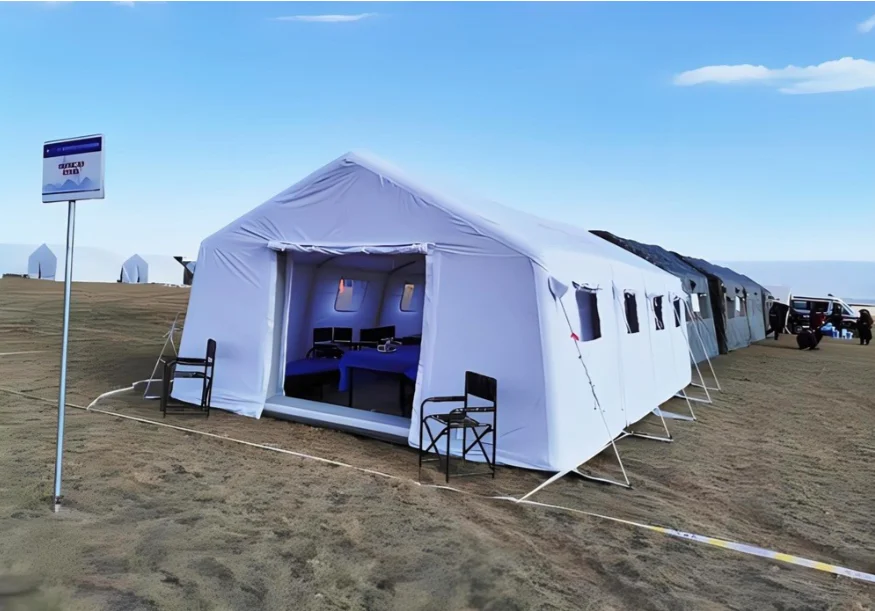

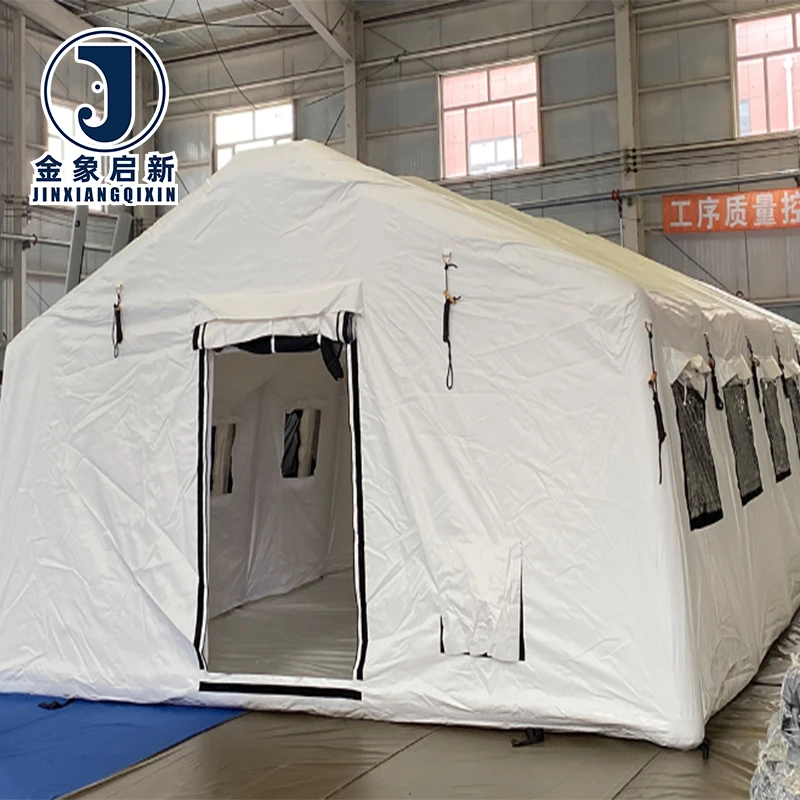

Description
Precision Coating Control — Nearly 30 years of PVC coated fabric manufacturing ensures consistent material behavior across every roll, critical for inflatable structures where seam integrity and fabric tension must align under continuous air pressure.
Technical Specifications
| Parameter | Value |
|---|---|
| Product Type | Inflatable Tent |
| Core Material | PVC Tarpaulin |
| Capacity Range | 1-12 Person |
| Construction | Single-layer |
| Season Rating | Four-Season |
| Waterproof Rating | Hydrostatic head ≥10,000mm |
| Fire-retardant Standard | EN 13501-1 (grade not stated in source — confirm required grade) |
| UV Treatment | UV-resistant (test basis not stated in source — request test report) |
| Anti-Static | Anti-static (standard not stated in source — confirm compliance requirement) |
| Customization | OEM & ODM — size adjustment, pattern printing, material specification modifications |
| Certifications | ISO 9001, ISO 14001, ISO 45001, CE |
Application Suitability
| Application | Exposure & Requirement |
|---|---|
| Commercial camping grounds | Prolonged outdoor UV exposure, repeated inflation cycles, guest safety compliance, seasonal or year-round deployment |
| Emergency response shelter | Rapid deployment under unpredictable weather, transport compactness, fire safety in temporary encampments |
| Industrial site crew housing | Remote location abrasion, wind load on inflated structure, anti-static requirement near equipment, continuous occupancy |
| Outdoor event temporary shelter | High foot traffic, public fire code compliance, branding visibility, frequent setup and teardown cycles |
| Mobile field operations | Transport vibration, variable climate exposure, quick assembly without specialized tools |
Why Fire-Retardant Claims Without a Grade Create Procurement Risk
A tent labeled "fire-retardant" without a named standard cannot be verified against your local fire code, leaving the buyer exposed at the point of site inspection.
Commercial inflatable camping tent procurement frequently stalls when the fire safety documentation does not match the jurisdiction’s required classification. Buyers specify fire-retardant fabric based on supplier assurance, only to discover during site audit that the test standard referenced does not align with EN 13501-1 or the equivalent local requirement [NEED_CITE: EN 13501-1 classification of construction products and building elements]. The result is failed inspection, delayed project handover, and in some cases complete removal of deployed structures. Sourcing an inflatable tent manufacturer that provides the test report with the named grade eliminates this verification gap entirely.
How Single-Layer PVC Tarpaulin Balances Durability and Logistics
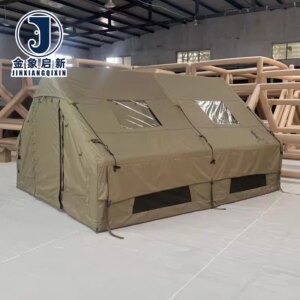
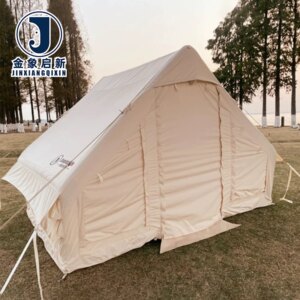
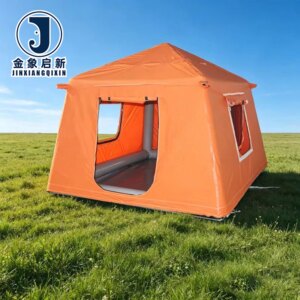
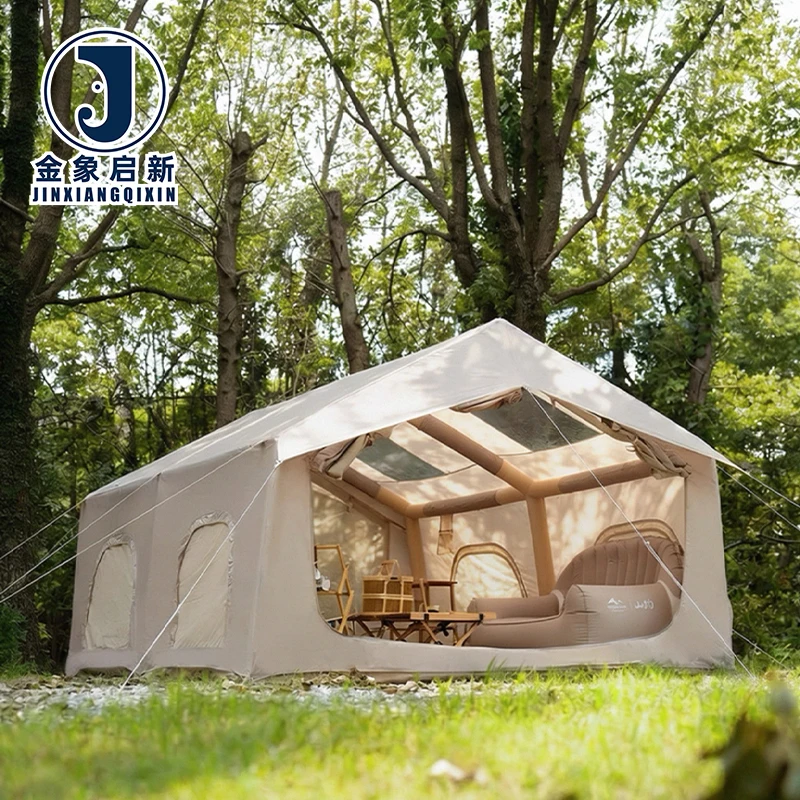
Single-layer PVC tarpaulin construction reduces packed volume and weight compared to multi-layer alternatives, an advantage that compounds when ordering inflatable camping tent fleets for commercial deployment. The Inflatable Camping Tent manufacturer produces this single-layer format to maintain structural rigidity under air pressure while keeping container loading efficient. Each roll ships with consistent thickness across the width, ensuring uniform inflation behavior when multiple units are deployed side by side at a camping ground or event site.
Waterproof Integrity at Every Seam and Flex Point
An inflatable structure places continuous stress on welded seams — the air beam junctions and entry point zippers experience flex cycles that test coating adhesion beyond what a static cover would endure. PVC tarpaulin with a hydrostatic head ≥10,000mm provides sustained waterproof protection, but the seam construction method determines whether that rating holds after repeated inflation and deflation [NEED_CITE: welded seam peel strength testing methods for coated fabrics]. This Inflatable Camping Tent manufacturer applies controlled heat welding parameters matched to the specific coating formulation, reducing the risk of seam delamination at high-stress junctions.
Understanding the Relationship Between Material Properties and Inflatable Performance
The hydrostatic head rating of ≥10,000mm indicates the fabric’s resistance to water penetration under sustained pressure — a critical metric for inflatable tents where internal air pressure pushes the membrane outward against rain load. PVC tarpaulin’s tear resistance determines how a small puncture propagates; a tear that runs along the weft or warp yarn direction can compromise an entire air beam before field repair is possible. The EN 13501-1 fire classification addresses reaction to fire for construction-related products, relevant when the inflatable tent serves as temporary accommodation or public event shelter subject to fire code enforcement. UV-resistant additives work by absorbing or scattering ultraviolet radiation before it degrades the polymer chains in the PVC coating, maintaining flexibility and color stability during prolonged outdoor deployment. Anti-static characteristics reduce surface charge accumulation, a consideration for industrial sites where the structure stands near electrical equipment or combustible dust environments [NEED_CITE: anti-static requirements for temporary structures in industrial environments].
The Hidden Cost of Inconsistent Batch-to-Batch Material Quality
Color variation between rolls from the same order becomes visible the moment two adjacent inflatable tents are inflated and displayed side by side at a commercial camping site. Beyond aesthetics, coating weight inconsistency across batches means that one tent may hold air pressure correctly while its neighbor runs slightly soft due to fabric porosity differences [NEED_CITE: coating weight tolerance impact on air-holding performance in inflatable structures]. Welding parameters dialed in for one batch may produce weak seams on the next if the coating formulation varies, leading to field failures that trace back to material inconsistency rather than fabrication error.
Why Sourcing This Inflatable Camping Tent Manufacturer Matters for Your Project
Three full production lines and 36 sets of professional processing equipment support bulk order capacity without sacrificing lead time reliability — critical when a commercial camping ground operator needs an entire fleet delivered before season opening. The 10-person R&D team handles material selection, custom sizing, and pattern printing development in-house, meaning specification changes do not require external consultation delays. Dedicated QA and QC inspection at every production stage catches coating weight deviations and color drift before rolls enter the welding department. Nearly 30 years of focused PVC coated fabric experience means the production team understands how formulation adjustments affect downstream welding behavior and long-term membrane performance. Sample development within days allows buyers to validate material behavior, seam strength, and inflation characteristics before committing to full production volume.
Documentation & Verification
- Material specification sheet stating PVC base fabric denier, coating type, and waterproof rating
- Fire-retardant test report referencing EN 13501-1 grade — request specific classification level
- UV and anti-static test documentation matching the treatment claimed for your batch
- ISO 9001, ISO 14001, ISO 45001, and CE certificates included with shipment documentation
- 100% pre-shipment waterproof inspection record with batch-specific quality report
- Roll packing list and certificate of origin provided for customs clearance support
Fabrication, Handling & Storage
- Heat welding temperature must match the specific PVC coating formulation to prevent seam delamination under inflation pressure
- Store PVC tarpaulin rolls vertically on pallets to avoid permanent crease marks that weaken the coating at fold lines
- Clean with mild detergent only — solvents degrade the PVC coating surface and reduce waterproof performance
- Allow fabric to reach ambient temperature before unfolding in cold conditions to prevent cracking at flex points
- Field puncture repair requires compatible PVC adhesive and patch material matching the single-layer coating weight
- Cutting layout planning should account for air beam curvature to minimize waste across the roll width
What We Need to Move Your Inquiry Forward
Provide the intended deployment environment — commercial campground, emergency response, industrial site — along with the expected climate exposure and any fire code classification your jurisdiction requires. Specify capacity range, quantity, and whether you need finished inflatable units or fabric rolls for your own welding facility. Confirm color requirements and whether pattern printing or branding is needed on the membrane surface, and indicate if sample validation is required before production commitment.
Frequently Asked Questions
Q: What customization options are available for size, capacity, and pattern printing?
A: OEM and ODM services cover size adjustment across the 1-12 person capacity range, custom pattern printing on the PVC tarpaulin surface, and material specification modifications. The 10-person R&D team develops samples within days for buyer approval before mass production. Specify your target dimensions, branding requirements, and any material treatment adjustments needed for your market.
Q: What fire-retardant and anti-static certifications accompany the tent for site compliance?
A: Fire-retardant treatment is aligned to EN 13501-1, with anti-static characteristics available for industrial site compliance. The specific grade classification must be confirmed against your local fire code requirements. Request the test report with your inquiry to verify the exact classification level matches your jurisdiction’s enforcement standard before placing a commercial order.
Q: How is batch-to-batch colour and material consistency controlled across large orders?
A: Dedicated QA and QC staff inspect every production stage, with 100% pre-shipment inspection covering coating weight, color consistency, and waterproof integrity. Batch-specific quality reports accompany each shipment. For fleet orders spanning multiple containers, request that all units be produced within a single coating run to eliminate inter-batch variation.
Q: What documentation is provided for quality verification and customs clearance?
A: Each shipment includes a material specification sheet, fire-retardant and UV test reports, ISO 9001/14001/45001 and CE certificates, pre-shipment inspection records, roll packing list, and certificate of origin. Additional documentation for specific customs requirements can be arranged — specify your import documentation needs during the quotation stage to avoid clearance delays.
Q: What is the sample development process and lead time for custom specifications?
A: The R&D team produces samples within days based on your application requirements, size specifications, and treatment needs. Samples undergo the same QA inspection as production material. Buyer approval of the sample triggers mass production scheduling. Request sample development early in the procurement cycle to validate material behavior and welding compatibility before committing to full order volume.