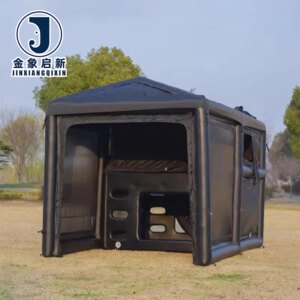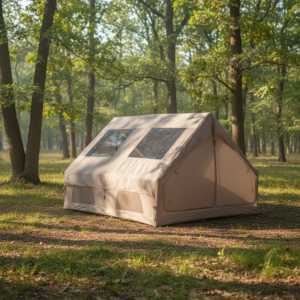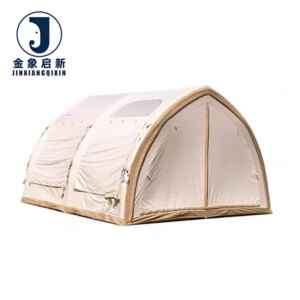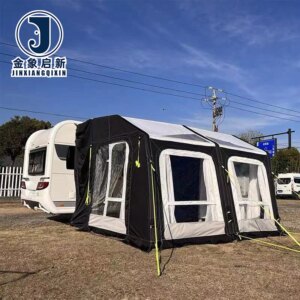
Description
Roll-to-Roll Consistency — Every batch of inflatable tent fabric is checked against the stated specification before dispatch, ensuring colour and GSM match across your entire order.
Technical Specifications
| Parameter | Value |
|---|---|
| Product Type | Inflatable Tent |
| Core Material | PVC Tarpaulin |
| Waterproof Rating | minimum 3000mm water column |
| UV Resistance | 400 hours accelerated aging test |
| Tear Strength Standard | ASTM D751 |
| Wind Load Capacity | up to 12m/s |
| Temperature Range | -10°C to 40°C |
| Dimensional Accuracy | ±2cm for large structures |
| Construction | Single-layer, inflatable design |
| Customization | OEM & ODM — sample customization, pattern printing, dimensions, color, ventilation configurations, reinforcement points |
| Inflation Test Protocol | 3-stage: 24-hour pressure, environmental simulation, structural load |
| Standards | ISO9001, ISO14001, ISO45001, CE |
| Sample Lead Time | 7-10 days |
| Standard Production Lead Time | 15-20 days for non-custom orders |
Application Suitability
| Application | Exposure & Requirement |
|---|---|
| Temporary construction site shelters | Rain, wind up to 12m/s, daily inflation/deflation cycles, ground abrasion |
| Mobile command centers for infrastructure maintenance | Extended outdoor deployment, UV exposure, frequent relocation |
| Equipment storage during outdoor operations | Water ingress prevention, dust barrier, temperature fluctuation from -10°C to 40°C |
| Disaster relief rapid deployment | Fast inflation under time pressure, transportability, repeated packing and unpacking |
| Remote industrial workspace coverage | Isolation from weather, long-term UV exposure, minimal maintenance access |
Why Batch Colour Variance Wrecks Inflatable Tent Installations
When you order multiple rolls of Inflatable Tent Fabric roll stock for a production run, the last thing you need is visible colour mismatch once the finished tents are lined up on a showroom floor or at a deployment site. Our in-process QA checks colour reference at every coating stage, not just at final packing.
I have seen coated fabric orders where the first roll and the last roll in the same shipment looked like two different products once fabricated side by side. The tent manufacturer then faces a choice: absorb the rework cost or ship mismatched units and damage their reputation with end buyers. This is not a rare occurrence in bulk PVC procurement — it happens when colour control is treated as a final inspection item rather than a process variable managed from the coating head onward [NEED_CITE: coating process colour consistency standards for PVC tarpaulin].
For Inflatable Camping Tent wholesale buyers running high-volume fabrication, consistent colour and specification across every roll is not a nice-to-have — it directly affects your rejection rate and your ability to fulfil contracts for event organisers and relief agencies who specify exact Pantone references.
How PVC Coating Weight Determines Inflatable Structure Performance
The inflatable camping tent relies on air pressure to maintain its shape, which means the fabric must hold tension uniformly across every panel. The PVC tarpaulin core provides the structural integrity needed for this pressurised environment, and coating weight directly influences how the material behaves under sustained internal pressure.
A fabric that is too light will stretch unevenly at the seams, creating stress concentrations that lead to premature failure at the welded joints. This is why Inflatable Tent Fabric roll specifications must account for both the base fabric denier and the coating weight applied to each side — neither number alone tells you how the finished tent will perform in the field.
The Relationship Between Tear Strength and Real-World Deployment
Tear strength tested to ASTM D751 gives procurement teams a standardised benchmark, but what matters in the field is how the fabric resists damage propagation once a puncture or cut occurs. Inflatable tents deployed on construction sites or in disaster relief scenarios encounter sharp debris, rocky ground, and hardware that can nick the surface during installation.
A tear that propagates quickly will compromise the entire air chamber, deflating the structure within minutes. The base fabric weave density and the coating adhesion strength work together to arrest tear propagation [NEED_CITE: ASTM D751 tear test methodology for coated fabrics]. This is why our material specification sheet states both the base fabric construction and the coating parameters — so your engineering team can model how the fabric will behave under field damage conditions.
Reading the Specification Sheet Beyond the GSM Number
GSM is often the first number buyers look at, but for inflatable tent fabric it tells only part of the story. The waterproof rating of minimum 3000mm water column indicates the coating integrity and thickness sufficient to prevent water penetration under sustained hydrostatic pressure — relevant when rain pools on curved inflatable roof surfaces.
The temperature range of -10°C to 40°C defines the operational envelope where the PVC remains flexible enough to fold and inflate without cracking in cold conditions, yet stable enough to resist softening and deformation under summer heat and internal air pressure. UV resistance validated through 400 hours of accelerated aging testing indicates the fabric can withstand extended outdoor deployment without significant surface degradation.
Wind load capacity rated to 12m/s reflects the combined performance of the fabric tensile strength, seam welding quality, and structural design of the inflatable form [NEED_CITE: wind load testing standards for temporary inflatable structures]. Each of these parameters interacts with the others — specifying one without considering the full set leads to procurement decisions that look correct on paper but fail in the field.
The Cost of Skipping Pre-Shipment Verification
When inflatable tent fabric arrives at your facility with a GSM lower than what was quoted, the consequences cascade through your entire production schedule. Panels cut to engineered patterns will weigh less than designed, affecting the structural calculations for air pressure and wind resistance. Welding parameters calibrated for a specific coating thickness will produce weak seams if the actual material is lighter than expected.
Beyond the immediate production disruption, you face the commercial problem of explaining to your customers why their order is delayed — or worse, why the tents you shipped do not meet the specification they paid for. This is why we conduct 100% inspection before shipment rather than relying on spot checks [NEED_CITE: pre-shipment inspection protocols for bulk coated fabric orders].
What Our Production Setup Means for Your Inflatable Tent Orders
Three full production lines and 36 sets of professional equipment allow us to run dedicated batches for Inflatable Camping Tent wholesale orders without cross-contamination between product families. Your rolls are produced in a continuous run with consistent coating head settings from start to finish.
A 10-person R&D team handles your sample development, pattern printing specifications, and custom sizing requirements, with samples completed within 7-10 days so you can validate material performance before committing to bulk production.
Dedicated QA and QC staff inspect at every production stage — not just at the end — catching coating weight deviations and colour drift before they propagate through the entire batch.
Our 3-stage inflation test protocol, covering 24-hour pressure holding, environmental simulation, and structural load verification, applies to finished inflatable tent units to validate that the fabric performs as engineered under realistic operating conditions.
ISO9001, ISO14001, ISO45001, and CE certifications are maintained across our management systems, giving your compliance team the documentation framework they need for procurement audits.
Documentation & Verification
- Material specification sheet stating GSM, base fabric denier, and coating weight with colour reference per roll
- Pre-shipment inspection record with 100% inspection covering dimensional accuracy within ±2cm tolerance
- Roll packing list with container loading plan by roll count and weight for your logistics team
- UV accelerated aging test results from 400-hour protocol available per batch
- Tear strength test data per ASTM D751 included with each shipment documentation package
- Batch-specific quality report with third-party testing from SGS or Intertek available on request
Fabrication, Handling & Storage
- Heat welding parameters should be calibrated to the specific PVC coating weight and single-layer construction of this inflatable tent fabric
- Reinforcement points at air valve openings and structural stress zones require additional fabric patches welded at controlled temperature
- Store rolls vertically on end caps to prevent flat spots that cause creasing when the PVC tarpaulin is unrolled for fabrication
- Allow cold-stored rolls to acclimatise to workshop temperature before unrolling to avoid coating micro-cracking below -10°C
- Clean finished inflatable tents with mild detergent only — solvent-based cleaners can degrade the PVC coating surface
- Repair field damage with compatible PVC patches heat-welded to the single-layer construction for airtight seal restoration
Planning Your Inflatable Tent Fabric Procurement
Tell us the deployment environment your end users will face — whether these tents are for disaster relief staging, construction site offices, or event infrastructure — and the climatic conditions they must withstand. Share your target dimensions, ventilation configuration requirements, and any reinforcement points specific to your inflatable design.
If your market requires specific fire-retardant grades or compliance certifications, confirm those requirements early so we can match the correct treatment to your order. Let us know whether you need Inflatable Tent Fabric roll stock for your own fabrication facility or finished inflatable camping tent units, and whether sample validation is required before bulk production.
Frequently Asked Questions
Q: How is GSM verified on arrival and what documentation supports the quoted weight?
A: Each roll ships with a material specification sheet stating the exact GSM, base fabric construction, and coating weight. We conduct 100% pre-shipment inspection and include the inspection record with your documentation. You can verify on arrival by cutting a measured sample and weighing it against the stated value.
Q: How do you ensure colour consistency across multiple rolls in the same bulk order?
A: Colour reference is checked at every coating stage, not just at final packing. All rolls in your order are produced in a continuous run on the same production line with consistent coating head settings. A colour reference is included on the material specification sheet for each roll.
Q: What test basis supports the UV resistance claim and what results are available?
A: UV resistance is validated through a 400-hour accelerated aging test protocol. Test results are available per batch and can be included in your shipment documentation. For specific outdoor exposure duration expectations in your deployment climate, share your location and we will advise accordingly.
Q: What are the minimum order quantities for custom dimensions, colours and printed branding?
A: Minimum quantities depend on the specific customisation you require — colour matching, pattern printing, and non-standard dimensions each have different production run requirements. Share your specifications and annual volume forecast, and we will confirm the minimum order for your configuration.
Q: How are rolls packed and loaded into containers to prevent damage during ocean freight?
A: Rolls are packed with protective end caps and wrapped to prevent surface abrasion during transit. A roll packing list details the count, weight, and container loading plan so your logistics team can plan unloading and storage. Vertical storage orientation is recommended upon arrival.