Description
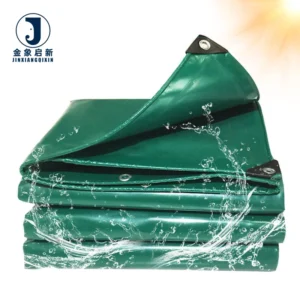
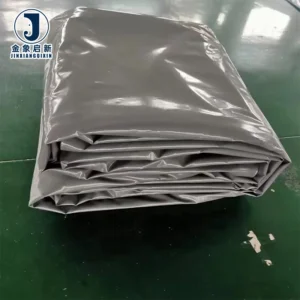
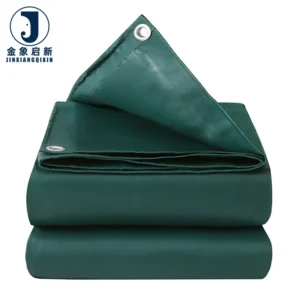
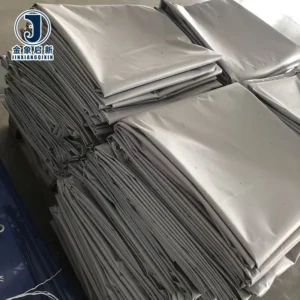
Bulk Roll Consistency — Three production lines maintain verified GSM and colour matching across every roll, so distributors receive uniform stock from first to last container.
Technical Specifications
| Parameter | Value |
|---|---|
| Product Type | PVC Coated Tarpaulin Roll |
| Coating Material | PVC |
| Base Fabric | 100% high toughness polyester yarn |
| Coating Method | Lamination technology and hot melt coating technology |
| Thickness (Medium-duty) | 0.35-0.45 mm |
| Weight (Medium-duty) | 400-500 g/m² |
| Base Fabric Denier (Medium-duty) | 500D |
| Tensile Strength (Medium-duty) | Longitude 1500-2000 / Latitude 1200-1800 N/5cm (test basis not stated) |
| Thickness (Heavy-duty) | 0.70-1.0 mm |
| Weight (Heavy-duty) | 700-1000 g/m² |
| Base Fabric Denier (Heavy-duty) | 1000D |
| Tensile Strength (Heavy-duty) | Meridian 2000-2500 / Latitude 1800-2200 N/5cm (test basis not stated) |
| Thickness (Super heavy) | 1.2-1.5 mm |
| Weight (Super heavy) | 1100-1500 g/m² |
| Base Fabric Denier (Super heavy) | 500D-2000D |
| Tensile Strength (Super heavy) | Warp 2500-3000 / Weft 2200-2800 N/5cm (test basis not stated) |
| Key Features | Waterproof, cold resistant cracking, mold proof, anti-static treatment (surface resistance not confirmed), flame retardant (grade not stated), excellent welding tear strength, best color fastness (test basis not stated) |
| Weather Resistance | 3-5 years (source value — verify against manufacturer catalog) |
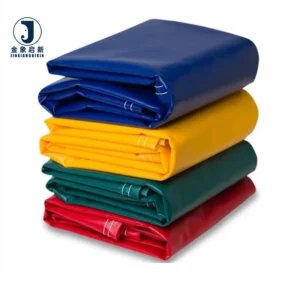
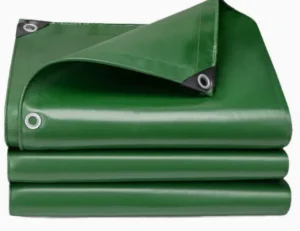
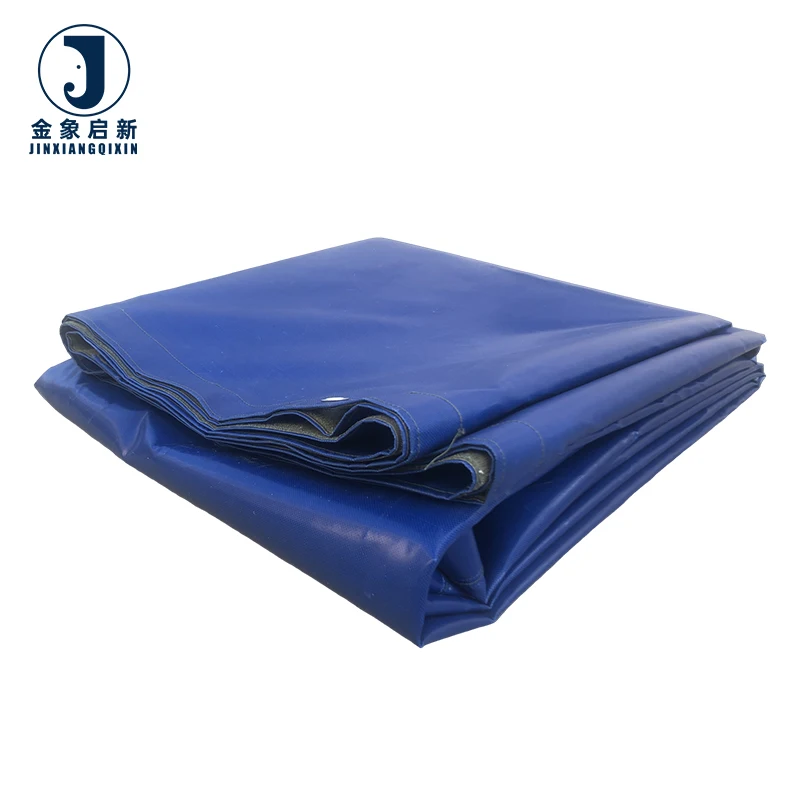
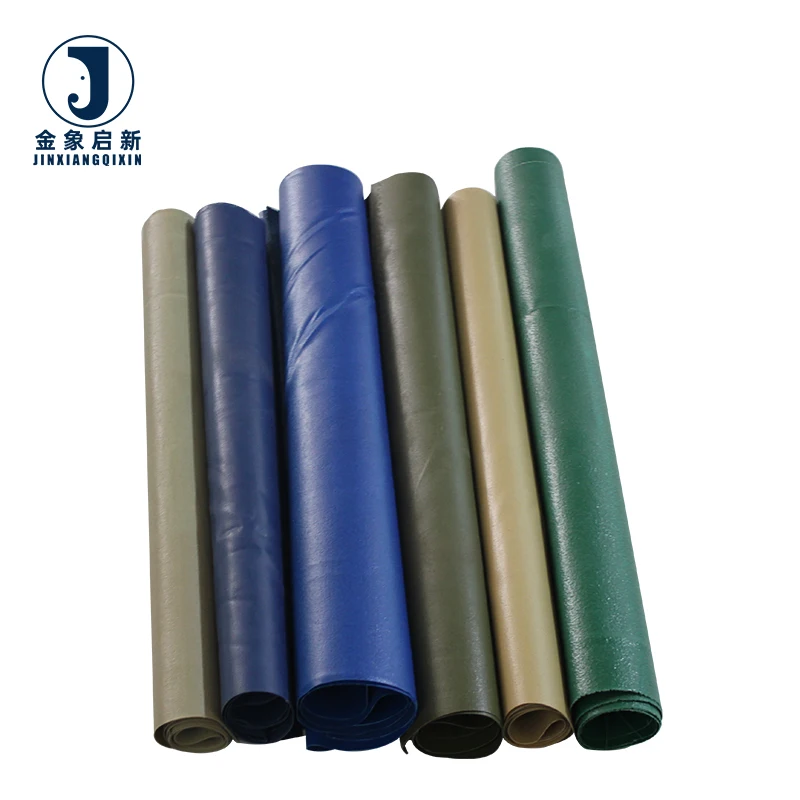
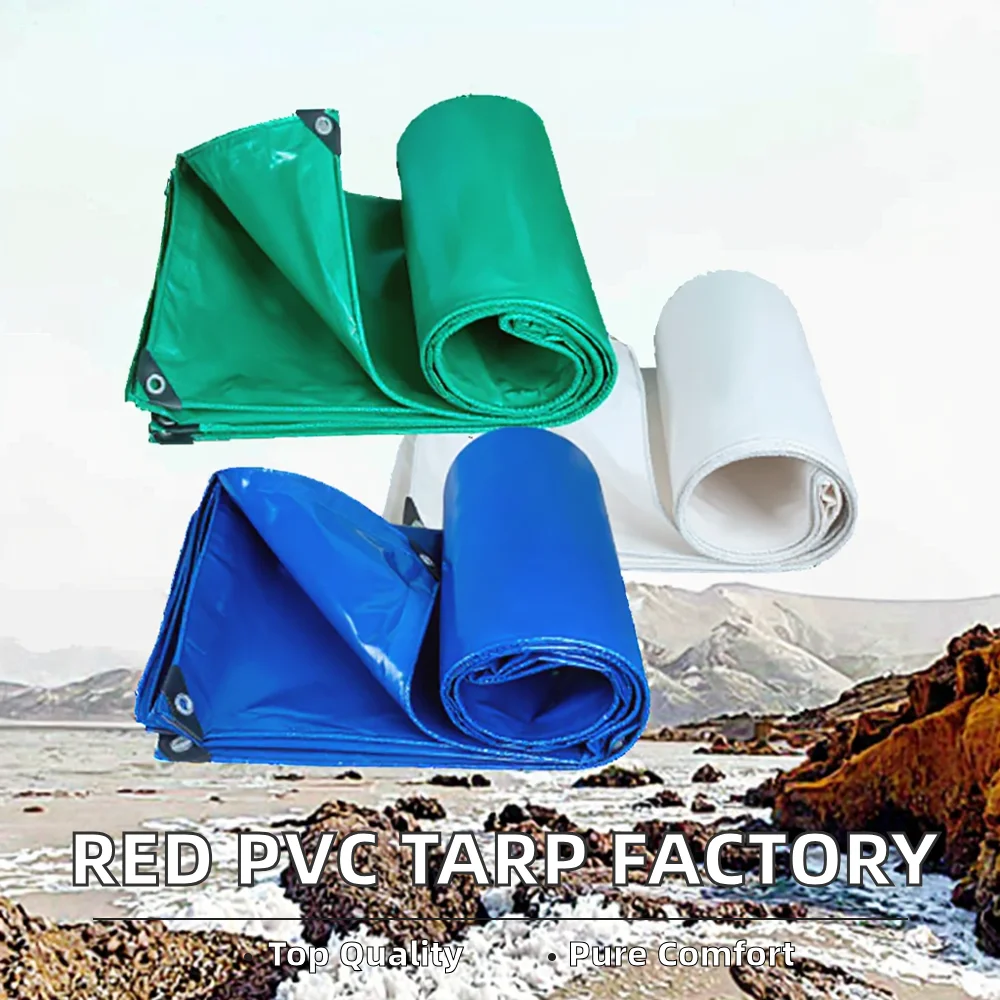
| Available Colors | Blue, Blue/Orange, Green, Grey, Black, Clear, Grey/Green, Orange, or custom |
| Standards | ISO, CE |
Application Suitability
| Application | Exposure & Requirement |
|---|---|
| Tarpaulin distributor stock | Regional resale requiring multiple GSM grades with consistent colour across batches |
| Logistics fleet roll procurement | In-house fabrication of truck and trailer covers demanding reliable weld strength and abrasion resistance |
| Tent and awning manufacturing | Production runs consuming full rolls where batch-to-batch weight and thickness uniformity prevent machine recalibration |
| Inflatable structure fabrication | Air-holding membrane panels requiring airtight coated surfaces with strong seam adhesion under inflation pressure |
| Agricultural and construction covers | Large or irregular loads exposed to weather, soil contact and mechanical handling |
| Industrial pipe canopy | Outdoor storage of steel or timber requiring waterproof coverage with mold resistance in humid conditions |
Why Roll-to-Roll Weight Variation Destroys Wholesale Margins
A quotation states 700 g/m² but the rolls arriving in your warehouse average closer to 620 g/m² — the material is lighter than agreed, and your downstream customers notice.
When purchasing PVC coated tarpaulin roll wholesale / bulk shipments, weight consistency across the container is not a bonus; it is the baseline that protects your reputation. Distributors who resell by the metre or by the roll cannot absorb a seven percent shortfall in coating weight without either short-changing their buyers or eating the loss. The problem compounds when a fabricator cuts and welds panels from a mixed-weight batch: some panels sag under their own load while others hold, and the warranty claim lands on the wholesaler, not the mill. [NEED_CITE: pre-shipment weight verification methods for coated textile rolls]
Stocking Multiple Grades from a Single Source
Distributors covering a regional market typically need medium-duty 400-500 g/m² rolls for agricultural covers, heavy-duty 700-1000 g/m² stock for truck side curtains, and super heavy 1100-1500 g/m² fabric for mining ventilation or tensioned structures. Consolidating a PVC coated tarpaulin roll wholesale / bulk order across these grades with one producer means every roll follows the same hot melt coating and lamination process, simplifying your warehouse sorting and reducing the variables your fabrication team must manage. Consistent base fabric sourcing across weight grades also means welding parameters remain predictable when your workshop shifts from one GSM to another mid-shift.
Colour Matching Across Batches and Containers
When two rolls from the same order are unrolled side by side at a job site, even a slight hue shift becomes visible, particularly in high-visibility colours like orange or blue. The PVC coated tarpaulin roll wholesale / bulk purchasing model demands that colour references are locked per purchase order, not merely per catalogue code. Each production run ties the colour formula to the specific batch number so that reorders placed months later can be matched against a retained sample rather than a generic swatch. This approach eliminates the visible panel mismatch that triggers on-site rejection and costly return freight. [NEED_CITE: colour fastness and batch matching standards for PVC coated textiles]
How Coating Method Determines Downstream Fabrication Behaviour
The lamination and hot melt coating technology used across these rolls directly affects how the fabric behaves at the weld line. Hot melt coating embeds the PVC into the polyester base yarn at elevated temperature, creating an adhesive bond that survives the thermal cycling of high-frequency welding. Fabricators using hot air or wedge welders benefit because the coating softens uniformly rather than delaminating under heat, producing seams whose tear strength matches or exceeds the body fabric. The base fabric denier — 500D in medium-duty, 1000D in heavy-duty and up to 2000D in super heavy — determines how far a tear propagates before the weave arrests it; higher denier yarns create more interlock points per centimetre, limiting tear extension under mechanical stress. Coating thickness, ranging from 0.35 mm to 1.5 mm depending on grade, governs both the waterproof barrier integrity and the material’s stiffness during fabrication on automated cutting tables.
The Hidden Cost of Specifying on Price Per Kilogram Alone
A roll priced aggressively per kilogram often achieves that figure through reduced coating weight or a lower-denier base fabric hidden inside the same GSM band. The PVC coated tarpaulin roll wholesale / bulk buyer who selects solely on unit cost may receive material that welds poorly because the coating-to-fabric ratio is too lean, or that cracks at fold lines after one winter because the PVC layer is too thin to absorb flex fatigue. [NEED_CITE: coating adhesion and peel strength testing for laminated fabrics] Fabricators discover these failures only after the material has been cut, welded and installed, turning a saving on raw stock into a warranty liability that dwarfs the original price difference.
Production Capacity Built for Volume Buyers
Three full production lines and 36 sets of professional equipment support container-scale PVC coated tarpaulin roll wholesale / bulk orders without sacrificing the per-roll inspection that smaller runs receive. The 10-person R&D team develops custom width and colour samples within days, allowing distributors to test market response before committing to full container loads. A dedicated QA/QC process inspects every roll before dispatch, catching GSM drift and surface defects at the mill rather than at the buyer’s dock. ISO and CE certified production provides the documentation framework that customs brokers and compliance officers in destination markets require, reducing clearance delays on international shipments.
Documentation & Verification
- Material specification sheet listing exact GSM, base fabric denier and coating method per roll batch
- Weight verification per roll against the stated GSM before dispatch, recorded on inspection report
- Roll packing list detailing roll count, net weight and container loading sequence
- Certificate of origin and customs support documents for international wholesale clearance
- Test reports for flame retardant and anti-static grades where specified, tied to batch number
Fabrication, Handling & Storage
- Hot air welding temperature should be calibrated to the specific coating thickness — 0.35 mm medium-duty requires lower heat input than 1.5 mm super heavy grades
- Store rolls horizontally on pallets in a shaded warehouse; vertical standing deforms the PVC coating at the base contact point over time
- Allow cold-stored rolls to acclimatise before unrolling; the cold resistant cracking treatment reduces brittleness but does not eliminate flex stress at low temperatures
- Cut super heavy 1100-1500 g/m² rolls with industrial rotary blades; standard utility knives produce ragged edges that compromise weld seam preparation
- Clean glossy PVC surfaces with mild detergent only; solvent-based cleaners degrade the coating and reduce welding adhesion on subsequent fabrication
- When nesting patterns on 500D medium-duty fabric, align the warp direction with the primary load axis to maximise tensile utilisation
Requesting a Quotation That Matches Your Market
Specify the GSM grade, roll width and annual volume your distribution network requires so the quotation reflects actual container loading rather than generic pricing. Confirm whether your destination market mandates a particular flame retardant classification or anti-static surface resistance, as treatment formulations vary by compliance region. Indicate if you need fabric in stock colours for immediate dispatch or custom colours with sample approval before production, since lead times differ between standard and matched batches.
Frequently Asked Questions
Q: How is GSM verified per roll and what documentation accompanies a bulk shipment?
A: Every roll is weighed during the pre-shipment inspection and the measured GSM is recorded against the quotation specification. The inspection record, material specification sheet and roll packing list ship with the container, giving your receiving team full traceability from production batch to individual roll identity without requiring separate lab testing on arrival.
Q: How do you ensure batch colour consistency across rolls in the same order?
A: Colour formula is locked to the purchase order batch number and retained as a physical reference sample. During production, in-process QA checks each roll against this reference under standardised lighting. For repeat orders, the retained sample from the original batch is used as the matching target, preventing drift between successive container shipments.
Q: What custom widths and roll lengths are available, and what are the minimums?
A: Rolls can be produced in custom widths and lengths to match your cutting table dimensions or automated fabrication equipment. Minimums depend on the specific width and colour combination required. The R&D team develops a sample roll for approval before full production begins, confirming dimensions, GSM and surface finish match your specification.
Q: How are rolls packed for container loading to prevent transit damage?
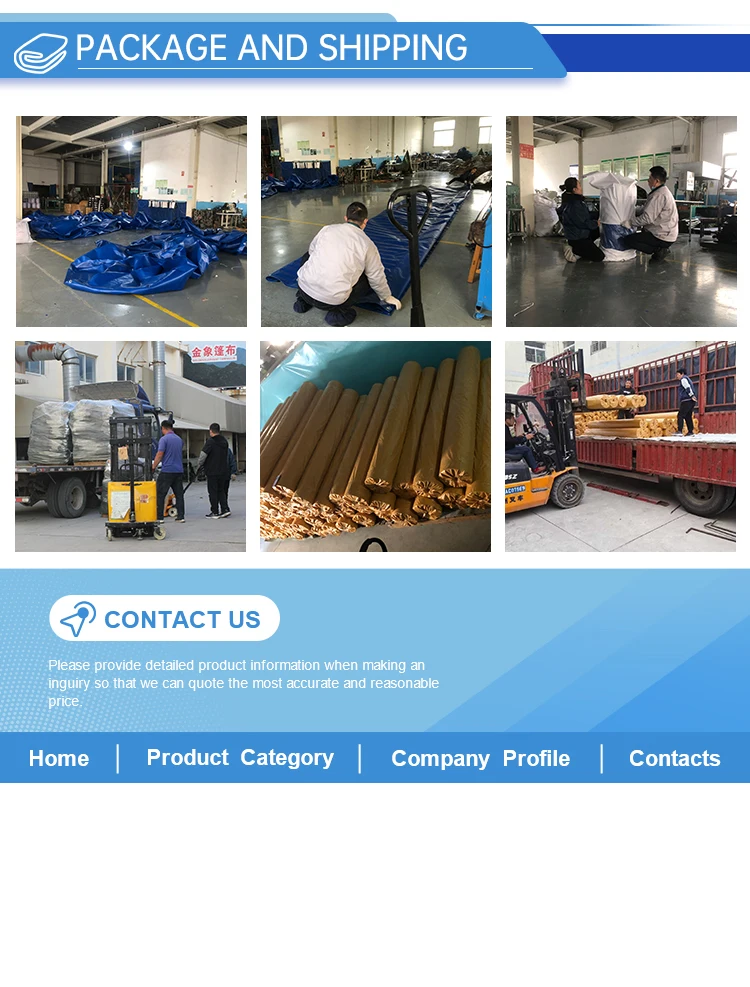
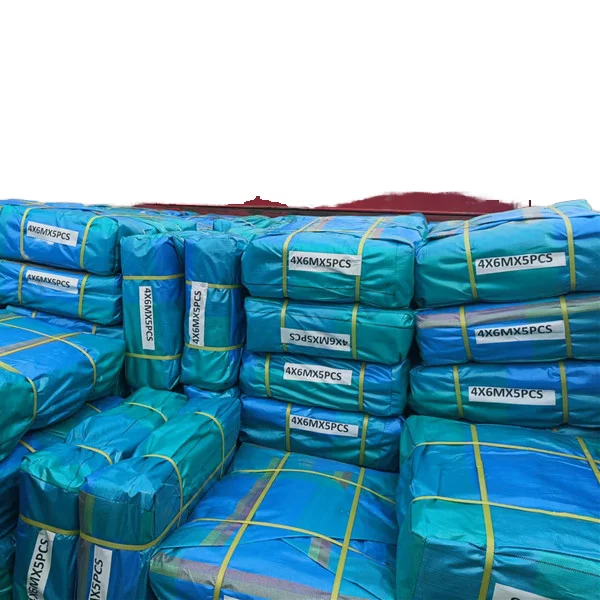
A: Each roll is wrapped in protective film and loaded according to a container loading plan documented on the packing list. Rolls are positioned to prevent crushing at the container floor and to distribute weight evenly, reducing the risk of coating deformation or edge damage during ocean freight handling at both origin and destination ports.
Q: Can flame retardant or anti-static grades be supplied with test reports?
A: Flame retardant and anti-static treatments are available across the product family. The specific grade and applicable test standard depend on the compliance requirements of your destination market. Request the treatment specification sheet for your target standard so the correct formulation is applied and the corresponding test report ships with your order documentation.