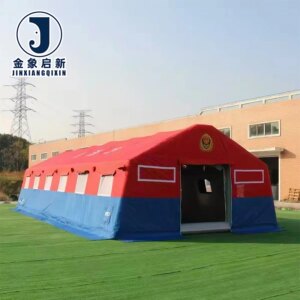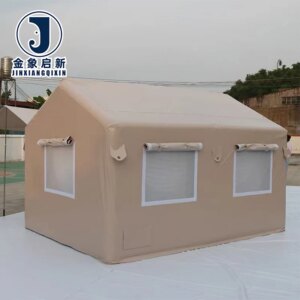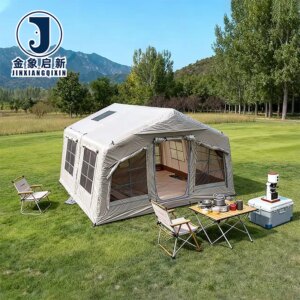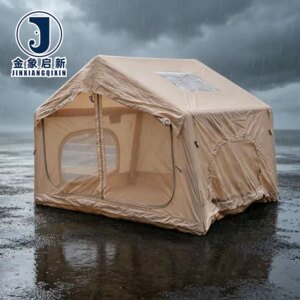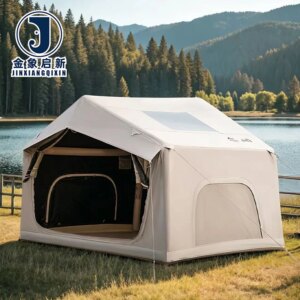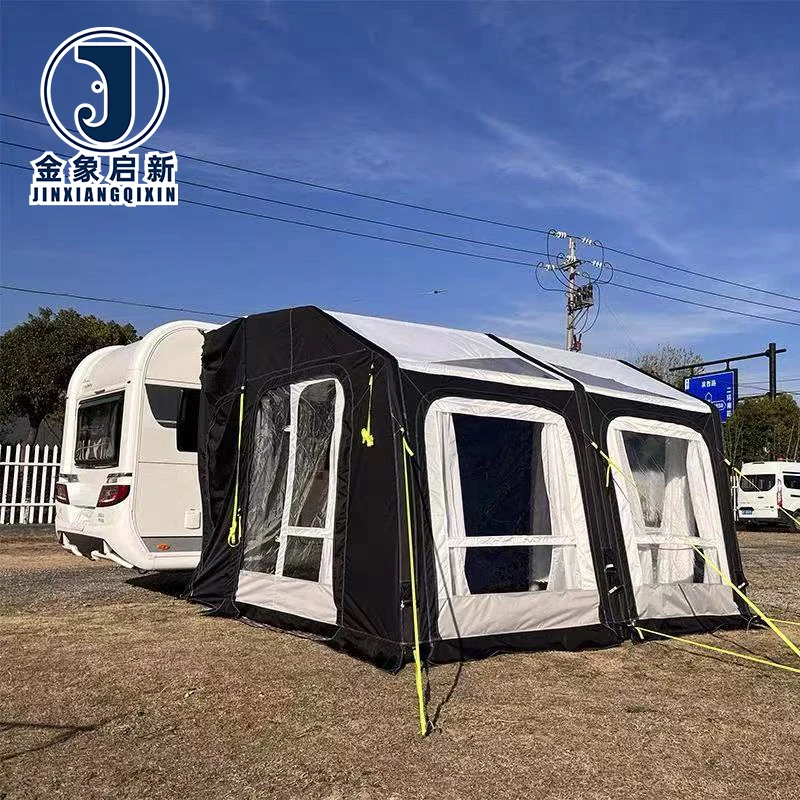

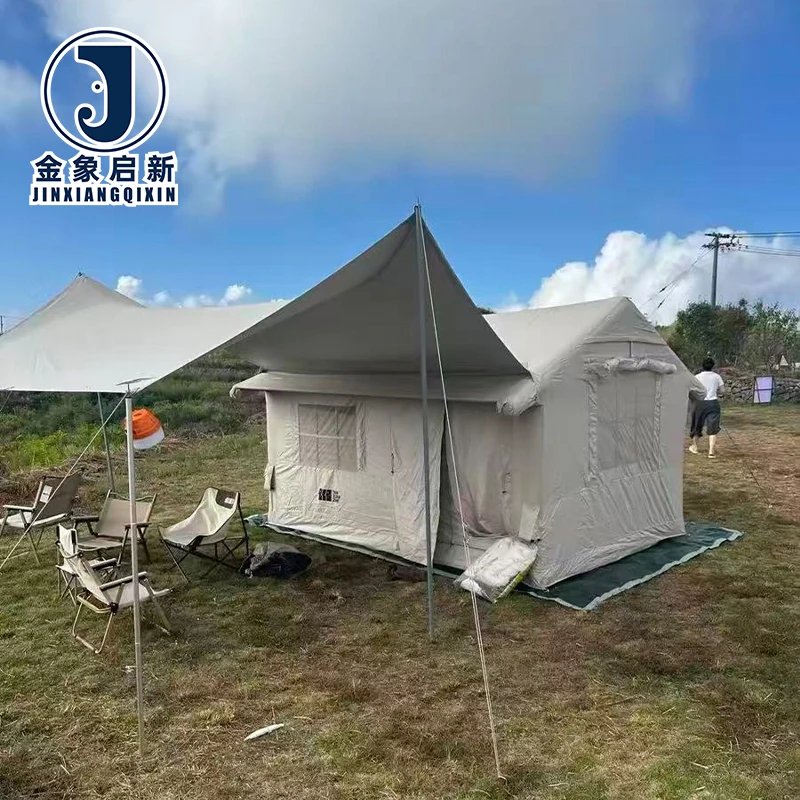
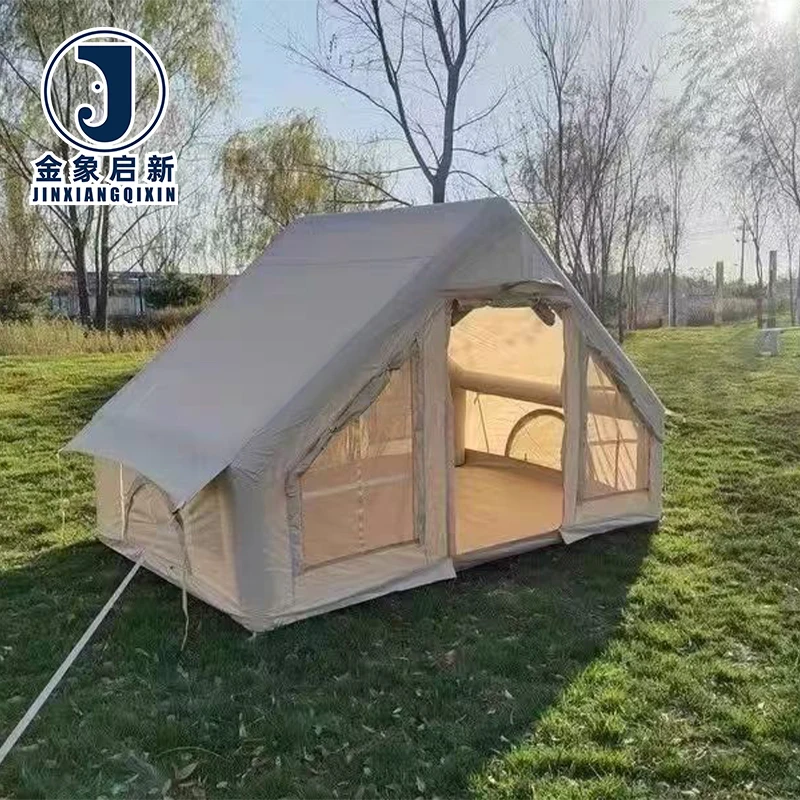
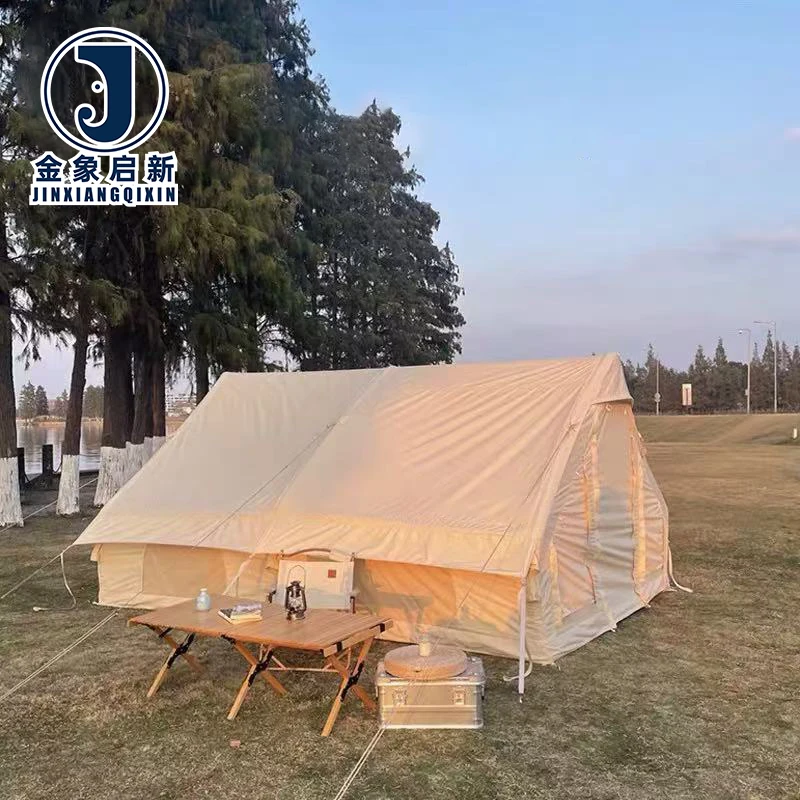
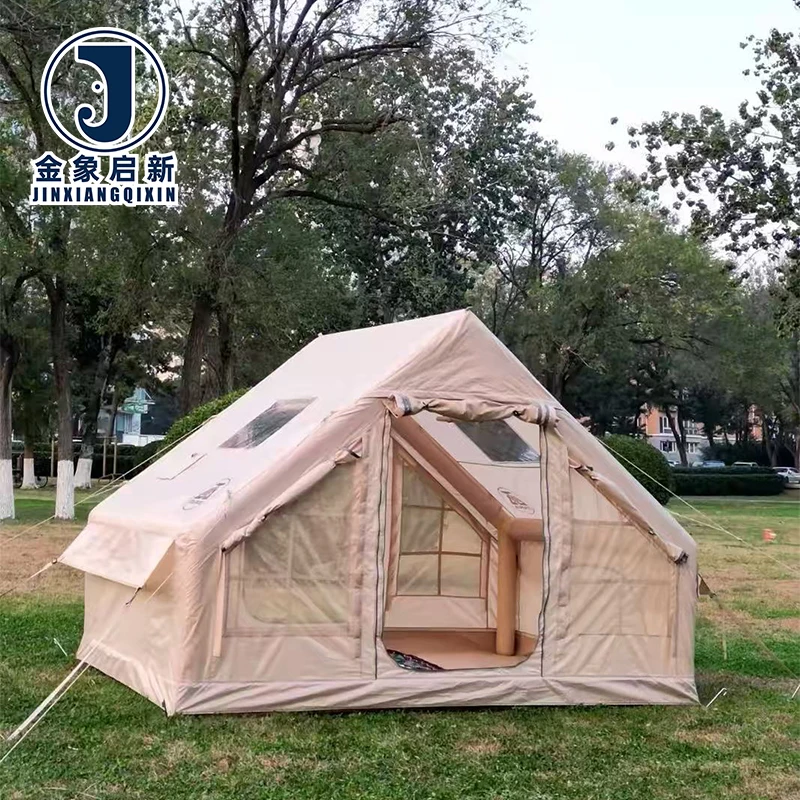
Description
Deep Coating Process Control — Nearly 30 years focused on PVC coated fabric delivers measurable consistency in coating weight, adhesion, and seam integrity across every inflatable tent unit produced.
Technical Specifications
| Parameter | Value |
|---|---|
| Product Type | Inflatable Tent |
| Core Material | PVC Tarpaulin |
| Product Forms | Single Layer Construction, Extended Type |
| Waterproof Rating | Withstands 500mm water column for 24 hours |
| Flame Retardant Grade | DIN 4102 B1 |
| UV Treatment | Service life up to 5 years under outdoor industrial conditions (test basis not stated in source) |
| Coating Thickness Tolerance | ±0.02mm |
| Seam Strength | 150N/cm |
| Size Range | 5㎡ to 100㎡ (OEM/ODM) |
| Color Option | Standard RAL color chart |
| Printing Option | Pattern printing available |
| Custom Features | Reinforced anchor points, ventilation systems |
| Inflation Test | 48-hour airtightness test before shipment |
| Standards | ISO 9001, ISO 14001, ISO 45001, CE, DIN 4102 B1 |
Application Suitability
| Application | Exposure & Requirement |
|---|---|
| Temporary site offices during infrastructure projects | Continuous outdoor weather exposure, wind loading, rapid deployment and relocation across phases |
| Equipment storage shelters in remote construction areas | UV degradation, dust ingress, temperature fluctuation, ground moisture contact |
| Emergency response stations for industrial accident management | Immediate inflation requirement, fire safety compliance on hazardous sites, repeated assembly cycles |
| Disaster relief rapid deployment shelters | Extreme weather resistance, transport abrasion, multi-season operational continuity |
When the Inflatable Tent Manufacturer Cannot Prove What the Quotation Claims
A product sheet that omits test standards leaves procurement exposed to site rejection and compliance failure.
Buyers sourcing an inflatable tent manufacturer for industrial or emergency shelter projects frequently receive quotations listing fire-retardant and waterproof claims without referencing the underlying test method. When a mining site safety officer requests the DIN 4102 certificate and the supplier cannot produce it, the entire shelter deployment stalls. [NEED_CITE: DIN 4102 fire classification for building materials] This gap between stated performance and documented proof is not a minor paperwork issue — it determines whether the shelter can legally operate on a regulated work site.
Full OEM/ODM Sizing Without Sacrificing Structural Integrity
Custom inflatable emergency shelter projects demand more than cutting fabric to a requested dimension. The relationship between internal air pressure, seam geometry, and anchor point placement must be recalculated for each size variant from 5㎡ to 100㎡. A standard pattern scaled upward without adjusting seam overlap or inflation channel diameter will produce uneven rigidity and potential failure at stress concentration points.
Production Consistency Across Batch Quantities
When a disaster relief procurement requires multiple identical shelters, color and coating uniformity across every unit is non-negotiable. Roll-to-roll variation in PVC coating thickness beyond the stated ±0.02mm tolerance creates visible panel differences once units are deployed side by side on site. This inflatable tent manufacturer maintains in-process QA checkpoints at every coating and lamination stage to hold consistency across full production runs.
How Coating Thickness Tolerance Translates to Field Performance
The ±0.02mm coating thickness tolerance directly governs how the PVC tarpaulin behaves under sustained internal air pressure. Thinner zones in the coating create localized flexibility differences that manifest as uneven surface tension when the shelter is fully inflated. Over repeated inflation and deflation cycles, these micro-variances accelerate fatigue cracking at the coating-to-base-fabric interface. [NEED_CITE: tensile and tear test methods for coated fabrics per ISO 1421] The 150N/cm seam strength specification addresses the junction where welded panels meet — historically the first failure point in inflatable structures subjected to wind loading and thermal expansion. Fire-retardant performance verified to DIN 4102 B1 ensures the shelter meets the fire safety threshold required on construction, mining, and industrial emergency sites across European and many international jurisdictions.
What Happens When Inflatable Tent Specifications Are Chosen on Price Alone
Selecting a shelter based on quotation cost without verifying coating weight, seam test data, and airtightness protocol produces predictable field failures. Units that pass initial inflation checks but skip the extended 48-hour airtightness verification often develop slow leaks within the first deployment cycle, requiring constant re-inflation that drains generator fuel and compromises occupant safety. [NEED_CITE: airtightness failure modes in inflatable industrial shelters] Batch-to-batch color inconsistency forces rejection of entire shipments when shelters are deployed together at high-visibility project sites. Missing flame-retardant documentation triggers site access denial regardless of the fabric’s actual performance.
Why Procurement Teams Specify This Product Line
Three full production lines and 36 sets of processing equipment support volume orders with maintained lead time reliability, eliminating the extended delays typical of single-line operations. A dedicated 10-person R&D team handles material selection, custom sizing from 5㎡ to 100㎡, pattern printing layout, and sample development within 7-10 days rather than weeks. Dedicated QA/QC protocols at every production stage with 100% pre-shipment inspection catch coating adhesion defects and seam inconsistencies before dispatch. Nearly 30 years of process control over PVC coating weight and fabric adhesion provides the technical depth to troubleshoot application-specific requirements. ISO 9001, ISO 14001, ISO 45001, and CE certification frameworks structure every production decision rather than serving as wall decoration.
Documentation & Verification
- Material specification sheet stating PVC coating type, base fabric construction, color reference, and GSM
- DIN 4102 B1 fire-retardant test report matched to the production batch
- Pre-shipment inspection record documenting 48-hour airtightness test results per unit
- 500mm water column waterproof test documentation for the supplied material grade
- ISO 9001, ISO 14001, ISO 45001, and CE certificates included with every shipment
- Third-party testing via SGS or Intertek arranged upon request for critical project validation
Fabrication, Handling & Storage
- Heat-weld seams using temperature and dwell time parameters matched to the PVC coating thickness tolerance of ±0.02mm
- Reinforce anchor points with additional PVC patches bonded to the base fabric layer, not just the coating surface
- Store rolled units upright on pallets to prevent flat-spot deformation of the inflatable air chambers
- Avoid deploying below the material’s minimum service temperature to prevent PVC coating embrittlement at fold lines
- Clean surfaces with neutral pH detergent only — solvent-based cleaners degrade the PVC coating bond over repeated use
- Field-repair minor punctures using compatible PVC adhesive patches matching the coating chemistry
Request a Specification Recommendation
Provide the intended deployment environment, expected wind and weather exposure levels, and any site-specific fire safety standards your project must satisfy. Specify the required floor area range, color preferences from the RAL chart, and whether pattern printing or branded panels are needed. Indicate your target delivery timeline and whether samples are required for compliance approval before full production begins.
Frequently Asked Questions
Q: What customization options are available for sizing, color, and structural features?
A: This custom inflatable emergency shelter is produced in sizes from 5㎡ to 100㎡ with full OEM/ODM capability. Color selection follows the standard RAL chart, and pattern printing is available for branding or identification. Structural reinforcements include additional anchor points and integrated ventilation systems designed during the R&D sample phase to match your deployment requirements.
Q: How is the DIN 4102 B1 flame-retardant grade verified for my market?
A: Every production batch carries a DIN 4102 B1 test report documenting the fire-retardant classification of the PVC tarpaulin used. This standard is widely accepted across European construction and mining sites. For markets requiring alternative fire safety classifications, confirm the specific standard with your procurement team and request third-party testing through SGS or Intertek before shipment.
Q: What is the sample development timeline for custom specifications?
A: Sample development for custom inflatable tent specifications typically requires 7-10 days from confirmed design parameters. The 10-person R&D team prepares material selection, sizing, and reinforcement details. Production lead time for approved samples runs 15-30 days depending on order volume and customization complexity.
Q: How do you maintain color consistency across multiple units in one order?
A: Coating batches are mixed and applied under controlled conditions with in-process QA checks at every stage. The ±0.02mm coating thickness tolerance ensures uniform pigment distribution across rolls. A 100% pre-shipment inspection compares panels from different rolls side by side under standardized lighting before units are packed together.
Q: What documentation accompanies each shipment for international compliance?
A: Each order ships with a material specification sheet, DIN 4102 B1 test report, 48-hour airtightness test records, pre-shipment inspection report, packing list, certificate of origin, and ISO 9001, ISO 14001, ISO 45001, and CE certificates. Third-party test reports from SGS or Intertek are available upon request for projects requiring independent validation.