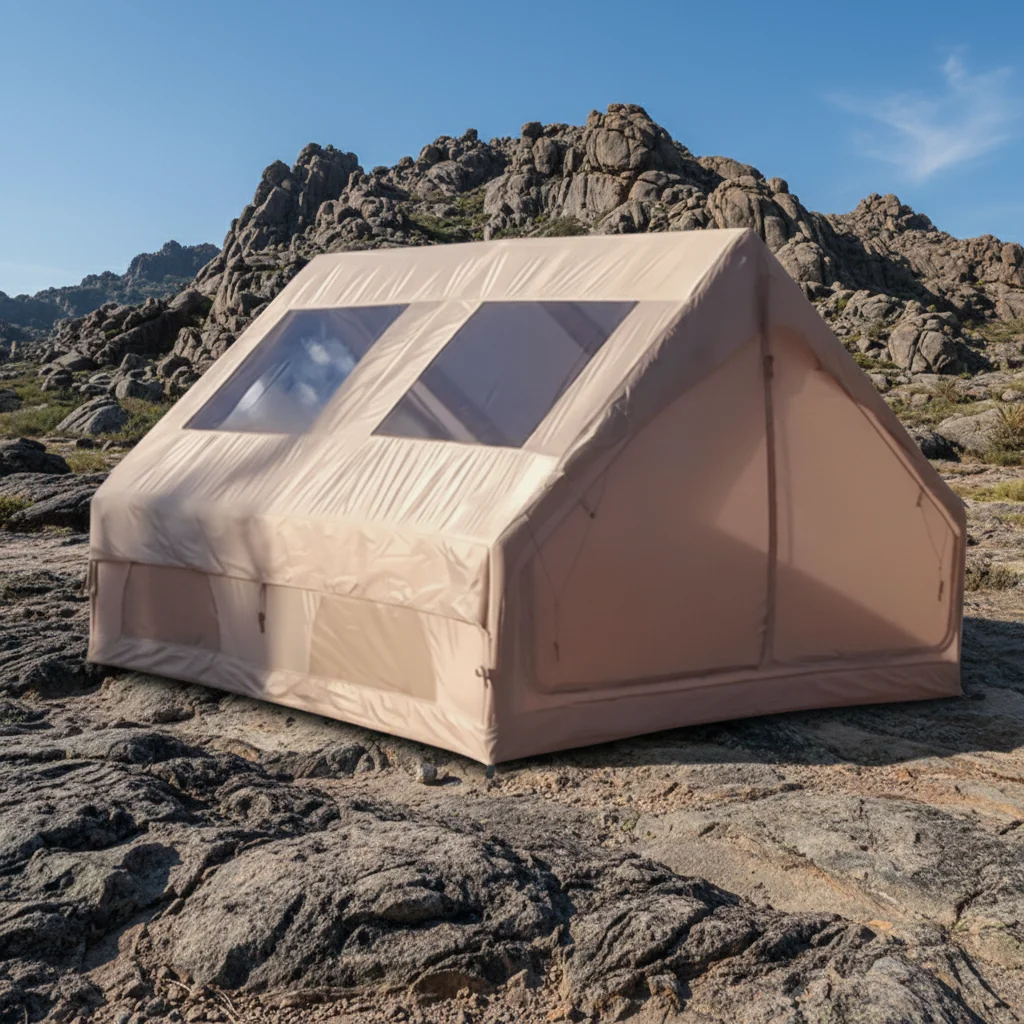





Description
Roll-stock consistency — Every roll of PVC inflatable tent fabric is verified for GSM, colour, and coating adhesion before leaving the factory, ensuring batch-to-batch reliability across container loads.
Technical Specifications
| Parameter | Value |
|---|---|
| Product Type | Inflatable Tent |
| Core Material | PVC Tarpaulin |
| Waterproof Performance | Yes (test basis not stated in source) |
| UV Resistance | Yes (test basis not stated in source) |
| Tear Resistance | Yes (test basis not stated in source) |
| Flame-Retardant Treatment | Yes (grade not stated in source) |
| Anti-Static Treatment | Yes (standard or surface resistance not stated in source) |
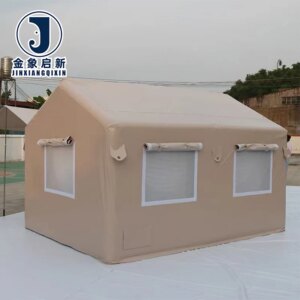
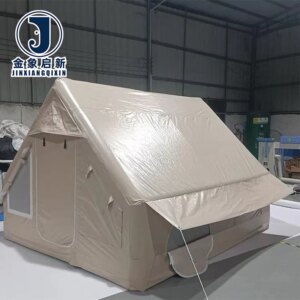
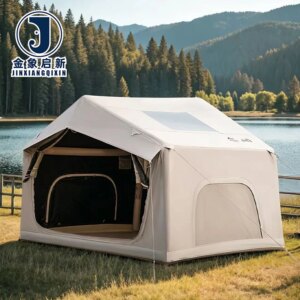
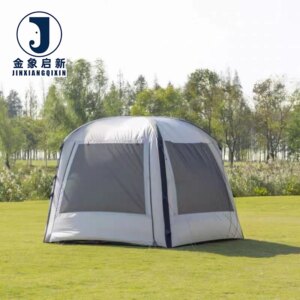
| Product Form | Inflatable structure with quick automatic opening |
| Customization | OEM & ODM (sample customization, pattern printing, size adjustment, custom color matching) |
| Quality Control | Full-process inspection; inflation testing for pressure retention and seam strength |
| Certifications | ISO9001, ISO14001, ISO45001, CE |
Application Suitability
| Application | Exposure & Requirement |
|---|---|
| Inflatable tent manufacturers | Roll-fed production lines requiring batch-consistent colour, coating weight, and weld integrity |
| Commercial outdoor adventure operators | Prolonged UV exposure, repeated inflation cycles, abrasion from ground contact and wind flex |
| Event infrastructure contractors | Large-scale deployment needing uniform appearance across multiple units, fire safety compliance on site |
| Industrial temporary shelters | Chemical exposure from site conditions, anti-static requirements in sensitive environments |
| Field operations in severe weather | Continuous water contact, low-temperature handling, structural pressure retention over extended use |
Why Roll-to-Roll Consistency Matters More Than Quoted GSM for Inflatable Tent Fabric Wholesale
A quoted GSM means nothing if the coating weight varies across the roll or shifts between batches.
Buyers who source inflatable tent bulk roll stock frequently encounter material that measures lighter than the agreed specification on arrival. The shortfall might be small per square metre, but it compounds across thousands of metres in a container. More critically, uneven coating distribution within a single roll causes inconsistent weld behaviour — some sections seal cleanly while others delaminate under inflation pressure. When manufacturers run this material through automated production lines, the result is scrapped units and missed delivery windows [NEED_CITE: tensile and tear test methods for coated fabrics per ISO 1421]. The problem intensifies when multiple rolls from the same order show colour variation visible once installed side by side at an event site.
Batch Colour Control Across Inflatable Tent Fabric Wholesale Orders
Colour matching for inflatable tent fabric wholesale orders requires process control at the coating stage, not just a Pantone reference at the enquiry phase. Pigment dispersion, coating temperature, and line speed all influence the final shade. Our production runs maintain colour consistency by locking process parameters for each batch and retaining reference samples for cross-checking before dispatch. This matters especially when buyers order multiple rolls for a single project — visible shade differences between adjacent panels damage the client’s perception of quality at the installation site.
Verifying Material Weight and Coating Adhesion Before Shipment
The gap between quoted GSM and delivered weight is one of the most common disputes in coated fabric procurement. Our QC process checks coating weight at multiple points across the roll width and along its length, recording actual values rather than relying on line settings. Coating adhesion is tested by measuring peel strength between the PVC layer and the base fabric, confirming that the bond will survive repeated inflation and deflation cycles without blistering or separation [NEED_CITE: DIN 4102 fire classification for building materials]. Each inspection record travels with the shipment documentation.
How Base Fabric and Coating Weight Interact in Inflatable Structures
The base fabric denier and weave density determine the structural skeleton of the material, while the PVC coating provides the air barrier and environmental protection. A heavier coating does not automatically mean a stronger fabric — if the base fabric is loosely woven, the coating simply fills gaps without adding meaningful tear resistance. Conversely, a tightly woven high-denier base with a thin coating may offer high tensile strength but poor weld performance because the heat cannot penetrate evenly through the dense weave. Understanding this relationship helps buyers specify material that inflates reliably, holds pressure under load, and seals cleanly at every seam.
The Hidden Cost of Specifying on Price Alone
Selecting inflatable tent bulk roll supply based on the lowest per-kilogram price frequently leads to downstream costs that exceed the initial savings. Material that arrives below the stated GSM wears through faster at ground-contact points and at flex zones where the structure bends during inflation. Rolls with inconsistent coating thickness produce weld failures that are only discovered during the pressure test — after the tent has already been cut, assembled, and fitted with valves. Rejecting a batch at that stage means lost production time, delayed client delivery, and the logistics cost of returning or replacing material [NEED_CITE: coated fabric weld strength and peel adhesion testing standards].
Why Procurement Teams Source PVC Inflatable Tent Fabric Here
Deep coating process control developed over nearly 30 years of focused production ensures that GSM, colour, and adhesion remain within tolerance across every roll shipped. Three dedicated production lines and 36 sets of processing equipment support bulk roll volumes without forcing buyers into extended lead times. A 10-technician R&D team handles custom colour matching, pattern printing, and sample development within days, allowing buyers to validate material before committing to full container orders. Full-process quality inspection with dedicated QA and QC staff catches deviations at the coating stage rather than at final packing. Pre-shipment inflation testing on finished samples confirms pressure retention and seam strength specific to each batch. Complete documentation packages accompany every dispatch, including batch-specific inspection records and material specification sheets.
Documentation & Verification
- Batch-specific quality inspection report covering waterproof performance, tear resistance, and coating weight measurements per roll
- Roll packing list with container loading data by roll count and weight for logistics and customs planning
- Pre-shipment inspection record with inflation test results confirming pressure retention and seam integrity
- Material specification sheet stating base fabric denier, coating type, GSM, and colour reference for traceability
- ISO9001, ISO14001, ISO45001, and CE certificates included with every international shipment
- Certificate of origin and customs documentation prepared for destination-country requirements
Fabrication, Handling & Storage
- Heat-weld parameters should be adjusted to the PVC coating thickness to avoid base-fabric scorching or incomplete bonding
- Store rolls vertically on pallets to prevent flat-spot deformation that affects unwinding and cutting accuracy
- Allow material to acclimatise to workshop temperature before welding, as cold PVC coating becomes brittle and cracks under pressure
- Use compatible PVC-based adhesives for field repairs, ensuring chemical compatibility with the coating formulation
- Plan cutting layouts to minimise offcuts, accounting for roll width and the seam allowance required for inflation chambers
- Avoid dragging rolls across rough surfaces to prevent scoring the coating layer before fabrication begins
Request a Specification Match for Your Inflatable Tent Production
To recommend the right roll-stock grade for your application, provide your target GSM range, required roll width, and annual volume estimate. If your market mandates specific flame-retardant or anti-static certifications, state the standard and grade so we can confirm test availability. For custom colour or printed rolls, share your Pantone reference and artwork so we can develop a production sample before your bulk order enters the line.
Frequently Asked Questions
Q: How is batch-to-batch colour consistency controlled across roll orders?
A: Colour is controlled by locking pigment ratios, coating temperature, and line speed for each production run. Reference samples from approved batches are retained and used for visual and instrumental comparison on subsequent orders. Every roll is checked against the retained standard before packing, and any deviation outside tolerance triggers a hold for review.
Q: What roll widths and lengths are available, and how is container loading optimized?
A: Roll widths and lengths are configured to match your cutting patterns and production line requirements. Container loading plans are calculated by roll count, roll diameter, and weight to maximise space utilisation while preventing crushing. Packing lists detail roll placement for efficient unloading at your facility.
Q: How is GSM verified on arrival, and what documentation supports weight claims?
A: Each shipment includes a batch-specific inspection report recording actual coating weight measurements taken at multiple points across the roll width and along its length. These records allow you to verify GSM on arrival against the stated specification without relying on random sampling alone.
Q: What flame-retardant and anti-static certifications are provided with each shipment?
A: Flame-retardant and anti-static treatments are available in various grades. Confirm the specific standard and classification required for your destination market, and we will supply the corresponding test report and certification documentation with your shipment for compliance verification.
Q: What is the MOQ for custom colour or printed rolls, and how are samples handled?
A: Minimum order quantities for custom colour and printed rolls depend on the width and coating specification selected. Production samples are developed within days for your approval before bulk manufacturing begins, ensuring colour accuracy and print registration meet your requirements without committing the full order volume.