
Description
Roll-to-Roll Consistency — standardized coating lines and dedicated QA checkpoints ensure every roll of inflatable tent fabric matches the approved sample across the entire batch.
Technical Specifications
| Parameter | Value |
|---|---|
| Product Type | Inflatable Tent |
| Core Material | PVC Coated Fabric |
| Construction | Single layer |
| Waterproof Performance | Fully waterproof coated construction |
| UV Resistance | Available with anti-UV treatment — confirm test basis required for your market |
| Tear Resistance | Tear-resistant PVC coated construction |
| Fire Retardancy | Available in fire-retardant grades — confirm the grade required for your market |
| Anti-Static Treatment | Available in anti-static grades — confirm the standard required for your site |
| Customization | OEM & ODM — sample customization, pattern printing, size adjustments, material thickness modifications |
| Production Lines | 3 full production lines |
| Processing Equipment | 36 sets of professional processing equipment |
| R&D Support | 10 technicians |
| Quality Control | Full-process inspection with dedicated QA & QC staff |
| Certifications | ISO 9001, ISO 14001, ISO 45001, CE |
Application Suitability
| Application | Exposure & Requirement |
|---|---|
| Construction site temporary shelter | Continuous outdoor exposure, wind loading, abrasion from equipment movement, fire safety compliance on active sites |
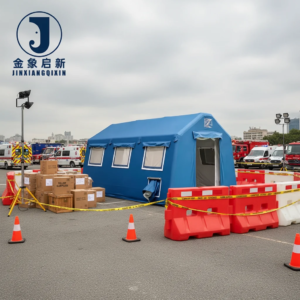
| Disaster relief command centers | Rapid deployment, all-season weather exposure, repeated inflation and deflation cycles |
| Outdoor event logistics | High foot traffic, UV exposure, rain and wind resistance, branded surface printing |
| Industrial storage facilities | Long-term weathering, fire-retardant compliance, anti-static requirements in sensitive zones |
| On-site operations | Frequent relocation, puncture and tear risk from ground contact, handling stress at seams |
Why Inflatable Tent Fabric Roll Consistency Matters More Than You Think
Batch colour variation between rolls is the single most common complaint in multi-panel inflatable tent production.
When you order inflatable tent fabric roll stock for an 8–10 person shelter, a single tent may require panels cut from two or three rolls. If one roll skews slightly warmer or cooler in tone, the mismatch becomes immediately visible once the panels are welded together and the structure is inflated on site. This is not a cosmetic issue your customer will overlook — it triggers rejection, rework, and replacement claims. The problem typically originates upstream, where pigment dosing or coating temperature drifts between production runs. [NEED_CITE: common causes of batch colour variation in PVC coated fabrics]
How PVC Coated Fabric Supports Structural Integrity Under Inflation Pressure
An inflatable tent relies entirely on air pressure to maintain its shape, which means the fabric must resist deformation while remaining flexible enough to fold, transport, and redeploy. PVC coated fabric provides the dimensional stability needed for this cycle. The coating bonds to the base fabric, preventing the weave from shifting under load, and the single-layer construction keeps weight manageable for field crews who carry and position these structures by hand.
When sourcing inflatable tent fabric roll material for 4 season shelters, the coating adhesion becomes critical. If the coating delaminates at a seam or flex point, the air beam loses pressure and the structure sags. Our 3 full production lines and 36 sets of processing equipment maintain consistent coating application across long production runs.
Batch-to-Batch Uniformity Across Container-Load Volumes
Tent manufacturers ordering by the container need confidence that roll number one and roll number forty will behave identically on the cutting table and under the weld bar. Variations in coating weight or surface texture force operators to adjust welding temperature and speed for each roll, slowing throughput and increasing scrap rates.
Standardized operating procedures across our coating lines address this directly. Each production batch follows the same coating parameters, and dedicated QA & QC staff verify consistency at multiple checkpoints before rolls are packed for dispatch. This matters especially for distributors stocking inflatable tent fabric roll stock for resale to fabricators who expect the same material behaviour every time they reorder. [NEED_CITE: ISO 1421 tensile and tear test methods for coated fabrics]
Reading the Specification Sheet Beyond the GSM Number
GSM alone tells you how much the fabric weighs per square metre, but it does not tell you how that weight is distributed between the base fabric and the coating. A heavy coating on a loosely woven base fabric can produce a high GSM reading while delivering disappointing tear strength. The denier of the yarn and the density of the weave determine how well the fabric resists tear propagation — the direction in which a puncture spreads once it starts. For inflatable tent panels, which experience concentrated stress at air beam junctions and door openings, tear resistance is often more important than tensile strength. The single-layer PVC coated construction used here balances coating weight against base fabric density to support both inflation pressure and handling stress without unnecessary excess weight.
The Real Cost of Choosing the Wrong Fabric Grade
Selecting fabric based on initial cost rather than field performance creates downstream expenses that are rarely captured in the procurement spreadsheet. A coating that is too thin for the intended climate degrades under prolonged UV exposure, leaving the base fabric exposed to moisture and mechanical wear. Seams that are welded at incorrect temperatures may pass visual inspection in the factory but fail at the weld line once the structure is pressurized and flexed by wind.
Fire-retardant fabric supplied without the correct grade documentation can halt a construction project at the site safety audit, forcing the contractor to source compliant material at short notice and absorb schedule penalties. These consequences all trace back to the specification conversation at the inquiry stage. [NEED_CITE: fire classification standards for temporary structures on construction sites]
Why Procurement Teams Source Inflatable Tent Fabric Here
Dedicated QA & QC staff inspect every roll before it leaves the facility, checking coating adhesion, colour consistency, and dimensional accuracy against the approved specification.
The 10-technician R&D team handles pattern printing development, custom sizing, and material thickness adjustments, producing samples within a defined timeframe so you can validate before committing to a production run.
Three full production lines with 36 sets of professional equipment provide the capacity to fill container-load orders within typical multi-week lead times while maintaining the batch consistency that multi-panel tent fabrication demands.
Material specification sheets accompany every shipment, stating base fabric details, coating composition, and performance parameters so your incoming inspection team can verify against the quotation.
ISO 9001, ISO 14001, ISO 45001, and CE certifications are maintained across the production system, and certificate of origin and customs documentation are prepared for export shipments.
Documentation & Verification
- Material specification sheet stating base fabric, coating weight, and colour reference per roll
- Batch-specific inspection report with waterproof rating and tensile strength results
- Roll packing list with count, weight, and dimensions for container loading plans
- ISO 9001, ISO 14001, ISO 45001, and CE certificates included with shipment
- Certificate of origin and customs documentation prepared for destination country
Fabrication, Handling & Storage
- Adjust hot-air weld temperature to match the PVC coating thickness of each roll batch
- Store rolls horizontally on padded racks to prevent creasing of the single-layer coated surface
- Use sharp rotary cutters to avoid fraying the woven base fabric at panel edges
- Allow cold-stored rolls to reach ambient temperature before unrolling to prevent coating cracking
- Clean printed surfaces with mild detergent to protect pattern integrity on custom-branded panels
What to Include in Your Next Inquiry
Provide the intended application and deployment environment so we can recommend the appropriate coating thickness and treatment package. Specify the roll width and estimated annual volume to determine production scheduling and container loading efficiency. If your market requires a specific fire-retardant grade or anti-static standard, state the reference standard so the correct formulation is quoted from the start.
Frequently Asked Questions
Q: How is roll-to-roll colour consistency maintained across a single order?
A: Pigment dosing and coating temperature are held constant within each production batch. QA staff compare every roll against the approved colour standard before packing. If your order spans multiple batches, we produce a reference panel from each batch for your approval before dispatch.
Q: What standard roll widths and custom lengths are available for inflatable tent panel cutting?
A: Standard stock widths are available for common tent panel layouts, and custom widths can be produced for specific cutting patterns that reduce waste. Roll lengths are configured to match your panel dimensions so that each roll yields a predictable number of cuts.
Q: What MOQ applies to custom thickness, colour, or pattern printing orders?
A: Minimum order quantities vary depending on the customization scope. Single-colour stock widths carry lower minimums than custom colours or printed patterns, which require dedicated line setup. Request a quotation with your specification to receive the applicable MOQ tier.
Q: How are rolls packed and loaded for container shipment?
A: Each roll is wrapped to protect the PVC coated surface during transit. Rolls are loaded horizontally or vertically based on container type and weight distribution requirements. A detailed packing list with roll count, individual weight, and total shipment weight is provided for logistics planning.
Q: How can I verify the material specification matches the quotation when goods arrive?
A: Every roll ships with a specification sheet stating the base fabric, coating details, and colour reference. We recommend weighing a measured sample from the first roll to confirm the stated GSM and comparing the coating surface against the approved sample panel retained from the sampling stage.