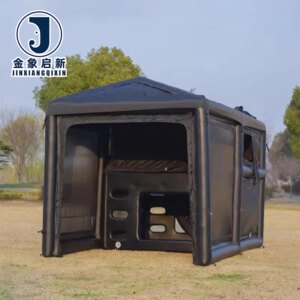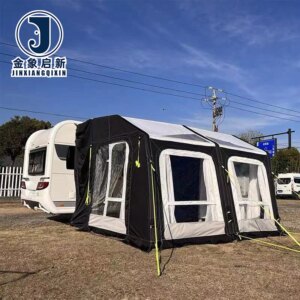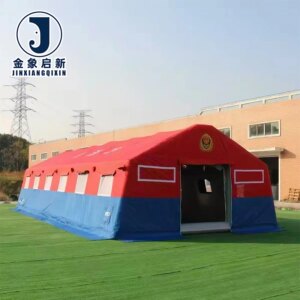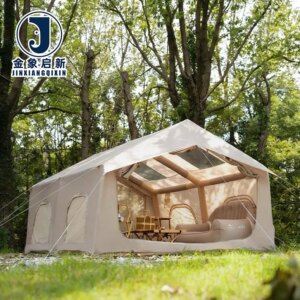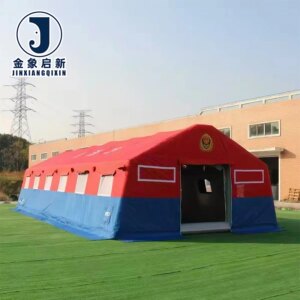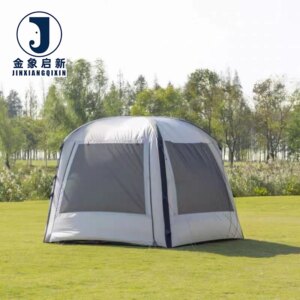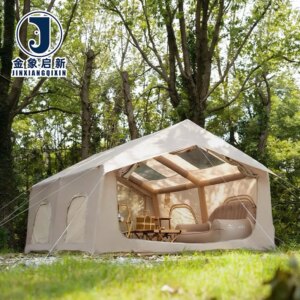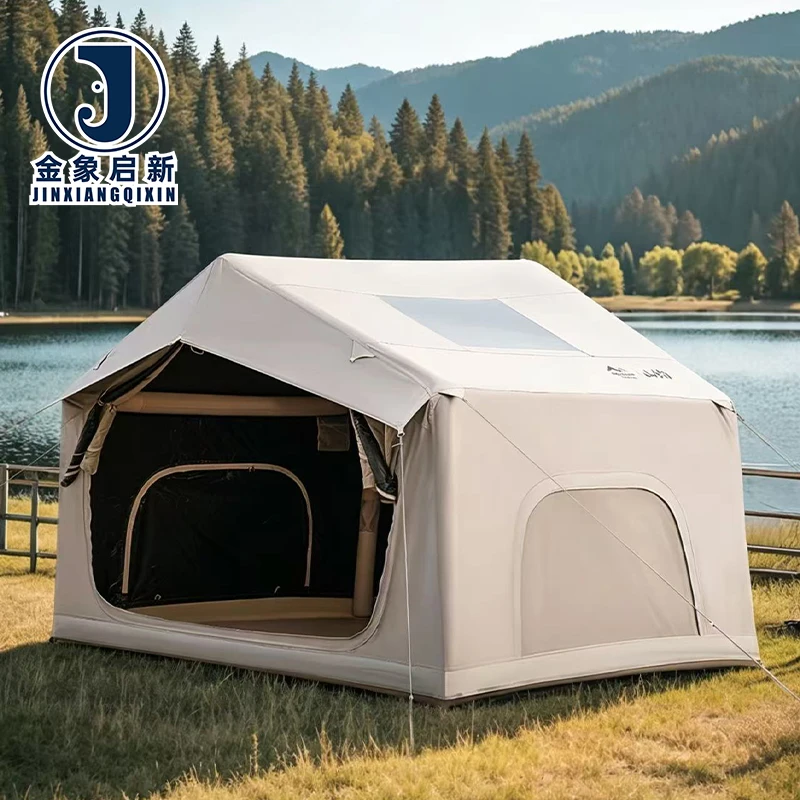
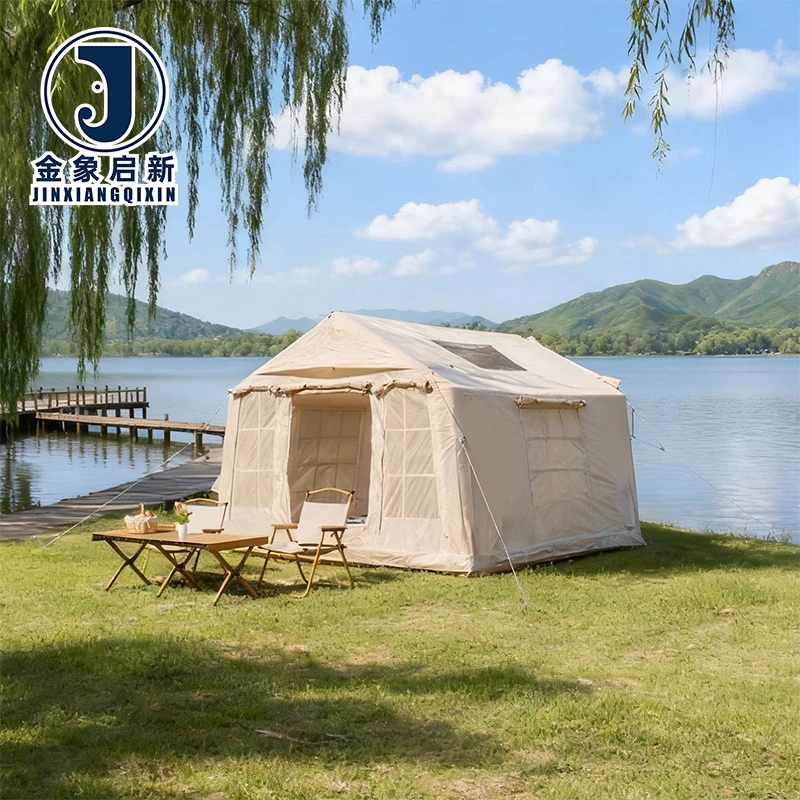
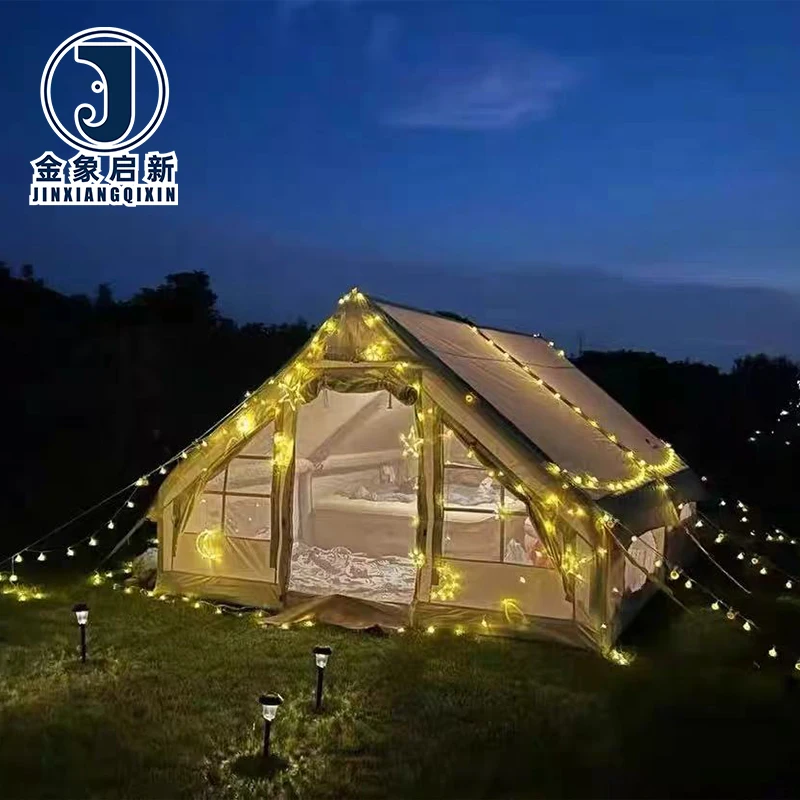
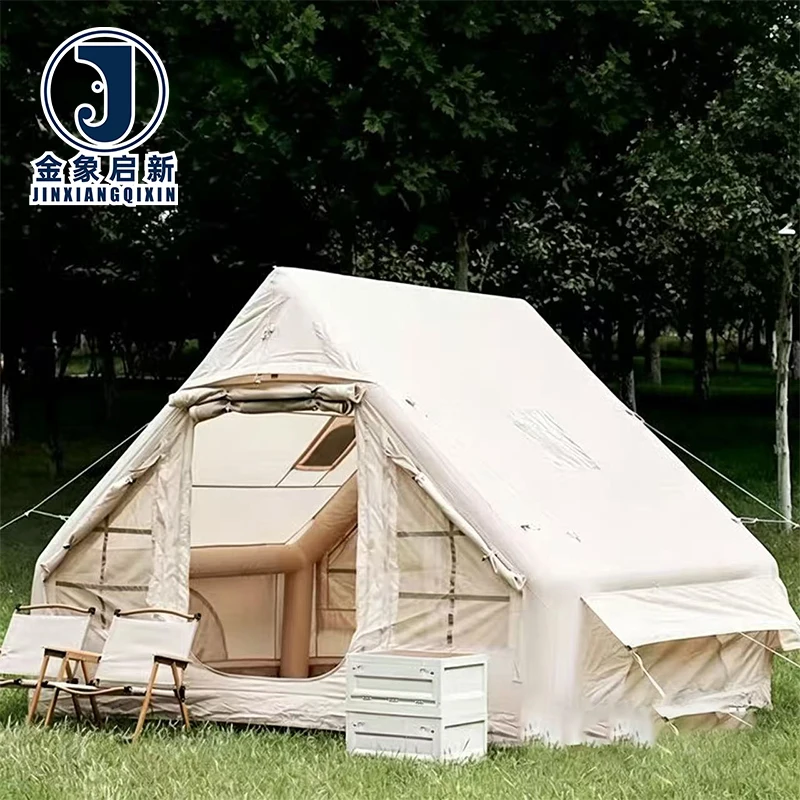
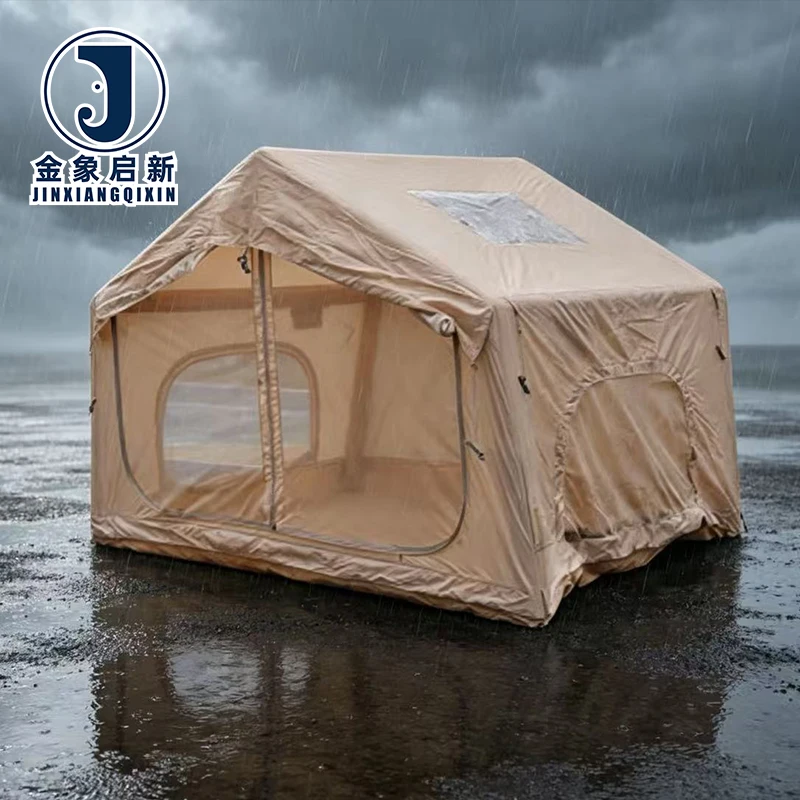
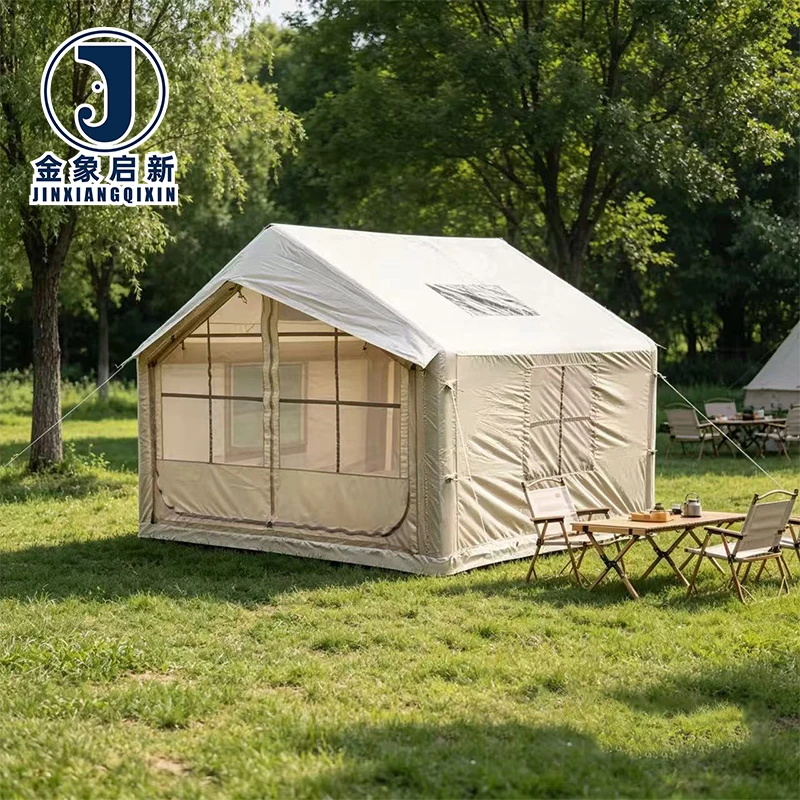
Description
Volume Roll Consistency — Every roll of waterproof inflatable camping tent fabric ships with batch-specific thickness and tensile verification, ensuring uniform pressure retention and welding behavior across your entire production run.
Technical Specifications
| Parameter | Value |
|---|---|
| Product Type | Inflatable Tent |
| Core Material | PVC Tarpaulin |
| Product Form | Inflatable structure with automatic opening mechanism |
| Capacity | 6–8 Person |
| Fabric Thickness | 0.3mm–0.8mm (confirm the grade for your application) |
| Waterproof Rating | Hydrostatic head ≥10,000mm |
| Fire-Retardant Standard | EN 13501-1 Class B |
| UV Resistance | 5+ years outdoor service life (test basis not stated) |
| Anti-Static | Yes (surface resistance standard not stated) |
| Deployment Cycle Durability | Tested to 1,000+ cycles |
| Pressure Retention | ≤5% pressure loss over 24 hours |
| Welding Inspection | Ultrasonic integrity checks at 50cm intervals |
| Key Features | Waterproof, UV-resistant, tear-resistant, fire-retardant, anti-static |
| Customization | OEM & ODM, sample development, pattern printing, color matching, logo printing, valve system modifications |
Application Suitability
| Application | Exposure & Requirement |
|---|---|
| Commercial glamping operations | Repeated guest turnover, rapid inflation/deflation cycles, four-season weather exposure, guest safety compliance |
| Outdoor hospitality venues | Permanent outdoor installation, UV degradation resistance, fire code compliance for public accommodation, aesthetic branding requirements |
| Premium outdoor accommodation fleets | High deployment frequency, transport abrasion during repositioning, consistent visual appearance across units, field repairability |
| Outdoor gear manufacturer catalogues | Branded product integration, OEM dimensional accuracy, repeatable weld seam quality across production batches |
Why Material Certificates Matter More Than the Quotation Sheet
Every batch we ship arrives with a lot-specific inspection report — not just a generic data sheet.
Procurement teams sourcing an inflatable camping tent often compare quotations based on headline specs like fabric thickness or fire-retardant claims. The problem surfaces when the delivered rolls do not match what was promised. A tent manufacturer I worked with received material that welded cleanly on the first batch but delaminated at the seams on the second — the coating formulation had shifted without notice, and no test documentation accompanied the replacement shipment [NEED_CITE: coating adhesion variability between production batches]. When your commercial glamping clients deploy tents in the field, inconsistent material performance creates liability exposure far beyond the cost of the fabric itself.
Roll-to-Roll Consistency Across Bulk Inflatable Tent Orders
When a commercial glamping operator orders multiple units, visible variation between tents undermines the premium positioning of the site. Our three full production lines maintain coating weight and colour consistency through controlled formulation and in-process monitoring. An inflatable camping tent manufacturer ordering container quantities receives material where thickness tolerance stays within ±0.1mm across every roll, so cutting patterns and weld parameters remain stable throughout the production run.
Welding Integrity and Pressure Retention Validation
Inflatable structures depend entirely on seam integrity. A pinhole at a weld line does not just leak air — it forces the blower to run continuously, shortening equipment life and increasing power consumption on a remote glamping site. Our ultrasonic welding inspections at 50cm intervals catch voids and cold-weld zones before the fabric leaves the facility. Each unit undergoes pressure retention verification, confirming no more than 5% loss over a 24-hour hold [NEED_CITE: pressure decay testing methodology for inflatable fabric structures]. This matters especially for commercial operators who cannot afford to walk every tent at dawn to check for overnight deflation.
How Coating Weight and Base Fabric Density Interact
The structural behaviour of PVC tarpaulin for inflatable tents depends on two variables working together: the denier and weave density of the polyester base fabric, and the coating weight applied to each face. A heavier coating does not automatically produce higher tensile strength — if the base fabric has a loose weave, the additional PVC simply fills inter-yarn gaps without contributing load-bearing capacity. Conversely, a tightly woven high-denier base with insufficient coating leaves fibre exposed to abrasion at fold points during packing and deployment. The thickness range of 0.3mm to 0.8mm covers different structural demands within the inflatable camping tent product family, and the correct grade depends on expected wind loading, inflation pressure, and deployment frequency. Fire-retardant classification under EN 13501-1 Class B addresses the reaction-to-fire requirements for commercial accommodation venues across European and aligned regulatory markets.
The Downstream Cost of Specifying the Wrong Grade
Selecting a fabric grade based on price per kilogram rather than total lifecycle performance creates predictable failures. Material that is too thin for the inflation pressure of a large-capacity tent will stretch beyond recovery after several deployment cycles, leading to permanent deformation that no field repair can correct. A coating formulation without adequate UV stabiliser will show surface chalking and colour shift within a single season — visible immediately when a replacement panel is installed beside original units [NEED_CITE: UV degradation mechanisms in plasticised PVC outdoor fabrics]. Fire-retardant grades that lack a recognised test standard will fail site inspection at the permitting stage, delaying a glamping site opening by weeks while replacement material is sourced.
Why Production Control Matters for Inflatable Tent Fabric
Our coating process control ensures that GSM and thickness specifications stated at quotation are verifiable on arrival. The 10-person R&D team develops prototype samples within days when custom dimensions, valve configurations, or branding requirements change between orders. Dedicated QA/QC staff run 100% water immersion testing and deployment cycle verification on finished units — not sampling, full inspection. Three production lines with 36 sets of professional equipment provide the capacity to fulfil container-volume orders without splitting a single batch across different machines, which is where roll-to-roll inconsistency originates. Every order ships with batch-specific documentation so your incoming inspection can confirm the material matches what was agreed.
Documentation & Verification
- Batch-specific inspection report with material lot numbers and pressure retention data per unit
- EN 13501-1 Class B fire-retardant test report aligned to your market’s regulatory framework
- Thickness and tensile verification per roll against agreed specifications before dispatch
- Pre-shipment 100% water immersion testing record with deployment cycle validation
- ISO 9001, ISO 14001, ISO 45001 and CE certificates covering the production environment
- Roll packing list with lot traceability and certificate of origin for customs clearance
Fabrication, Handling & Storage
- Heat-weld parameters must account for the 0.3mm–0.8mm thickness range to avoid cold joints or burn-through
- Store rolls upright on pallets to prevent flat-spot compression marks that distort the cutting pattern
- Ultrasonic welding at 50cm intervals ensures seam continuity across high-stress inflation chambers
- Field repairs on PVC tarpaulin surfaces require compatible PVC adhesive and patch material of matching thickness
- Anti-static treatment reduces dust attraction during storage — avoid plastic shrink-wrap that traps plasticiser migration
- Valve system modifications should be confirmed at sample stage to ensure weld flange compatibility
What We Need to Quote Your Inflatable Tent Project
To provide an accurate specification and sample, share your intended tent dimensions, target inflation pressure, and the fire-retardant or safety standards your end market requires. Let us know whether you need fabric in roll form for your own fabrication line, or finished OEM units with valve systems and branding applied. Colour references, print artwork, and annual volume estimates help us confirm lead times and production line allocation for your inflatable camping tent order.
Frequently Asked Questions
Q: How does EN 13501-1 Class B align with local fire codes for commercial glamping?
A: EN 13501-1 Class B is the European reaction-to-fire classification widely accepted for temporary and semi-permanent accommodation structures. If your target market references a different standard, we can discuss alternative fire-retardant grades available in our coating formulations. Confirm the specific classification your local authority requires before sampling.
Q: What customisation options are available for dimensions and valve systems?
A: Our OEM and ODM process covers custom tent dimensions, fabric thickness selection from the 0.3mm to 0.8mm range, colour matching, logo printing, and valve system modifications. Prototype samples are developed for your evaluation before bulk production begins, ensuring the inflation behaviour and structural geometry meet your design requirements.
Q: Can we receive samples to verify material performance before committing to a bulk order?
A: Yes. We produce prototype samples incorporating your specified thickness, colour, and printing requirements. These samples allow you to validate welding parameters, inflation pressure retention, and visual appearance under your own test conditions before approving the production run.
Q: How do you ensure batch-to-batch consistency across repeat orders?
A: Each production batch is accompanied by a lot-specific inspection report documenting thickness measurements, tensile data, and pressure retention results. Our three dedicated production lines run with controlled coating formulations, and we do not split a single order across different machines, which eliminates the primary source of roll-to-roll variation.
Q: What maintenance and field repair procedures are recommended for high-turnover commercial use?
A: PVC tarpaulin inflatable tent surfaces should be cleaned with mild detergent — avoid solvent-based cleaners that degrade the plasticiser. Minor punctures can be patched in the field using compatible PVC repair adhesive and matching-thickness material. We include repair guidance with each shipment and can supply pre-cut repair kits matched to your fabric grade.