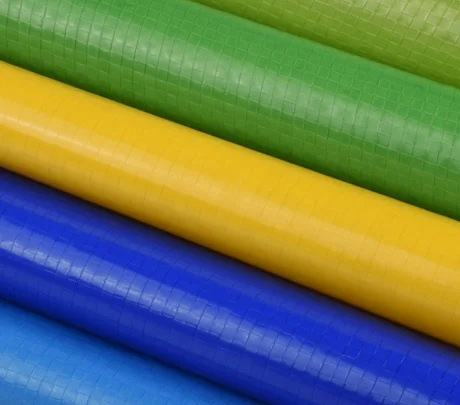
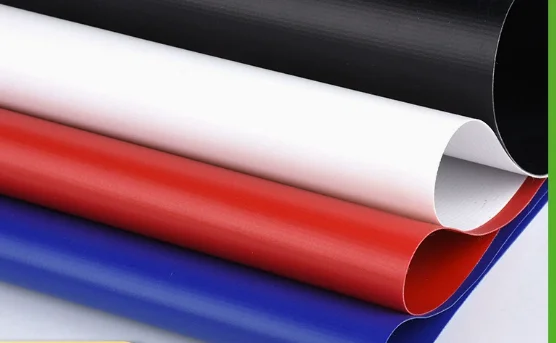
Description
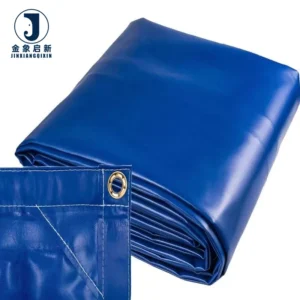
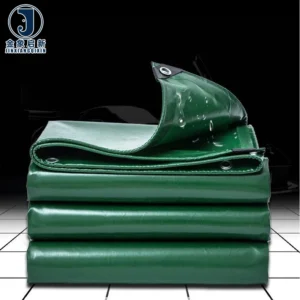
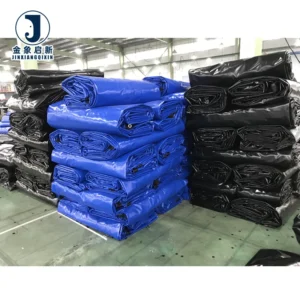
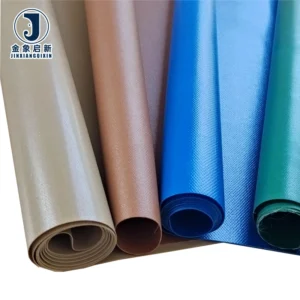
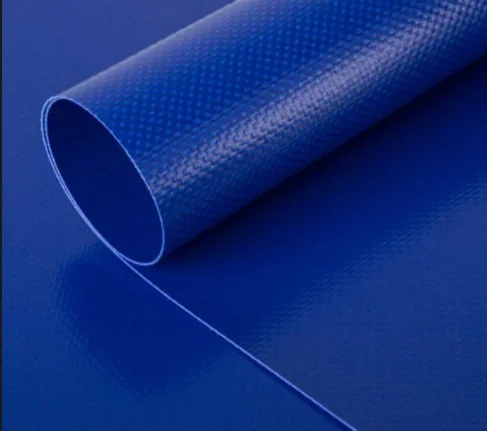
Batch Uniformity — Every roll of knife coated PVC tarpaulin is inspected for GSM, colour, and coating adhesion before dispatch, ensuring distributors receive shipment-to-shipment consistency across container loads.
Technical Specifications
| Parameter | Value |
|---|---|
| Product Type | PVC Knife Coated Tarpaulin Roll |
| Coating Method | Knife coated |
| Coating Material | PVC |
| Key Features | Fire retardant (grade not stated — confirm required grade for your market); UV treated (test basis not stated); antibacterial and mildew proof; oil and stain resistant; acid and alkali resistant; anti-oxidation; self-cleaning surface |
| Temperature Resistance | High temperature and cold resistance |
| Flexibility | Highly flexible, crack resistant under repeated folding |
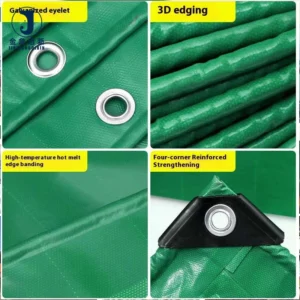
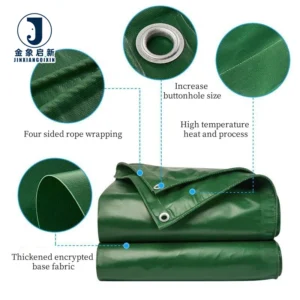
| Welding Compatibility | HF welding, hot air welding, sewing |
| Tensile Strength | Excellent (grade not stated in source) |
| Tear Strength | Excellent (grade not stated in source) |
| Peeling Resistance | Excellent (grade not stated in source) |
| Weather Resistance | Durable and weather-resistant |
Application Suitability
| Application | Exposure & Requirement |
|---|---|
| Tensile membrane structures | Sustained UV exposure, wind loading, long-term colour retention across panels |
| Airport hangar covers | Wide-span fabrication, fire retardant compliance, fuel and chemical exposure |
| Portable storage buildings | Repeated assembly and disassembly, flexing at frame contact points |
| Stadium architectural roofs | Large continuous panels, thermal expansion, high visibility of colour drift between rolls |
| Shade systems and awnings | Continuous sun exposure, self-cleaning surface requirement, batch colour matching |
| Large-format technical textiles | Converter stock requiring roll-to-roll GSM uniformity for downstream lamination or printing |
Why Batch Consistency Matters More Than Quoted GSM for PVC Tarpaulin Roll Wholesale
A quoted GSM figure means nothing if the rolls in one container vary from each other.
When buying PVC knife coated tarpaulin by the roll, distributors and fabricators face a problem that does not show up on a data sheet: colour drift and weight variance between rolls within the same shipment. A fabricator installing tensile panels side by side will see banding the moment two adjacent rolls differ in shade or gloss. A distributor stocking inventory for regional resale cannot explain to their own customers why last month’s roll and this month’s roll do not match. The quoted specification on paper may be correct, but without in-process quality control at every coating stage, the physical product arriving at the warehouse tells a different story [NEED_CITE: tensile and tear test methods for coated fabrics per ISO 1421].
Roll-to-Roll Colour and Weight Control in Volume Supply
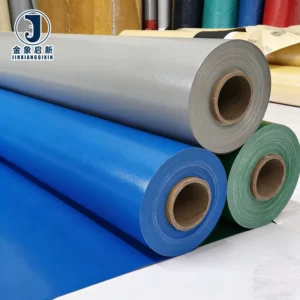
Maintaining consistency across a container load of PVC tarpaulin roll stock requires monitoring at points where variation typically enters the process. Coating weight must be verified not just at the start of a production run but continuously, because PVC paste viscosity shifts with ambient temperature and mixing batch age. Colour matching is set at the paste preparation stage and must be checked against reference standards before coating begins, with additional checks mid-run to catch drift.
For buyers sourcing PVC knife coated tarpaulin roll wholesale, this means requesting a pre-shipment inspection record that documents roll-by-roll GSM verification and colour assessment, not just a single sample from the beginning of the batch.
Welding and Fabrication Compatibility Across Roll Stock
Fabricators cutting from bulk roll inventory need every roll to behave identically under HF welding or hot air joining. Coating thickness variation between rolls forces machine operators to adjust temperature, pressure, and dwell time for each new roll — slowing throughput and increasing reject rates at the seam. Knife coated PVC construction supports HF, hot air, and sewing methods, giving downstream manufacturers flexibility in choosing their fabrication approach [NEED_CITE: HF welding parameters for PVC coated polyester fabrics].
When rolls within the same order share consistent coating weight and base fabric tension, weld settings established on the first roll carry through the entire production run without adjustment.
Understanding What the Knife Coating Process Delivers
Knife coated PVC applies a controlled paste layer directly onto the base fabric under a precision blade, producing a coating with strong mechanical adhesion to the yarn structure. This method builds tensile and tear resistance by ensuring the coating penetrates the weave rather than sitting on the surface as a separate film. The result is a material that resists delamination at stress points — the peeling resistance that distinguishes knife coated fabric from calendered or laminated alternatives.
Surface finish affects long-term maintenance in architectural and shade applications. A self-cleaning surface allows rain to wash away dust accumulation, reducing manual cleaning frequency on installed structures. Anti-oxidation treatment extends the period before surface chalking or yellowing becomes visible, which matters when panels are viewed at close range in public-facing installations like stadiums and airport terminals. Temperature resistance in both directions — cold flexibility and high-temperature stability — determines whether the material can be stored in unconditioned warehouses and deployed across different climate zones without cracking or softening.
The Hidden Cost of Specifying on Weight Alone
Selecting PVC tarpaulin roll stock based solely on GSM ignores the interaction between base fabric construction and coating adhesion that actually determines field performance. A lighter fabric with tight weave density and strong knife coat penetration can outperform a heavier fabric with loose weave and surface-only coating — yet the heavier fabric wins on paper when buyers compare only the quoted weight.
Fire retardant grades present a similar trap. A supplier may describe fabric as fire retardant without specifying which classification standard applies. Building codes in different markets require different grades — B1 per DIN 4102 in parts of Europe, NFPA 701 in North America, M2 in France. A roll that passes one test may not pass another, and the cost of discovering this at site inspection rather than at quotation stage falls entirely on the fabricator or importer [NEED_CITE: DIN 4102 fire classification for building materials].
Colour inconsistency discovered after installation means either replacing entire panels to achieve a uniform appearance or accepting a visible mismatch that damages the fabricator’s reputation with their end client. Either outcome costs far more than verifying colour matching before the container leaves the factory.
Why Volume Buyers Source Knife Coated Rolls Here
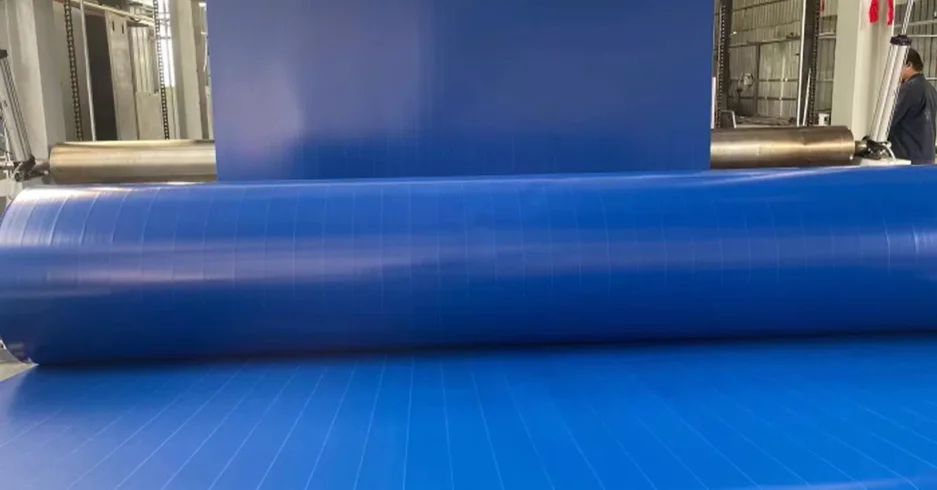
Three full production lines with 36 sets of professional equipment give the capacity to fill container orders without splitting production across disconnected runs, which is where batch variation typically enters.
A 10-person R&D team develops custom width, colour, and surface finish options with sample turnaround measured in days, not weeks — important when distributors need to confirm stock grades before committing to a full container.
Dedicated QA and QC at every production stage, with 100% pre-shipment inspection, means every roll is checked against the order specification before packing, not spot-sampled after the fact.
Nearly 30 years of process control over coating weight and adhesion provides the experience base to anticipate where variation occurs and build checkpoints at those exact stages.
Full documentation accompanies each shipment: material specification sheets matched to each roll batch, pre-shipment inspection records, and packing lists that support freight planning and receiving verification.
Documentation & Verification
- Material specification sheet stating GSM, base fabric construction, and coating type per roll batch
- Pre-shipment inspection record confirming roll-by-roll weight and colour check before dispatch
- Fire retardant and UV treatment test reports provided with documentation package where applicable
- Roll packing list with roll count, net weight, and container loading plan for freight coordination
- Certificate of origin and customs documentation supporting international shipment clearance
Fabrication, Handling & Storage
- HF welding settings should be validated on a sample from each new roll batch to confirm coating thickness consistency
- Hot air welding temperature and speed must match the knife coated PVC layer thickness to achieve full seam adhesion
- Store rolls upright on pallets in shaded conditions to prevent surface compression marks on the self-cleaning coating
- Allow cold-stored rolls to reach ambient temperature before unrolling to avoid stiffness-related cracking
- Use compatible PVC-based cleaners only — solvent-based products may degrade the antibacterial surface treatment
- Plan cutting layouts to minimise off-cuts, accounting for available roll widths against panel dimensions
What to Include in Your PVC Tarpaulin Roll Enquiry
Provide your target application and the environmental conditions the installed fabric will face — sustained sun exposure, chemical contact, or temperature extremes — so the appropriate treatment grade can be recommended. Specify the roll widths and GSM range your fabrication setup requires, along with estimated annual volume, to receive accurate lead time and minimum order guidance.
If your market mandates a particular fire retardant classification or UV performance standard, state the exact requirement upfront so test reports can be prepared alongside your quotation rather than after the order is placed.
Frequently Asked Questions
Q: How is roll-to-roll colour consistency controlled across a bulk PVC tarpaulin roll order?
A: Colour is set at the paste preparation stage using reference standards, then verified at multiple points during production. A pre-shipment inspection checks each roll against the approved colour reference before packing, ensuring every roll in a container matches. Buyers receive an inspection record documenting these checks alongside the material specification sheet.
Q: What widths and roll lengths are available for stock versus custom PVC knife coated tarpaulin roll grades?
A: Stock grades are held in commonly ordered widths suitable for standard fabrication equipment. Custom widths and roll lengths are produced to order, with lead times and minimum order quantities confirmed during the quotation stage. Buyers should specify their equipment’s maximum working width and preferred roll length for the most efficient cutting layout.
Q: How is GSM verified on arrival and what documentation supports the quoted weight?
A: Each roll batch is inspected for GSM before dispatch, and the results are recorded in the pre-shipment inspection document. This record accompanies the shipment alongside the material specification sheet, which states the quoted GSM, base fabric, and coating details. Buyers can cross-reference the inspection record with their own receiving measurements.
Q: What container loading options are available by roll count and total weight?
A: A detailed roll packing list is prepared before dispatch, showing roll count, individual roll weight, and total shipment weight. Container loading plans are provided to help buyers plan freight and receiving. The packing format protects rolls during transit and supports efficient unloading at the destination warehouse.
Q: What welding and fabrication methods work with this knife coated PVC tarpaulin fabric?
A: The knife coated PVC construction is compatible with HF welding, hot air welding, and industrial sewing. Fabricators should validate machine settings on a sample cut from each new roll to confirm optimal parameters. The coating adhesion achieved through the knife coating process supports strong weld seams that match the base fabric strength.