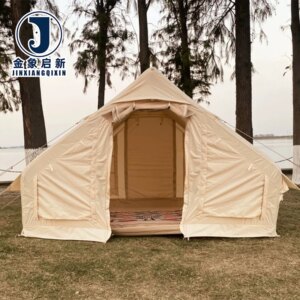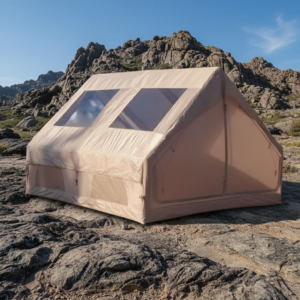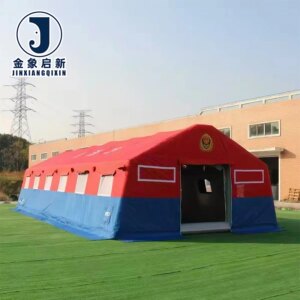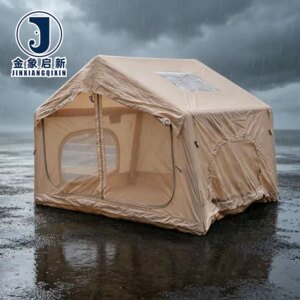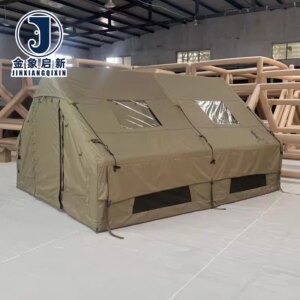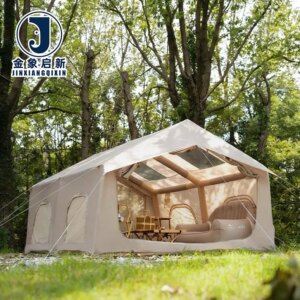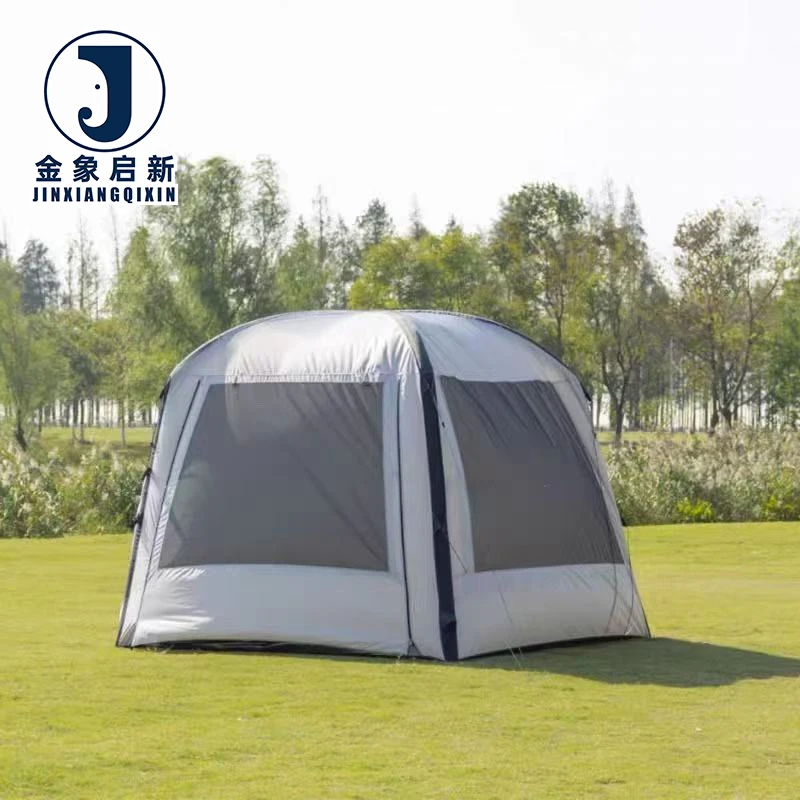
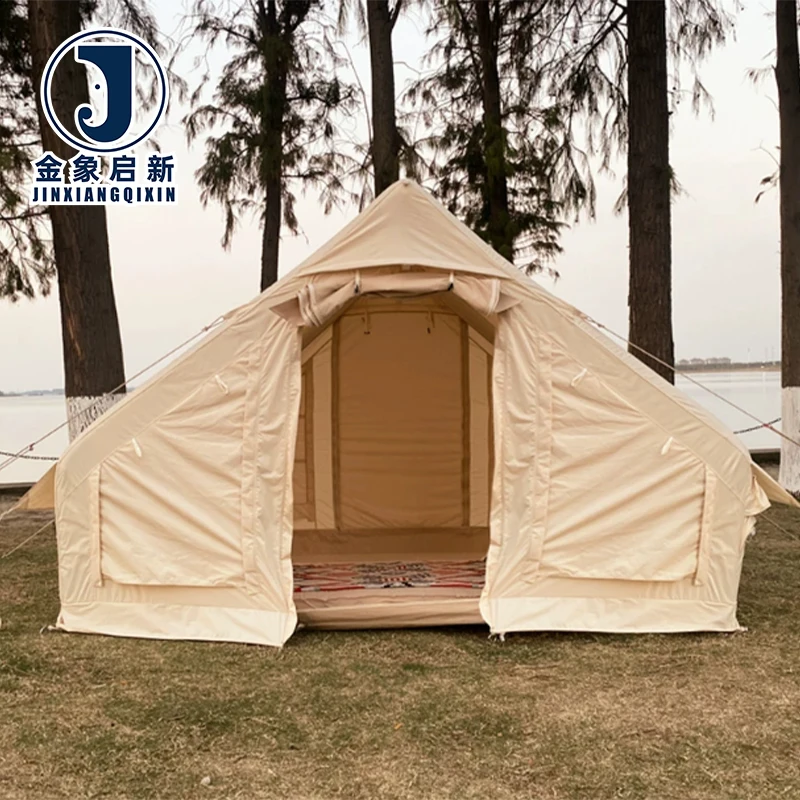
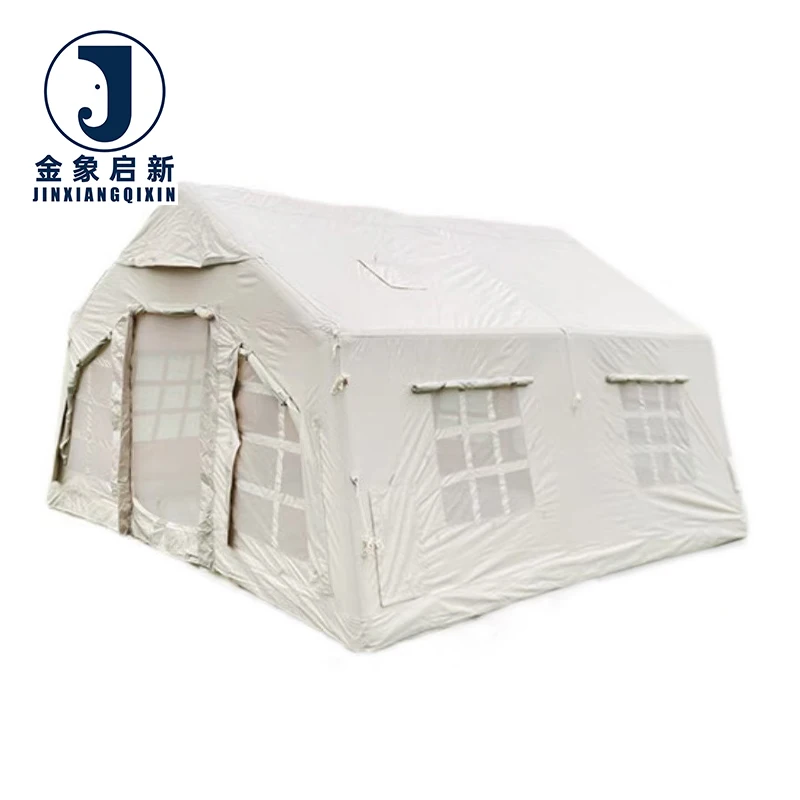
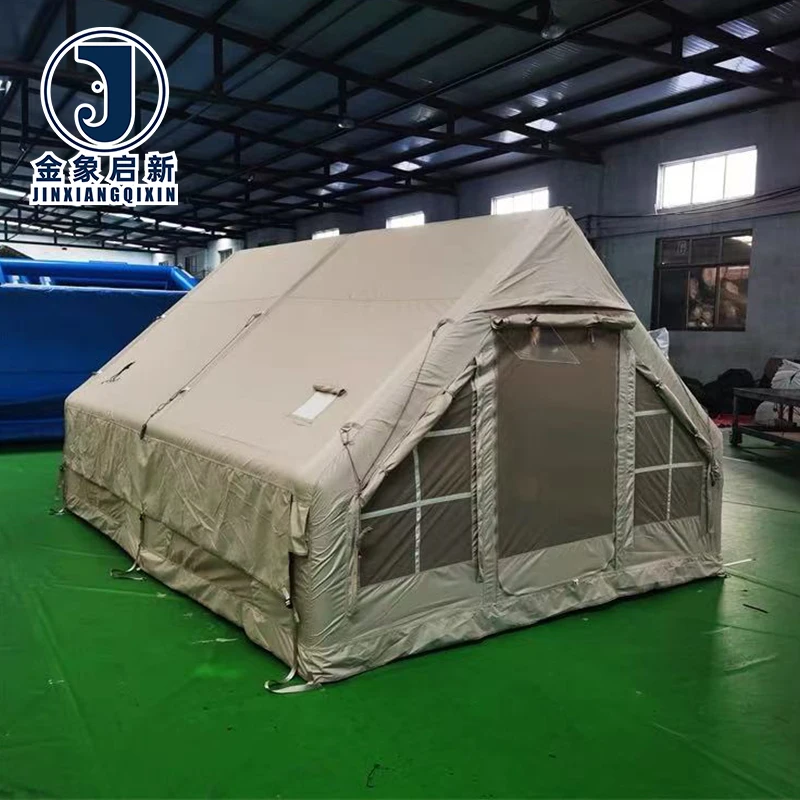
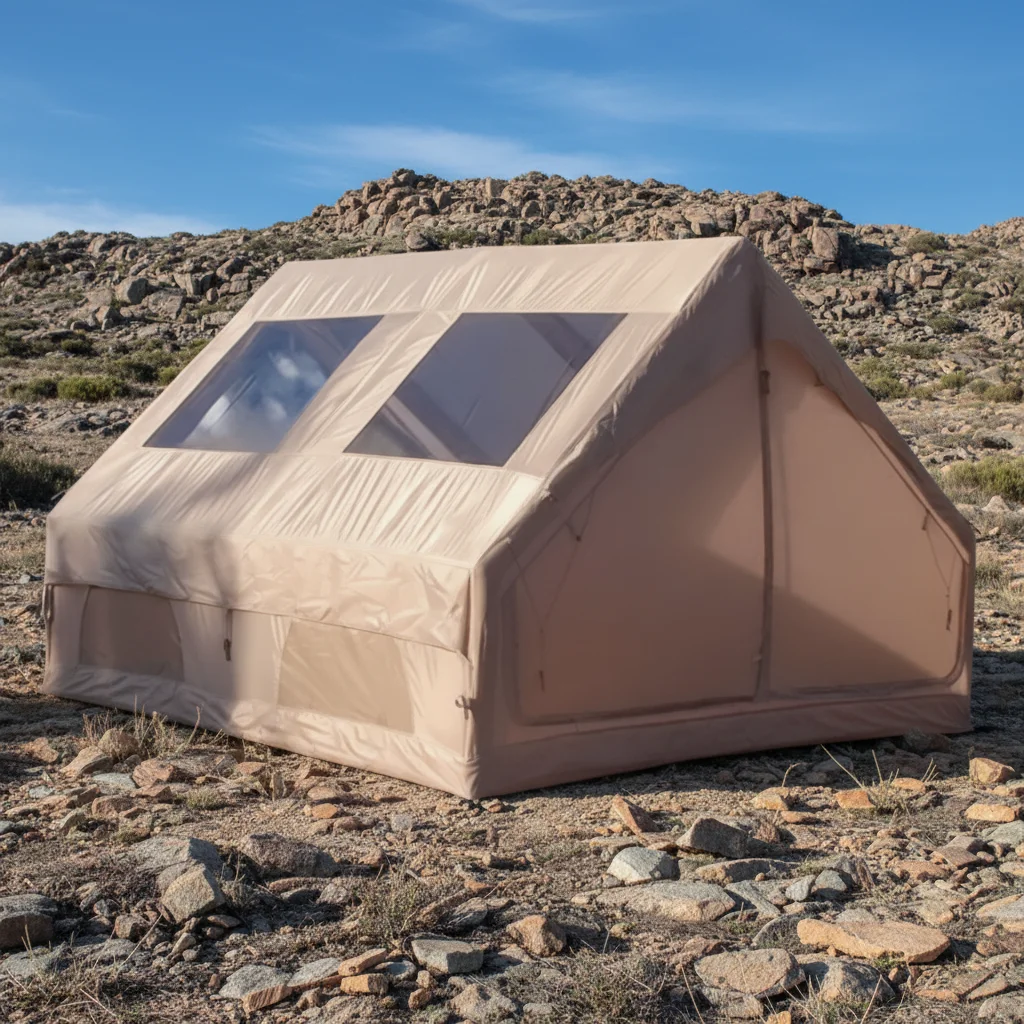
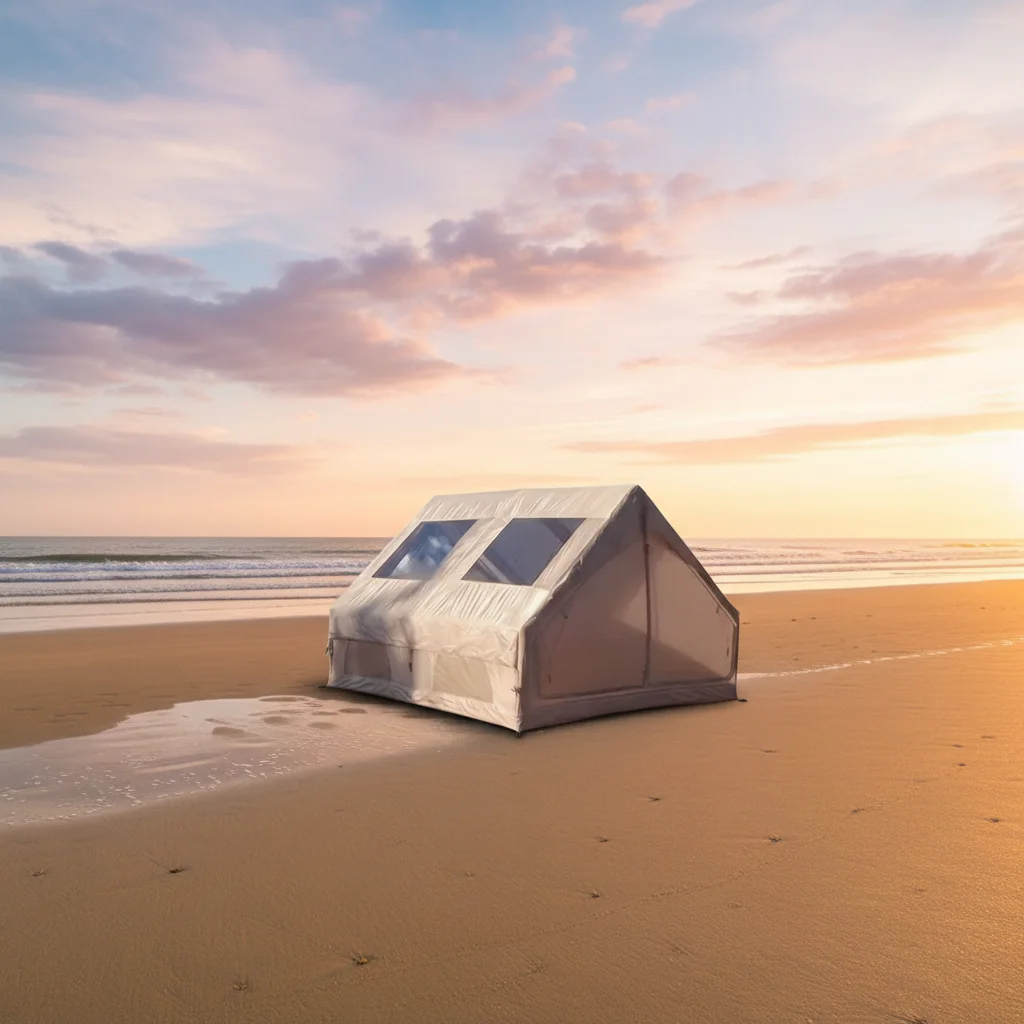
Description
Coated Fabric Expertise — nearly three decades of PVC coating process control applied to inflatable structure fabric, ensuring consistent air retention and seam integrity across every production run.
Technical Specifications
| Parameter | Value |
|---|---|
| Product Type | PVC 6-Person Inflatable Glamping Tent |
| Core Material | PVC knife-coated tarpaulin |
| Capacity | 6-person |
| Waterproof Rating | 1000mm water column |
| Flame Retardant Grade | DIN 4102 B1 |
| UV Resistance | 2000-hour accelerated aging tested |
| Air Retention | 72-hour pressure hold, <0.5% leakage per hour |
| Wind Load Resistance | Up to 12 m/s |
| Seam Strength | 250 N minimum |
| Material Thickness Tolerance | ±0.1 mm |
| Hardware Durability | 500-cycle operation tested |
| Inflation System | Airtight, quick automatic opening |
| Customization | OEM & ODM, Pantone color matching, logo printing, custom dimensions, accessory configurations |
| Certifications | ISO 9001, ISO 14001, ISO 45001, CE |
Application Suitability
| Application | Exposure & Requirement |
|---|---|
| Commercial glamping and camping ground operations | Continuous outdoor deployment across four seasons, UV exposure, wind loading, guest safety compliance |
| Construction site temporary shelters | Rapid-deploy enclosures, dust and weather protection, fire-retardant site requirements |
| Outdoor event and exhibition facilities | Frequent inflation and deflation cycles, branded appearance, transport and storage durability |
| Industrial mobile workspaces | Extended field use, abrasion from ground contact, structural stability under variable weather |
Why Inflatable Tent Fabric Buyers Cannot Rely on Unverified Flame-Retardant Claims
A fire-retardant rating without a named standard is a liability, not a feature.
When procurement teams source a custom inflatable tent for commercial or industrial sites, the site safety officer will ask for the test certificate before the structure goes up. Suppliers who state "flame retardant" without referencing DIN 4102 B1 or an equivalent standard leave buyers exposed to site inspection failures and contract penalties [NEED_CITE: DIN 4102 fire classification for building materials]. In our experience reviewing field returns, inflatable structures that lack traceable flame-retardant documentation are frequently rejected at commissioning, causing costly project delays that no amount of material savings can offset.
How Knife-Coated PVC Delivers Structural Air Retention
The inflatable tent fabric manufacturer process begins with a knife-coated PVC layer applied to a woven base fabric, creating a composite that holds air under sustained pressure. Unlike dipped or laminated coatings, knife coating controls the material deposit precisely, which directly supports the 72-hour airtight retention specification. For buyers evaluating a PVC inflatable tent aftermarket supplier, this coating method also determines how well the fabric withstands repeated inflation and deflation cycles without delamination at stress points.
What 12 m/s Wind Load Means for Site Planning
Wind load resistance up to 12 m/s positions this inflatable structure for open-terrain deployment, where gusts impose cyclical lateral forces on every welded seam. The 250 N minimum seam strength specification addresses this directly: seams are typically the first failure point when wind load exceeds design limits [NEED_CITE: tensile and tear test methods for coated fabrics per ISO 1421]. Buyers planning installation in exposed locations should factor local wind data into anchoring design, treating the fabric rating as one element of a complete structural system.
Reading the Specification Sheet Beyond Surface Claims
Waterproof rating, thickness tolerance, and flame-retardant grade each interact with real deployment conditions. The 1000 mm water column rating confirms the coated surface resists water penetration under hydrostatic head pressure, relevant for sustained rainfall on a deployed structure. Thickness tolerance of ±0.1 mm matters because inconsistent material gauge causes uneven stress distribution during inflation, leading to localized weak zones. The DIN 4102 B1 classification aligns with European fire safety requirements for temporary structures, but buyers targeting North American or Middle Eastern markets should confirm whether NFPA 701 or local civil defense standards apply instead. Hardware rated to 500 operation cycles indicates valve and connection points are tested for the repeated setup-and-strike rhythm that event and construction schedules demand.
The Hidden Cost of Skipping Pre-Production Samples
When buyers approve an inflatable tent order without reviewing a physical sample, the most common field complaint involves seam failure at the inflation chamber junction. Welded seams on PVC knife-coated fabric require specific temperature and dwell-time settings; if the factory adjusts these parameters to increase throughput, the weld line becomes the weakest point in the structure [NEED_CITE: high-frequency welding parameters for PVC coated fabrics]. A seam that fails before the fabric body does is almost always traceable to rushed production settings rather than material deficiency, and it is preventable through sample-stage verification of peel strength at every welded joint.
Why Sourcing from a Coated-Fabric Specialist Matters
Process control over PVC coating weight and adhesion is maintained across three full production lines, giving the inflatable tent fabric manufacturer capacity to handle volume orders without splitting batches across subcontractors. A ten-person R&D team develops custom Pantone matches, logo prints, and dimensional variations before production begins, reducing revision cycles after the order is placed. Every roll undergoes an 8-point inspection covering seam strength, thickness tolerance, and waterproof integrity before shipment. ISO 9001, ISO 14001, ISO 45001, and CE documentation ships with each batch, providing the traceability that commercial and industrial procurement requires. Sample development within days allows buyers to validate material feel, weld quality, and color accuracy before committing to full production.
Documentation & Verification
- Material specification sheet stating PVC resin grade, knife-coating method, and verified GSM for this inflatable tent fabric
- DIN 4102 B1 flame-retardant test report included with each shipment batch
- 2000-hour UV accelerated aging test report available for extended outdoor deployment verification
- ISO 9001, ISO 14001, ISO 45001, and CE certificates accompanying every dispatch
- Pre-shipment inspection record with digital quality report covering seam strength and thickness tolerance
- 8-point QA/QC batch record available for buyer audit upon request
Fabrication, Handling & Storage
- High-frequency welding temperature and dwell time must match PVC knife-coated thickness to achieve 250 N minimum seam strength
- Store rolls vertically in shaded, climate-controlled space to prevent permanent creasing in the ±0.1 mm tolerance coated material
- Avoid dragging inflated structures across abrasive ground surfaces to protect the waterproof PVC coating layer
- Clean with mild detergent only; solvent-based cleaners can degrade the knife-coated surface and compromise UV additives
- Cold-weather deployment requires gradual inflation to allow PVC fabric to reach flexibility without stressing cold-stiffened seams
What to Include in Your Inquiry
Provide the intended deployment environment, including typical wind conditions, expected duration of continuous inflation, and any fire-safety standards your local authority requires. Specify whether you need stock dimensions or custom sizing with Pantone color matching and logo placement. Indicate your annual volume and whether pre-production samples with revision cycles are required before bulk commitment.
Frequently Asked Questions
Q: What fire-retardant certifications does the tent fabric carry, and do they meet my target market’s requirements?
A: The fabric carries DIN 4102 B1 classification, which satisfies European temporary-structure fire codes. Buyers targeting markets governed by NFPA 701, BS 7837, or local civil defense regulations should confirm equivalency with their authority before ordering. Test reports ship with every batch for submission to site inspectors.
Q: How is UV resistance tested and verified for extended outdoor exposure?
A: The PVC knife-coated fabric undergoes 2000-hour accelerated UV aging in a controlled chamber, simulating prolonged sun exposure. A test report documenting the result is available per shipment. Buyers deploying in high-irradiance regions should request the report to confirm suitability for their specific latitude and season.
Q: What customization options are available for dimensions, color, and branding?
A: OEM and ODM services cover custom dimensions, Pantone color matching, logo printing, and accessory configurations such as ventilation systems and door types. Pre-production samples are provided with up to three revision cycles to validate color accuracy and print clarity before bulk production begins.
Q: How do you ensure batch-to-batch color and material consistency across large orders?
A: Each production run references a locked Pantone standard and a material specification sheet covering GSM, base fabric, and coating weight. The 8-point pre-shipment inspection compares every roll against the approved sample. Digital batch records are maintained and available for buyer review.
Q: What documentation is included with each shipment, and can third-party testing be arranged?
A: Standard documentation includes the material specification sheet, DIN 4102 B1 test report, UV aging report, ISO and CE certificates, pre-shipment inspection record, and packing list. Third-party testing through SGS, Intertek, or TÜV can be arranged upon request before dispatch.