
Description
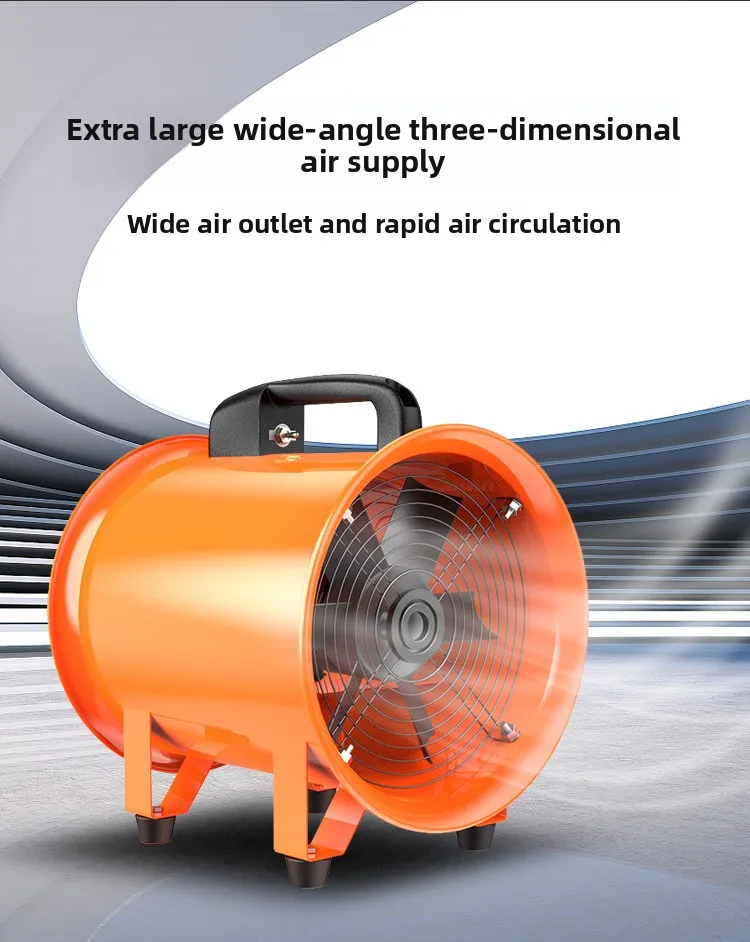
Sustained Output Capacity — 11 fan models from 200mm to 900mm held in regular production runs, supporting bulk site deployments without splitting orders across multiple suppliers.
Technical Specifications
| Parameter | Value |
|---|---|
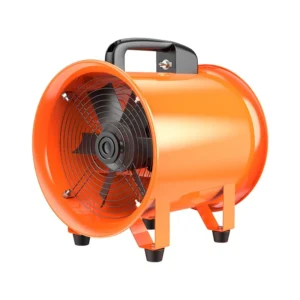
| Product Type | Axial Flow Fan |
| Size Range | 200mm, 250mm, 300mm, 350mm, 400mm, 450mm, 550mm, 650mm, 750mm, 850mm, 900mm |
| Power Range | 250W to 5500W |
| Air Volume Range | 1300 m³/h to 28000 m³/h |
| Total Pressure Range | 140 Pa to 320 Pa |
| Voltage | 220V / 380V |
| Speed | 3000 RPM |
| Noise Level | 57 dB(A) to 88 dB(A) depending on model |
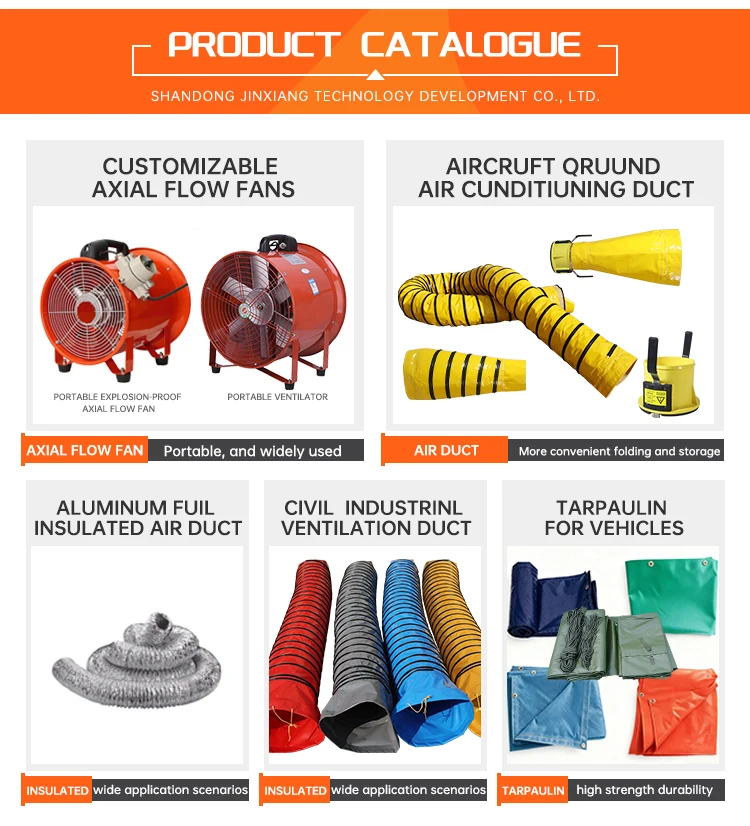
| Accessory | Flexible Duct Hose |
| Standards | ISO, CE |
Application Suitability
| Application | Exposure & Requirement |
|---|---|
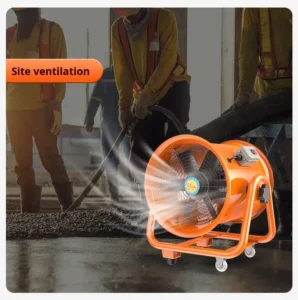
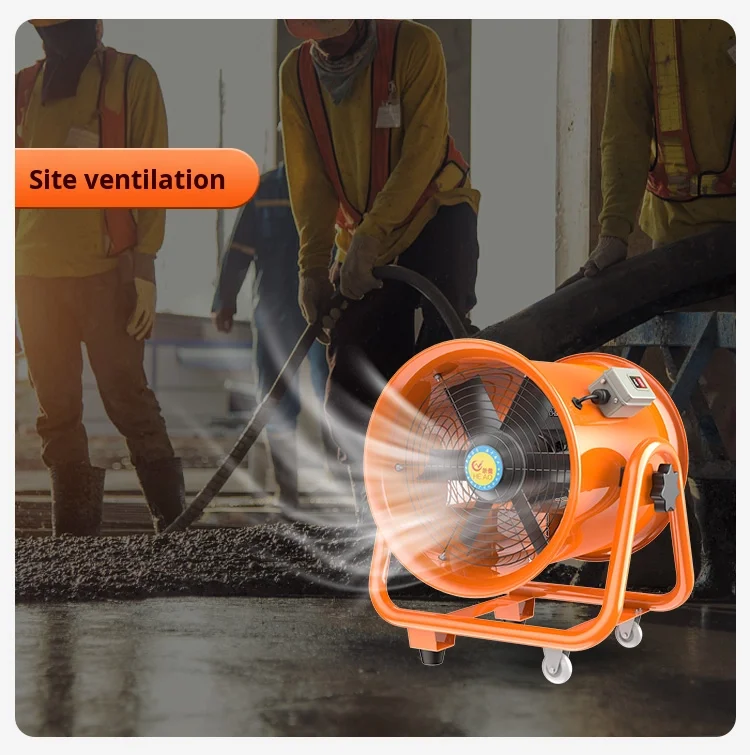
| Construction site exhaust ventilation | Dust-laden air, temporary setup, frequent relocation between zones |
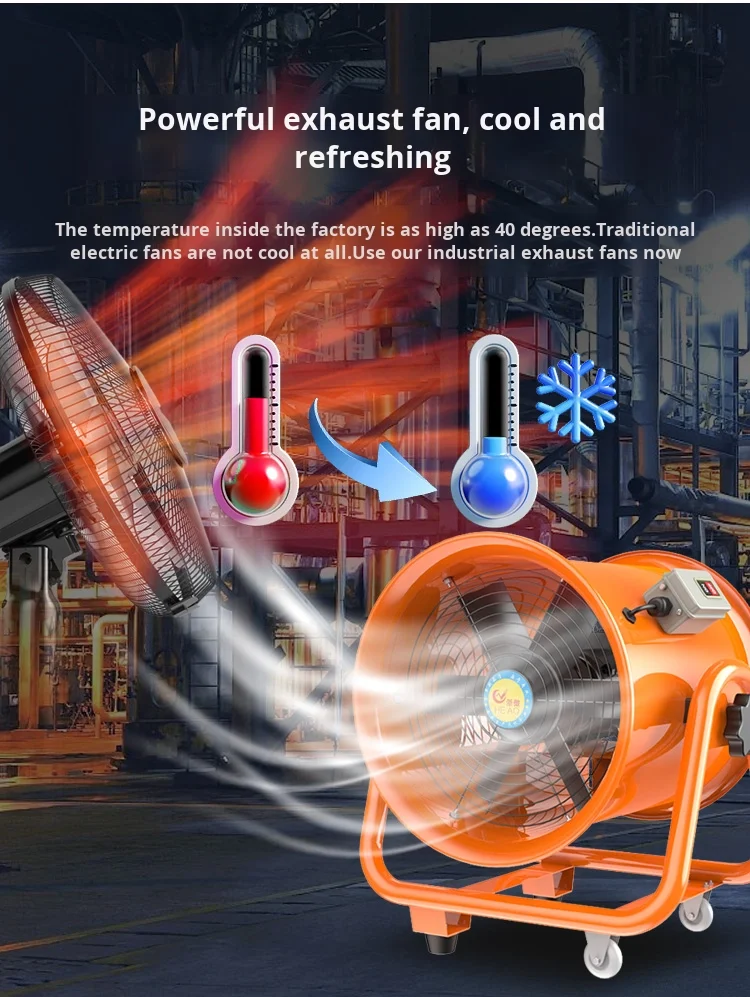
| Factory floor fume extraction | Continuous duty operation, chemical vapour exposure, fixed duct runs |
| Mining and tunnelling ventilation | Confined space airflow, extended duct hose lengths, high static pressure demand |
| Warehouse and workshop air movement | Intermittent use, general particulate clearance, low to medium duct runs |
Why Air Volume Figures Alone Do Not Guarantee Site Compliance
Matched fan pressure and duct hose resistance determine whether breathable air actually reaches the work face.
Ventilation is often the last item specified on a site mobilisation list. By the time the portable axial flow fan for industrial ventilation and duct hose are ordered, other equipment has already arrived and crews are waiting for breathable air. Selecting a unit based only on air volume without accounting for duct run length, bends and friction loss leads to underperforming systems that fail site safety audits [NEED_CITE: industrial ventilation design standards for confined space work].
Procurement teams sourcing multiple units for a single project also face batch consistency issues — fans arriving with different motor characteristics or duct connectors that do not mate properly on site create delays that no airflow calculation can predict.
Sizing the Fan and Duct Hose for Your Airflow Requirement
Choosing the correct portable axial flow fan for industrial ventilation starts with calculating total system resistance. Every metre of flexible duct hose adds friction loss, and each bend or junction reduces effective air volume at the delivery end. A 300mm fan rated at 1300 m³/h in free air may deliver substantially less when connected to a 20-metre duct run with two 90-degree bends.
Larger diameter fans in the 650mm to 900mm range generate higher total pressure, maintaining airflow over extended duct lengths typical in tunnelling and deep excavation work. Confirming the required air delivery at the work face — not just the fan outlet — prevents undersized installations that compromise worker safety and regulatory compliance.
Voltage Selection and Site Electrical Infrastructure
Site power availability dictates whether a 220V or 380V configuration is specified. Single-phase 220V units in the smaller size range suit temporary construction setups where standard electrical outlets are available. Three-phase 380V models in the higher power range connect directly to site distribution boards and industrial generators [NEED_CITE: electrical supply requirements for portable ventilation equipment on construction sites].
Mismatched voltage specification causes motor burnout or underperformance. Buyers consolidating orders across multiple project sites should confirm the electrical supply at each location before finalising the fan model and quantity, particularly when deploying units to remote mining or tunnelling operations where power infrastructure varies.
Reading the Specification Sheet Beyond the Air Volume Number
Air volume rated in m³/h indicates free-air delivery with no duct connected. Once a flexible duct hose is attached, the operating point shifts along the fan curve, and actual delivery depends on total system resistance measured in Pascals. The total pressure range of 140 Pa to 320 Pa across the model lineup reflects each fan’s ability to overcome this resistance.
Power consumption from 250W to 5500W correlates with both air volume and pressure capability. Higher wattage models push air through longer duct runs or against greater back-pressure from filters and junction boxes. Noise levels ranging from 57 dB(A) to 88 dB(A) scale with fan size and motor power, which affects placement decisions in occupied work areas where hearing protection limits apply.
The Hidden Cost of Underspecified Ventilation Systems
When a portable axial flow fan for industrial ventilation is selected without calculating duct friction loss, the result is a system that measures compliant at the fan outlet but delivers insufficient air at the work face. Site inspectors testing at the delivery end record readings below threshold, triggering work stoppages that cost far more than the price difference of a correctly sized unit [NEED_CITE: consequences of inadequate ventilation in confined space operations].
Batch inconsistency across multiple fans ordered for the same project compounds the problem. Units with varying motor performance characteristics produce uneven airflow across different zones, making it impossible to demonstrate uniform compliance during a site audit.
Why Bulk Buyers Source Ventilation Equipment Here
A complete size range from 200mm to 900mm allows a single purchase order to cover every ventilation zone on a project, eliminating the coordination overhead of splitting orders across multiple suppliers. Production runs maintain motor and connector consistency across units in the same batch, so fans deployed to different zones perform predictably.
Dedicated pre-shipment inspection verifies each unit before dispatch, catching assembly defects that would otherwise surface during site commissioning. The 10-person R&D team supports voltage and frequency adaptation for export markets, confirming compatibility before production begins. Documentation packages ship with every order, providing the traceability that site safety managers require for audit records.
Documentation & Verification
- Product specification sheet confirming fan size, power, air volume and pressure rating per model
- ISO and CE certification documentation provided with each shipment
- Pre-shipment inspection record verifying motor performance and assembly integrity before dispatch
- Packing list detailing unit count, model breakdown and container loading configuration
- Certificate of origin and customs documentation supporting international freight clearance
Fabrication, Handling & Storage
- Flexible duct hose connects to fan outlet via clamped collar — confirm diameter match before site deployment
- Store fans upright on pallets to prevent motor bearing load from prolonged horizontal positioning
- Protect flexible duct hose from sharp edge contact during installation to avoid inner lining puncture
- Verify 220V or 380V supply at the connection point before energising the motor
- Inspect duct hose for compression creases after transport and fully extend before clamping to the fan outlet
What to Include in Your Ventilation Enquiry
Specify the duct run length, number of bends and required air volume at the work face so the correct fan size and pressure rating can be recommended. Confirm the site voltage supply and whether single-phase or three-phase power is available at each installation point.
Indicate the total quantity needed and whether units will be deployed to a single site or distributed across multiple locations, as this affects production scheduling and batch allocation. State any fire-retardant or anti-static certification requirements for the flexible duct hose based on your site safety regulations.
Frequently Asked Questions
Q: How do I determine which fan size delivers the airflow my duct run requires?
A: Calculate total system resistance by adding friction loss per metre of flexible duct hose plus losses from each bend and junction. Compare the result against the fan’s pressure curve at the required air volume. Our technical team can run this calculation if you provide the duct layout, run length and target airflow at the delivery end.
Q: Is the flexible duct hose included with the fan or ordered separately?
A: The flexible duct hose is supplied as an accessory paired to the fan model. Specify the required hose length and confirm the diameter matches the fan outlet size. Fire-retardant or anti-static hose variants are available — state your site compliance requirements when requesting the quotation.
Q: What documentation ships with the fans for site safety audits?
A: Each shipment includes a product specification sheet, CE and ISO certification documents, and a pre-shipment inspection record. These documents provide the traceability that site safety managers need to demonstrate compliance during regulatory inspections and internal audits.
Q: Can multiple fans be matched for consistent airflow across a large site?
A: Yes. Fans from the same production batch maintain consistent motor characteristics and airflow performance. Specify the total quantity and deployment plan in your enquiry so units can be allocated from a single production run, ensuring uniform performance across all ventilation zones on your project.