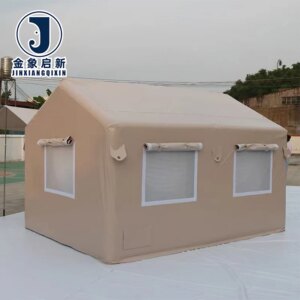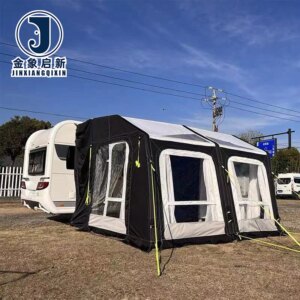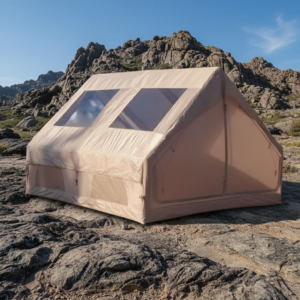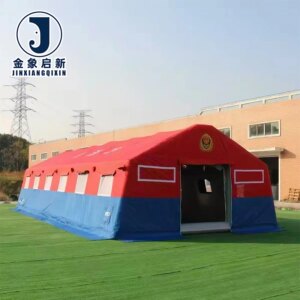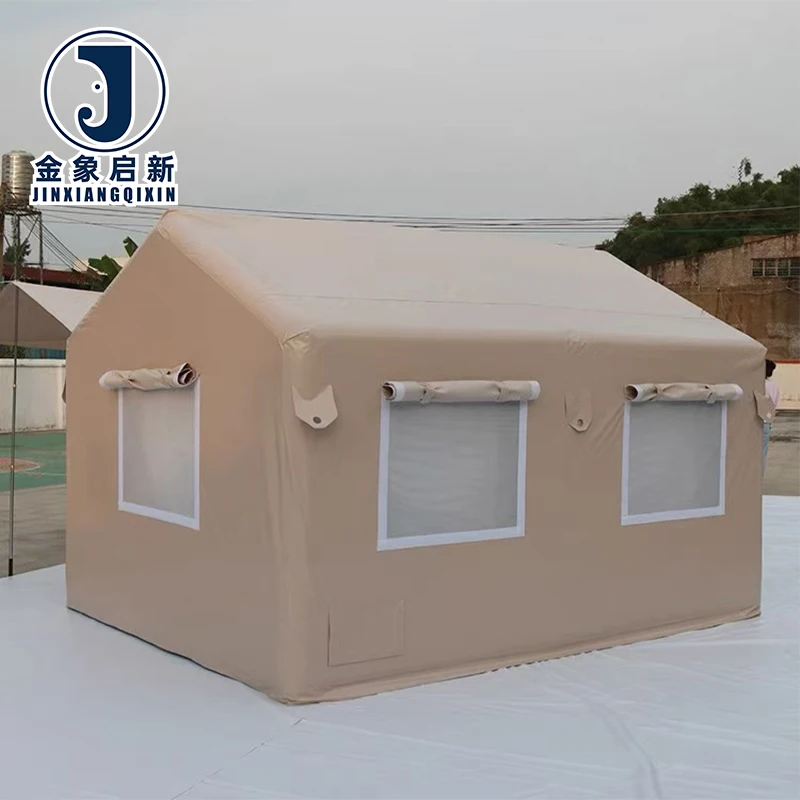
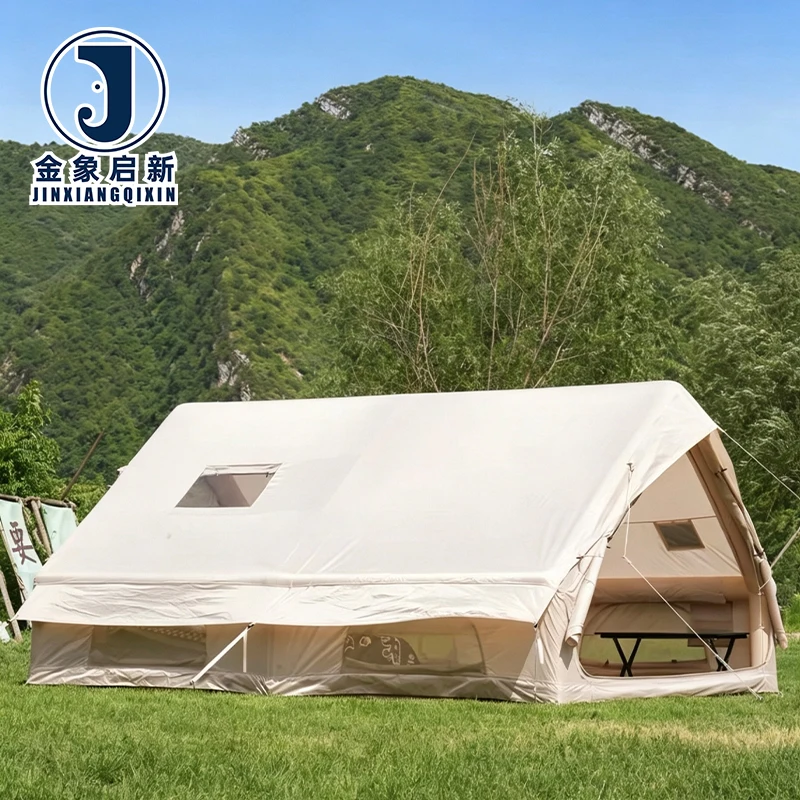
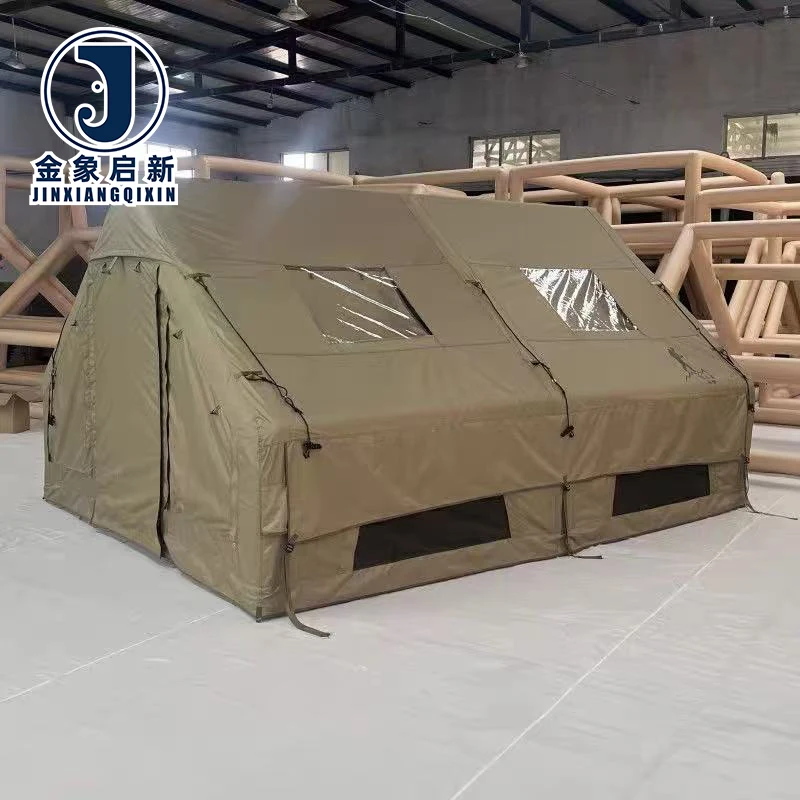
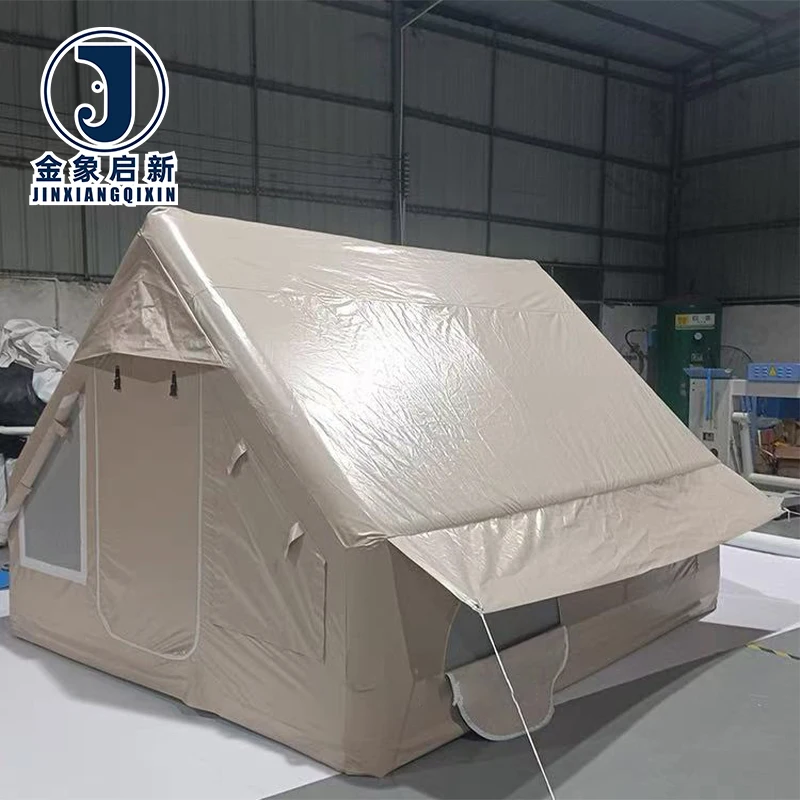
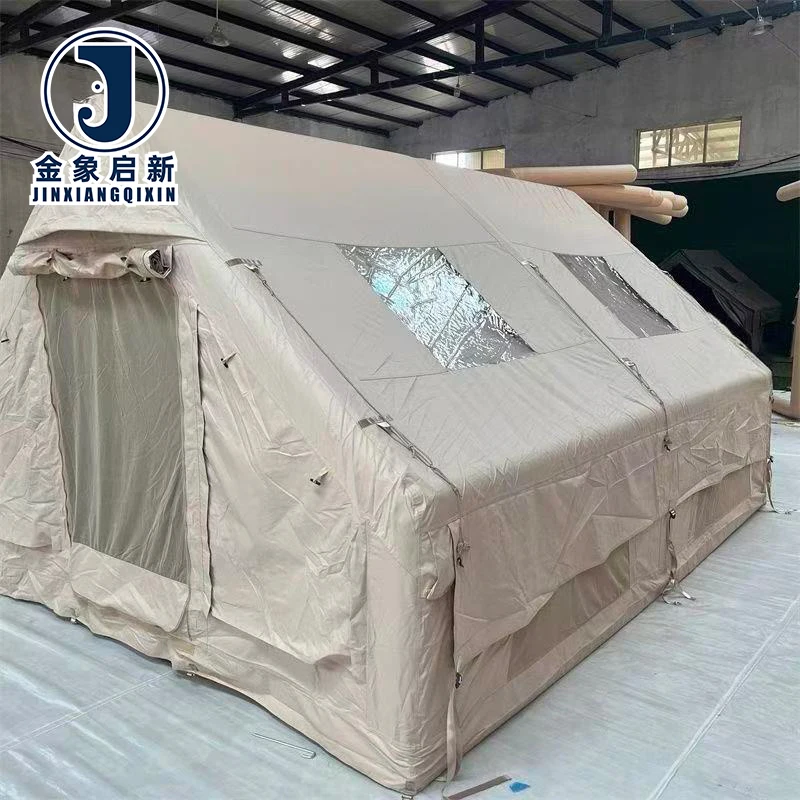
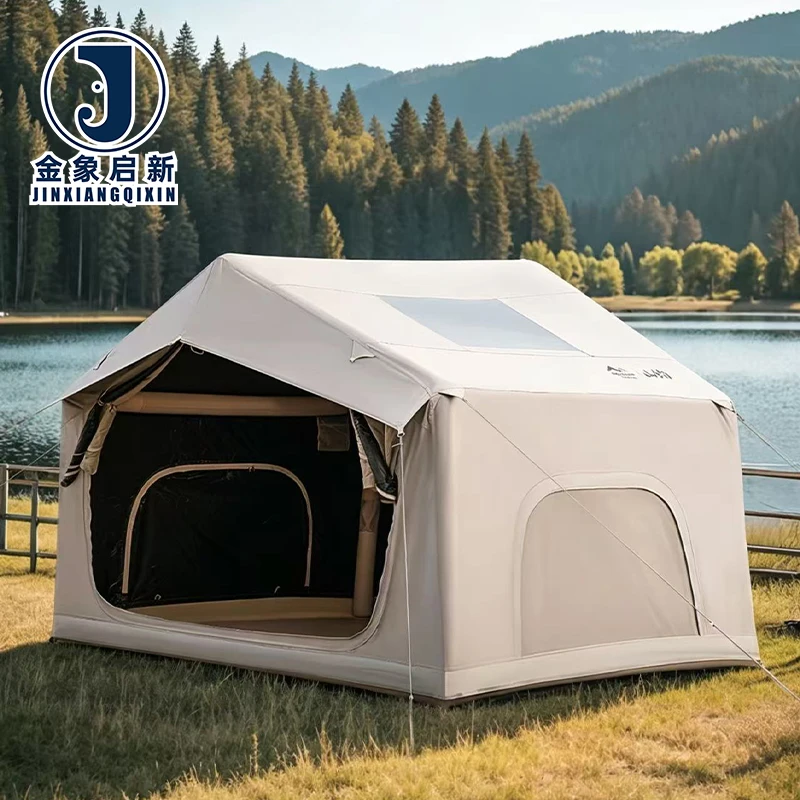
Description
Roll-to-Roll Consistency — Three dedicated production lines maintain batch uniformity across every PVC inflatable tent order, ensuring material and colour stay identical from first unit to last.
Technical Specifications
| Parameter | Value |
|---|---|
| Product Type | Inflatable Tent |
| Capacity | 6-8 persons |
| Opening Mechanism | Quick automatic opening |
| Design Feature | Four-season design |
| Construction | Single layer |
| Type | Extended type |
| Core Material | PVC tarpaulin |
| Key Features | Waterproof, UV-resistant (test basis not stated), tear-resistant |
| Customization | OEM & ODM support |
| Standards | ISO9001, ISO14001, ISO45001, CE |
Application Suitability
| Application | Exposure & Requirement |
|---|---|
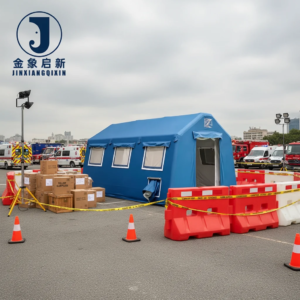
| Construction site command centers | Continuous outdoor exposure, wind load, dust and debris impact, rapid deployment need |
| Logistics storage shelters | Heavy goods movement, forklift proximity, weather protection for inventory |
| Emergency response staging areas | Unpredictable terrain, extreme weather, immediate inflation and structural stability |
| Outdoor industrial events | Crowd loading, UV exposure, repeated assembly and teardown cycles |
| Temporary workspace solutions | Prolonged occupation, ventilation requirements, thermal insulation needs |
Why Colour Drift Between Units Undermines a Bulk Inflatable Tent Order
A ten-unit PVC inflatable tent deployment that shows three different shades across the site fails before anyone checks the seams.
Colour variation between units in the same shipment is one of the most visible failures a tarpaulin distributor can deliver to an end client. When PVC inflatable tents are deployed side by side at a construction site or event venue, even minor pigment inconsistencies across the batch become obvious. This is not a cosmetic complaint—it signals uneven coating dispersion or pigment mixing that may also affect UV resistance and tensile behaviour unit to unit. [NEED_CITE: coating dispersion variance and its effect on mechanical performance in PVC tarpaulins] Procurement teams ordering inflatable tent roll stock in volume need assurance that every unit in the container matches the approved sample, not just in weight but in colour, texture, and surface finish.
How Batch Consistency Is Controlled Across the Line
Maintaining identical PVC inflatable tent characteristics across a large production run requires controlled input at every stage. The PVC compound must be mixed to a single formula batch, and the coating weight held constant through calibrated feed systems on each of the three production lines. When a distributor orders PVC inflatable tent wholesale volumes, the coating thickness, surface gloss level, and base fabric tension must remain stable from the first metre of fabric to the last—otherwise, finished tents cut from different roll positions will behave differently under inflation pressure.
What Happens When Coating Adhesion Varies Unit to Unit
A PVC inflatable tent relies on consistent seam integrity and air-holding performance across its entire envelope. If coating adhesion to the base fabric varies between rolls, some units will hold shape under full inflation while others develop soft spots or delamination at welded joints. This kind of inconsistency only reveals itself after deployment, making it a costly failure for contractors who have already committed to a site schedule. [NEED_CITE: coating adhesion test methods for PVC coated fabrics per ISO standards] Full-process quality inspection with dedicated QA and QC staff at every production stage catches these deviations before rolls reach the cutting table.
Reading the Specs That Actually Matter for Inflatable Fabric
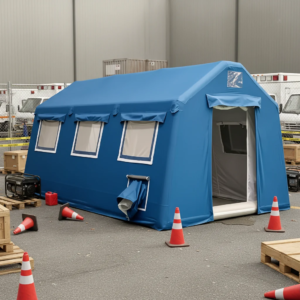
The single-layer extended-type construction of this PVC tarpaulin balances transport efficiency with structural rigidity once inflated. A lighter construction reduces packed volume and shipping weight per unit, which directly affects container loading calculations for wholesale buyers. The quick automatic opening mechanism depends on uniform material flexibility—if the PVC compound is too stiff in some sections and too soft in others, inflation will be uneven and setup times will vary unpredictably across the batch. The waterproof and tear-resistant properties of the core PVC tarpaulin ensure the tent body withstands ground contact, wind-driven rain, and mechanical stress from anchoring points without requiring a secondary protective layer.
The Cost of Overlooking Material Uniformity in Bulk Orders
When a distributor accepts a PVC inflatable tent shipment without verifying batch consistency, the consequences compound. A construction contractor who deploys ten units as site offices and finds that two have noticeably different surface colour will reject the entire lot, not just the two affected units. Welded seams on inflatable structures face continuous stress from internal air pressure; if the PVC coating weight varies between units, some welds will fail prematurely while others hold, creating unpredictable field performance. [NEED_CITE: weld strength variation in PVC tarpaulin inflatable structures] These are not edge cases—they are the most common complaints from end users who sourced inflatable tent roll stock without requesting batch-specific inspection documentation.
Why Sourcing PVC Inflatable Tents from a Specialist Coated Fabric Plant Matters
This is not a trading company reselling finished goods from multiple workshops. The PVC tarpaulin core material is produced, coated, and finished under one roof, giving direct control over every variable that affects the final inflatable tent. Three full production lines and 36 sets of professional equipment support the volume requirements of wholesale buyers without subcontracting to external shops where quality oversight is limited. A 10-person R&D team handles material selection, pattern development, and sample fabrication, meaning OEM and ODM specifications are developed in-house rather than passed through intermediaries. Every unit undergoes 100% pre-shipment inspection, not random sampling, so the PVC inflatable tent wholesale buyer receives documented verification of each order.
Documentation & Verification
- Material specification sheet confirming PVC tarpaulin type, coating construction, and colour reference per order
- Batch-specific quality inspection reports documenting performance parameters for each production run
- ISO9001, ISO14001, ISO45001, and CE certification covering the manufacturing facility
- Roll packing list with unit count, weight, and container loading plan for shipment tracking
- Certificate of origin and full customs support documentation prepared per destination market requirements
Fabrication, Handling & Storage
- Heat-weld seams at temperatures calibrated to single-layer PVC tarpaulin thickness to prevent base fabric damage
- Store inflated units deflated and flat-rolled to avoid permanent crease marks across the PVC coating surface
- Use compatible PVC adhesive patches for field repairs on tear-resistant fabric without delaminating adjacent coating
- Allow cold-stored tents to reach ambient temperature before inflation to prevent low-temperature PVC stiffness cracking
- Clean surfaces with mild detergent only—solvent-based cleaners degrade the waterproof PVC coating finish
What to Include in Your PVC Inflatable Tent Inquiry
Specify the deployment environment and expected weather exposure so the material weight and treatment package can be matched to your application. Confirm whether you need finished tents cut and welded to a specific dimension, or roll stock for your own fabrication facility. State your target colour and whether OEM branding or pattern printing is required on the tent surface, along with estimated annual volume to align production scheduling.
Frequently Asked Questions
Q: How is batch consistency maintained across large-volume PVC inflatable tent orders?
A: Every production run uses a single PVC compound batch with calibrated coating feed systems across all three lines. Full-process QA and QC staff inspect coating weight, colour, and adhesion at each stage. A 100% pre-shipment inspection verifies that every unit matches the approved sample before container loading, and batch-specific inspection reports accompany each shipment.
Q: What OEM and ODM customization is available for inflatable tent orders?
A: Custom sizing, colour matching, and pattern printing are available with OEM and ODM support. The 10-person R&D team develops samples within days for client approval before full production begins. Specify your required dimensions, colour reference, and any branding elements, and a sample unit will be fabricated for evaluation prior to bulk commitment.
Q: How is container loading planned for bulk PVC inflatable tent shipments?
A: Loading plans are calculated by deflated unit dimensions and weight to maximise container utilisation. A detailed roll packing list is provided showing unit count, gross and net weight, and container position for each carton. This allows distributors to plan onward distribution and customs clearance before the shipment arrives at destination port.
Q: Can samples be evaluated before committing to a full production order?
A: Yes. Sample units are developed based on your specified material, colour, and dimensional requirements. These samples allow you to verify inflation performance, seam integrity, and surface finish before authorising bulk production. Sample lead times are kept short to avoid delaying project timelines.
Q: How are UV-resistant and tear-resistant properties verified for inflatable tent material?
A: The PVC tarpaulin core is specified as UV-resistant and tear-resistant. Verification test reports can be provided on request — confirm the specific test standard or performance grade required by your destination market so the appropriate documentation is prepared alongside your order.